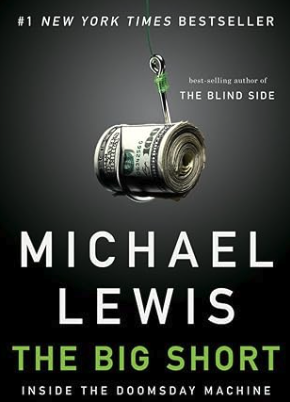
The Big Short: Chapters 4–5
This nonfiction narrative focuses on the people who were affected by the global financial crisis of 2007–2008, especially those who profited from betting against the risky loans to low-income Americans who couldn't pay for their homes.
Here are links to our lists for the book: Prologue–Chapter 1, Chapters 2–3, Chapters 4–5, Chapters 6–8, Chapter 9–Epilogue
40 words
25 learners
Learn words with Flashcards and other activities
Definition First

Other learning activities
Full list of words from this list:
-
insurrection
organized opposition to authorityOddly, Cassano was as likely to direct his anger at profitable traders as at unprofitable ones, for the anger was triggered not by financial loss but by the faintest whiff of insurrection.
-
nuance
a subtle difference in meaning or opinion or attitudeThey were constrained, however, by a boss with an imperfect understanding of the nuances of his own business, and whose judgment was clouded by his insecurity.
-
masquerade
pretend to be someone or something that you are notConfronted with the new fact—that his company was effectively long $50 billion in triple-B subprime mortgage bonds, masquerading as triple-A-rated diversified pools of consumer loans—Cassano at first sought to rationalize it.
-
underpin
confirm or support with evidence or authorityThe AIG FP traders present were shocked by how little thought or analysis seemed to underpin the subprime mortgage machine: It was simply a bet that home prices would never fall.
-
construe
make sense of; assign a meaning toOnce he understood this, and once he could construe it as his own idea, Joe Cassano changed his mind.
-
offset
compensate for or counterbalanceIt sold no more credit default swaps to Wall Street but did nothing to offset the 50 billion dollars’ worth that it had already sold.
-
quixotic
not sensible about practical mattersThe loans that were being made to actual human beings only grew crappier, but, bizarrely, the price of insuring them—the price of buying credit default swaps—fell. By April 2006 Lippmann’s superiors at Deutsche Bank were asking him to defend his quixotic gamble.
-
depravity
a corrupt or degenerate act or practiceIn his search for stock market investors he might terrify with his Doomsday scenario, Lippmann had made a lucky strike: He had stumbled onto a stock market investor who held an even darker view of the subprime mortgage market than he did. Eisman knew more about that market, its characters, and its depravities than anyone Lippmann had ever spoken with.
-
agitprop
political propaganda communicated via art and literatureRight up until the collapse, Lippmann would pepper them with agitprop about the housing market, and his own ideas of which subprime mortgage bonds his customers should bet against.
-
teem
be full of or abuzz withThe housing blogs of southern California teemed with stories of financial abuses made possible by these so-called thirty-year payment option ARMs, or adjustable-rate mortgages.
-
purport
have the often misleading appearance of being or intendingFICO scores—so called because they were invented, in the 1950s, by a company called the Fair Isaac Corporation—purported to measure the creditworthiness of individual borrowers.
-
perverse
deviating from what is considered moral or right or properBefore that happened, the Wall Street firm enjoyed a perverse monopoly. They’d phone up an originator and say, “Don’t tell anybody, but if you bring me a pool of loans teeming with high thin-file FICO scores I’ll pay you more for it than anyone else.”
-
egregious
conspicuously and outrageously bad or reprehensibleThe more egregious the rating agencies’ mistakes, the bigger the opportunity for the Wall Street trading desks.
-
allay
lessen the intensity of or calmVinny and Danny already suspected that the subprime market had subcontracted its credit analysis to people who weren’t even doing the credit analysis. Nothing they learned that day allayed their suspicion.
-
proprietary
relating to ownership or an ownerA proprietary trader at Goldman Sachs in London, informed that this trader at Deutsche Bank in New York was making a powerful argument, flew across the Atlantic to meet with Lippmann and went home owning a billion dollars’ worth of credit default swaps on subprime mortgage bonds.
-
discern
perceive, recognize, or detectEven as late as the summer of 2006, as home prices began to fall, it took a certain kind of person to see the ugly facts and react to them—to discern, in the profile of the beautiful young lady, the face of an old witch.
-
insulate
place or set apartMike Burry was odd in his desire to remain insulated from public opinion, and even direct human contact, and to focus instead on hard data and the incentives that guide future human financial behavior.
-
prevalent
most frequent or commonEach filled a hole; each supplied a missing insight, an attitude to risk which, if more prevalent, might have prevented the catastrophe.
-
jargon
technical terminology characteristic of a particular subjectHe’d never traded a mortgage bond, knew essentially nothing about real estate, was bewildered by the jargon of the bond market, and wasn’t even sure Deutsche Bank or anyone else would allow him to buy credit default swaps on subprime mortgage bonds—since this was a market for institutional investors, and he and his two partners, Ben Hockett and Jamie Mai, weren’t anyone’s idea of an institution.
-
implausible
highly imaginative but unlikelyEvery new business is inherently implausible, but Jamie Mai and Charlie Ledley’s idea, in early 2003, for a money management firm bordered on the absurd: a pair of thirty-year-old men with a Schwab account containing $110,000 occupy a shed in the back of a friend’s house in Berkeley, California, and dub themselves Cornwall Capital Management.
-
pallor
an unnatural lack of color in the skinCharlie Ledley was even worse: He had the pallor of a mortician and the manner of a man bent on putting off, for as long as possible, definite action.
-
contemporary
a person of nearly the same age as anotherBoth were viewed by contemporaries as sweet-natured, disorganized, inquisitive, bright but lacking obvious direction—the kind of guys who might turn up at their fifteenth high school reunions with surprising facial hair and a complicated life story.
-
stint
an unbroken period of time during which you do somethingTheir stint in the private equity business—in which firms buy and sell entire companies over the counter—led them to believe that private stock markets might be more efficient than public ones.
-
thrift
extreme care in spending moneyThen, in July 2002, its stock crashed—falling 60 percent in two days, after Capital One’s management voluntarily disclosed that they were in a dispute about how much capital they needed to reserve against potential subprime losses with their two government regulators, the Office of Thrift Supervision and the Federal Reserve.
-
capricious
determined by chance or impulse rather than by necessityIt claimed that it had done nothing wrong, that the regulators were being capricious, and announced no special losses on its $20 billion portfolio of subprime loans.
-
heresy
beliefs that are different from the official or approved onesThere were times, Greenblatt explained, when it made more sense to buy options on a stock than the stock itself. This, in Greenblatt’s world of value investors, counted as heresy.
-
vindicated
freed from any question of guiltSoon after Cornwall Capital laid their chips on the table, Capital One was vindicated by its regulators, its stock price shot up, and Cornwall Capital’s $26,000 option position was worth $526,000.
-
inherently
in an essential mannerThe options suited the two men’s personalities: They never had to be sure of anything. Both were predisposed to feel that people, and by extension markets, were too certain about inherently uncertain things.
-
subsidy
a grant of financial assistance, especially by a governmentHe didn’t know much about ethanol, but he could see that it enjoyed a U.S. government subsidy of 50 cents a gallon, and so was supposed to trade at a 50-cent-a-gallon premium to gasoline, and always had.
-
inexplicable
incapable of being explained or accounted forLike most of what befell them in the financial markets, their first brush with a big Wall Street firm was delightfully weird but ultimately inexplicable.
-
grievance
a complaint about a wrong that causes resentmentWhen he went in to quit, his Deutsche Bank bosses insisted that he list his grievances.
-
arbitrage
a hedged investment capturing slight differences in priceHe suspected, not unreasonably, that he might be the only person in Berkeley looking for arbitrage opportunities in the market for credit derivatives.
-
dilettante
an amateur engaging in an activity without serious intentionBen thought of Charlie and Jamie less as professional money managers than as dilettantes or, as he put it, “a couple of smart guys just punting around in the markets.”
-
discrepancy
a difference between conflicting facts or claims or opinionsOnce, Charlie found what he thought was a strange price discrepancy in the market for gasoline futures, and quickly bought one gas contract, sold another, and made what he took to be a riskless profit—only to discover, as Jamie put it, “one was unleaded gasoline and the other was, like, diesel.”
-
coup
a sudden and decisive change of government by forceOne week later, the Thai military overthrew the elected prime minister. The Thai baht didn’t budge. “We predicted a coup, and we lost money,” said Jamie.
-
intuit
know or grasp by instinct or feeling aloneThere was a possible explanation for their success, which Charlie and Jamie had only intuited but which Ben, who had priced options for a big Wall Street firm, came ready to explain: Financial options were systematically mispriced.
-
chutzpah
unbelievable gall; insolence; audacity“It always ended with them sort of asking, ‘So what do you have?’”
Chutzpah. Plus $30 million with which they were willing and able to do anything they wanted to do. -
provision
a stipulated conditionIf, on the other hand, the trade went against Cornwall Capital, they were required to post the amount they were down, daily. At the time, Charlie and Jamie and Ben didn’t worry much about this provision, or similar provisions in the ISDA they landed with Bear Stearns.
-
disingenuous
not straightforward or candidTheir very names were disingenuous, and told you nothing about their contents, their creators, or their managers: Carina, Gemstone, Octans III, Glacier Funding.
-
artful
not straightforward or candidThe best way to use this information, he thought, was to buy what appeared to be the sounder mortgage bonds and simultaneously sell the unsound ones.
The insider’s artful complexity didn’t much interest Cornwall Capital.
Created on Mon Sep 09 09:05:20 EDT 2024
(updated Tue Sep 10 12:17:10 EDT 2024)
Sign up now (it’s free!)
Whether you’re a teacher or a learner,
Vocabulary.com can put you or your class
on the path to systematic vocabulary improvement.