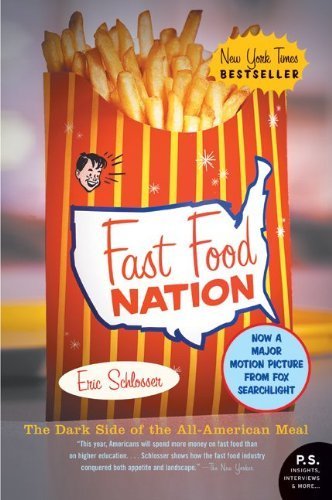
Fast Food Nation: Chapters 2–4
In this exposé, award-winning journalist Eric Schlosser explores the effects of the American fast food industry on global health, labor conditions, and the environment.
Here are links to our lists for the book: Introduction–Chapter 1, Chapters 2–4, Chapters 5–7, Chapters 8–9, Chapter 10–Afterword
40 words
329 learners
Learn words with Flashcards and other activities
Definition First

Other learning activities
Full list of words from this list:
-
trappings
ornaments; embellishments to or characteristic signs ofKroc and Disney both dropped out of high school and later added the trappings of formal education to their companies.
-
demographic
of or relating to the characteristics of human populationsThey perfected the art of selling things to children. And their success led many others to aim marketing efforts at kids, turning America’s youngest consumers into a demographic group that is now avidly studied, analyzed, and targeted by the world’s largest corporations.
-
concession
a contract for the right to operate a subsidiary businessAccording to one account, Disney’s company asked Kroc to raise the price of McDonald’s french fries from ten cents to fifteen cents; Disney would keep the extra nickel as payment for granting the concession; and the story ends with Ray Kroc refusing to gouge his loyal customers.
-
accede
yield to another's wish or opinionThe strike finally ended when Disney acceded to the union’s demands.
-
precarious
not secure; beset with difficultiesThe animators’ strike had left the Disney Studio in a precarious financial condition.
-
succinctly
with concise and precise brevity; to the pointHis faith in the goodness of American technology was succinctly expressed by the title of a film that the Disney Studio produced for Westinghouse Electric: The Dawn of Better Living.
-
encompass
include in scopeTomorrowland encompassed everything from space travel to the household appliances of the future, depicting progress as a relentless march toward greater convenience for consumers.
-
qualm
uneasiness about the fitness of an actionAnd yet, from the very beginning, there was a dark side to this Tomorrowland. It celebrated technology without moral qualms.
-
idyll
a charming, peaceful, or idealized episode or situationWithin a decade of its opening, Disneyland was no longer set amid a rural idyll of orange groves, it was stuck in the middle of cheap motels, traffic jams on the Santa Ana freeway, fast food joints, and industrial parks.
-
synergy
the working together of two or more things to produce an effectAmong other cultural innovations, Walt Disney pioneered the marketing strategy now known as “synergy.” During the 1930s, he signed licensing agreements with dozens of firms, granting them the right to use Mickey Mouse on their products and in their ads.
-
fervor
feelings of great warmth and intensityKroc believed completely in whatever he sold and pitched McDonald’s franchises with an almost religious fervor.
-
pragmatic
concerned with practical mattersPromoting McDonald’s to children was a clever, pragmatic decision. “A child who loves our TV commercials,” Kroc explained, “and brings her grandparents to a McDonald’s gives us two more customers.”
-
intangible
incapable of being perceived by the senses, especially touchThe restaurant chain evoked a series of pleasing images in a youngster’s mind: bright colors, a playground, a toy, a clown, a drink with a straw, little pieces of food wrapped up like a present. Kroc had succeeded, like his old Red Cross comrade, at selling something intangible to children, along with their fries.
-
surreptitiously
in a secretive mannerThey send cultural anthropologists into homes, stores, fast food restaurants, and other places where kids like to gather, quietly and surreptitiously observing the behavior of prospective customers.
-
proprietary
protected by trademark or patent or copyrightThe Character Lab, a division of Youth Market System Consulting, uses a proprietary technique called Character Appeal Quadrant Analysis to help companies develop new mascots.
-
proliferate
grow rapidlyDuring the 1980s and 1990s, children’s clubs proliferated, as corporations used them to solicit the names, addresses, zip codes, and personal comments of young customers.
-
ethos
the distinctive spirit of a culture or an eraMcDonald’s began to sell its hamburgers and french fries at Disney’s theme parks. The ethos of McDonaldland and of Disneyland, never far apart, have finally become one.
-
gambit
a strategic maneuver“In one of the most despicable marketing gambits,” Michael Jacobson, the author of “Liquid Candy” reports, “Pepsi, Dr Pepper and Seven-Up encourage feeding soft drinks to babies by licensing their logos to a major maker of baby bottles, Munchkin Bottling, Inc.”
-
eclectic
combining or composed of elements drawn from a variety of sourcesAside from a Kinko’s, a Bruegger’s Bagel Bakery, a Subway, and a couple of Starbucks, there are no chain stores, not a single Gap in sight. An eclectic mixture of locally owned businesses line Tejon Street, the main drag.
-
harbinger
something indicating the approach of something or someoneIn many ways Colorado Springs today is what Los Angeles was fifty years ago—a mecca for the disenchanted middle class, a harbinger of cultural trends, a glimpse of the future.
-
enclave
an enclosed territory that is culturally distinctMuch like Los Angeles, Colorado Springs was a sleepy tourist town in the early part of the twentieth century, an enclave of wealthy invalids and retirees, surrounded by ranchland.
-
staunch
firm and dependable especially in loyaltyThe region is now more staunchly Republican than the American South.
-
altruistic
showing unselfish concern for the welfare of othersBut the stance of the fast food industry on issues involving employee training, the minimum wage, labor unions, and overtime pay strongly suggests that its motives in hiring the young, the poor, and the handicapped are hardly altruistic.
-
inculcate
teach and impress by frequent repetitions or admonitionsIn the absence of good wages and secure employment, the chains try to inculcate “team spirit” in their young crews.
-
grievance
an allegation that something denies some legal rightIn other mass production industries ruled by the assembly line, labor unions have gained workers higher wages, formal grievance procedures, and a voice in how the work is performed.
-
laissez faire
a doctrine that government should not interfere in commerceWhen it comes to wage rates, however, the company is remarkably silent and laissez-faire. This policy allows operators to set their wages according to local labor markets—and it absolves the McDonald’s Corporation of any formal responsibility for roughly three-quarters of the company’s workforce.
-
anomie
a personal state of isolation and anxietyThe turmoil of an earlier era has been replaced by a sad and rootless anomie. “I have lots and lots of kids who are terribly depressed,” Trogdon says.
-
arbitrarily
in a random or indiscriminate mannerGood managers created a sense of pride in the work and an upbeat atmosphere. They allowed scheduling changes and encouraged kids to do their schoolwork. Others behaved arbitrarily, picked on workers, yelled at workers, and made unreasonable demands.
-
innocuous
not causing disapprovalThe proposed guidelines were entirely voluntary and seemed innocuous. OSHA recommended, for example, that late-night retailers improve visibility within their stores and make sure their parking lots were well lit.
-
ubiquitous
being present everywhere at onceBut crime and fast food have become so ubiquitous in American society that their frequent combination usually goes unnoticed.
-
platitude
a trite or obvious remarkNorman Brinker—a legend in the industry, the founder of Bennigan’s and Steak and Ale, the current owner of Chili’s, a major donor to the Republican Party—spoke to the conference in language that was simple, direct, and free of platitudes.
-
palpable
capable of being perceivedThe wide gulf between Colorado Springs and Pueblo—a longstanding social, cultural, political, and economic division—is starting to narrow. As you drive through the streets of Pueblo, you can feel the change coming, something palpable in the air.
-
emulate
strive to equal or match, especially by imitatingThe automobile, soft drink, oil, and motel industries later relied upon franchising for much of their initial growth. But it was the fast food industry that turned franchising into a business model soon emulated by retail chains throughout the United States.
-
paternalism
attitude that people should be controlled in a fatherly wayKroc was an inspiring, paternalistic figure who looked for people with “common sense,” “guts and staying power,” and “a love of hard work.”
-
tantamount
being essentially equal to somethingDisobeying the McDonald’s Corporation became tantamount to violating the terms of the lease, behavior that could lead to a franchisee’s eviction.
-
encroachment
entry to another's property without right or permissionAs the American market for fast food grows more saturated, restaurants belonging to the same chain are frequently being put closer to one another. Franchisees call the practice “encroachment” and angrily oppose it.
-
bilk
cheat somebody out of what is due, especially moneyAt the time, a few chains were operated much like pyramid schemes. They misrepresented potential risks, accepted large fees up front, and bilked millions of dollars from small investors.
-
discretion
power of making choices unconstrained by external agenciesAccording to Susan Kezios, president of the American Franchise Association, the contracts offered by fast food chains often require a franchisee to waive his or her legal right to file complaints under state law; to buy only from approved suppliers, regardless of the price; to sell the restaurant only to a buyer approved by the chain; and to accept termination of the contract, for any cause, at the discretion of the chain.
-
tenet
a basic principle or belief that is accepted as trueCoble’s bill would for the first time obligate franchise chains to act in “good faith,” a basic tenet of the nation’s Uniform Commercial Code.
-
haphazardly
in a random manner“Don’t network haphazardly,” Peter Lowe preaches in his $19.95 Peter Lowe’s Success Yearbook.
Created on Mon Jul 11 13:03:23 EDT 2022
(updated Tue Jul 12 10:26:24 EDT 2022)
Sign up now (it’s free!)
Whether you’re a teacher or a learner,
Vocabulary.com can put you or your class
on the path to systematic vocabulary improvement.