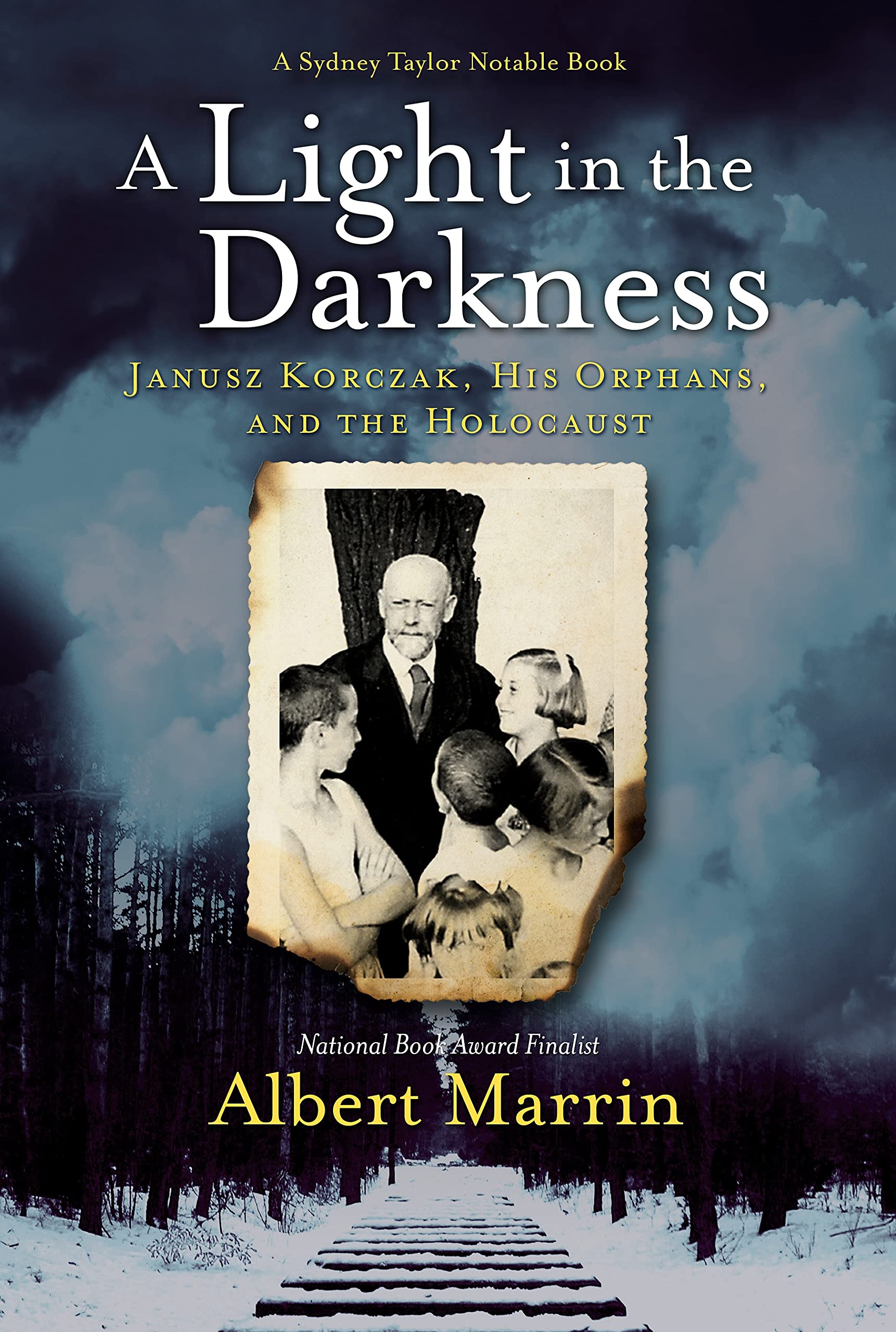
A Light in the Darkness: Prologue–Part I
This biography details the life of Janusz Korczak, a Polish doctor who refused to abandon the orphaned children in his care during the Holocaust.
Here are links to our lists for the book: Prologue–Part I, Part II, Part III, Part IV, Parts V–VI
40 words
273 learners
Learn words with Flashcards and other activities
Definition First

Other learning activities
Full list of words from this list:
-
disinter
dig up for reburial or for medical investigationAfter people were gassed, the Nazis buried and later disinterred and burned their bodies.
-
inherently
in an essential mannerSince every child is worthy of respect, it follows that every child is inherently precious, “a person born to be free.”
-
indoctrinate
teach uncriticallyChildren are people in their own right, not merely adults in the making. Adults must cherish them for themselves, not as living material to be sorted, shaped, molded, counted, cataloged, managed, regulated, regimented, bullied, programmed, trained, directed, commanded, worked, and indoctrinated.
-
ghetto
the restricted quarter of European cities where Jews livedIn 1940, the Nazis caged Polish Jews in ghettos, segregated walled-in sections of cities meant as the starting point on the road to extermination.
-
gentile
belonging to or characteristic of non-Jewish peoplesWhen herded with his children into the Warsaw ghetto, the Old Doctor could have escaped with the help of gentile (non-Jewish) friends.
-
profound
showing intellectual penetration or emotional depthThat other story raises profound questions. How could Germany—one of the modern world’s most cultured and advanced nations—have murdered millions of innocents?
-
clinical
relating to or based on direct observation of patientsYet most psychiatrists who have studied him agree that Hitler was not crazy, at least not in the clinical sense.
-
manifest
clearly revealed to the mind or the senses or judgmentRacism can be manifest in different ways and to different degrees.
-
ideology
an orientation that characterizes the thinking of a groupRacism as an ideology, or worldview, is most sinister. As used in this book, the term ideology refers to a set of beliefs held as the master key to how human affairs work. Ideology makes every action fall into its proper place, like the splinters of a shattered mirror magically rejoined. An ideology explains all that has happened with people, is happening now, and will happen in the future. It is also a textbook on how to live, work, think, play, educate, and, yes, reproduce.
-
lucrative
producing a sizeable profitThanks to Józef’s lucrative law practice, they lived in an elegantly furnished apartment in an upscale neighborhood.
-
truss
secure with or as if with ropesJózef spent years in and out of mental hospitals. Family visits were an ordeal. Henryk heard screams and curses and saw wild-eyed people trussed in straitjackets, long-sleeved canvas garments used to bind the arms as a means of restraint.
-
brooding
deeply or seriously thoughtfulAn untitled poem, dark and brooding, captures his mood at this time.
-
tenement
a run-down apartment house barely meeting minimal standardsWarsaw had the Old Town, a district dating from the Middle Ages, with grim tenements lining the Vistula River.
-
residency
a period of specialized training in medicineAfter receiving his medical degree in March 1905, he began his residency in the Bersohn and Bauman Children’s Hospital, which, though funded by Jewish charities, served all children.
-
ramshackle
in poor or broken-down conditionThe small orphanage that the organization already funded occupied a ramshackle building and was run by a poorly trained staff.
-
prolific
intellectually productive“I am,” she said, “neither an accomplished speaker nor a prolific writer. I can only work hard, though slowly and cautiously.”
-
conflagration
a violent clash or conflictIn 1920, Vladimir Lenin, the Soviet dictator, invaded Poland, the gateway to Western Europe, as the first step in a world revolution. “The road to worldwide conflagration will run over the corpse of Poland,” he declared.
-
instill
teach and impress by frequent repetitions or admonitionsKorczak explained that he aimed to instill, by example, the attitude that all honest work is honorable.
-
idle
not in action or at workThe Court must defend the conscientious and hard-working that they should not be annoyed by the careless and idle.
-
conscientious
characterized by extreme care and great effortThe Court must see that there is order because disorder does the most harm to the good, the quiet and the conscientious.
-
innate
present at birth but not necessarily hereditaryDom Sierot’s director believed in the innate goodness of children and in their ability to improve if given a chance and the proper guidance.
-
punitive
inflicting punishment“He is a child who has not given up yet, but does not know who he is. A punitive sentence would adversely influence his future sense of self and his behavior. Because it is society that has failed him and made him behave this way, the Court should not condemn the criminal but the social structure.”
-
diaspora
the dispersion of something that was originally localizedAfter finally crushing resistance in AD 135, Roman legions slaughtered much of the population and banished most of the survivors to lands across the Middle East and Europe. Jews call that event the Diaspora, or scattering.
-
libel
a false and malicious publicationIt was said that Jews were children of Satan, demons who poisoned wells and spread plague. Supposedly, Jews were also vampires, using the blood of murdered Christian children when making matzo, the flat bread eaten during Passover, the festival celebrating the Israelites’ flight from Egyptian slavery. To this very day, the “blood libel” persists in some parts of Europe and the Middle East.
-
pogrom
organized persecution of an ethnic group, especially JewsMass hysteria ignited pogroms, organized assaults against a defenseless group of people. Before the rise of Adolf Hitler, the worst anti-Jewish pogrom occurred in 1648–1649, when mobs massacred more than a hundred thousand Jews in Poland and neighboring Ukraine.
-
assimilate
become like one's environmentReligious Jews, especially, refused to assimilate, to integrate into society by adopting its language, customs, and attitudes.
-
higgledy-piggledy
in a disordered mannerMost Polish Jews lived in a shtetl, a small town where they usually outnumbered gentiles. A traveler described a typical shtetl as “a jumble of wooden houses clustered higgledy-piggledy about a marketplace...with its shops, booths, tables, stands, butchers’ blocks.”
-
yeshiva
an academy for the advanced study of Jewish textsYoung boys attended heder, an elementary school for Jewish children, and older boys attended yeshiva, a Jewish school of higher education.
-
caftan
a long loose dress or tunicMen wore a black caftan, a long-sleeved, ankle-length tunic, over their trousers, and a black skullcap called a yarmulke under a broad-brimmed hat.
-
piety
righteousness by virtue of being religiously devoutReligious men did not shave; long beards and side curls twisted behind their ears signified piety.
-
secular
not concerned with or devoted to religionThey walked to neighborhood public schools, where instruction was entirely in Polish. As noted by Itzchak Belfer, a former resident of the orphans’ home, Dom Sierot “was run along secular lines.”
-
pastoral
of or relating to a ministerIn 1936, Cardinal August Hlond, head of the Catholic Church in Poland, issued a pastoral letter titled “On Catholic Moral Principles.”
-
squalid
foul and run-down and repulsiveLondon’s Jewish Chronicle described Polish Jews as “a helpless minority sunk in squalid poverty and misery.”
-
eminent
standing above others in quality or positionSholem Asch, an eminent Jewish writer based in New York, was appalled. Polish Jews were being slowly “buried alive,” Asch noted.
-
teeming
abundantly filled with especially living thingsA British visitor called Jewish Warsaw “a teeming city of wretchedness.”
-
kibbutz
a collective farm or settlement in modern IsraelHowever, in the 1880s, the Turks allowed Zionists to set up their first kibbutz, or farming settlement. Then, as now, all property belonged to the kibbutz. In return for their labor, settlers received food, housing, education, and childcare instead of wages.
-
brethren
people who are members of the same social or cultural groupAs an assimilated Jew, he thought his Polish brethren belonged in Poland, not struggling to adapt to so alien a place as Palestine.
-
dejected
affected or marked by low spiritsDejected and angry, Korczak took a time-out with another six-week visit to Ein Harod.
-
farce
a comedy characterized by broad satireKorczak expressed his fears in a 1931 play titled The Senate of Madmen, which he called “a black farce.” To be sure, its mood was so dark that the play closed after only a few performances.
-
lewd
suggestive of or tending to moral loosenessBarbaric sports, pagan dances and lewd songs are here again....The times [are] bad, my boy: Sadness, crime, premonitions of things to come.
Created on Tue Aug 24 15:02:25 EDT 2021
(updated Thu Aug 26 14:38:54 EDT 2021)
Sign up now (it’s free!)
Whether you’re a teacher or a learner,
Vocabulary.com can put you or your class
on the path to systematic vocabulary improvement.