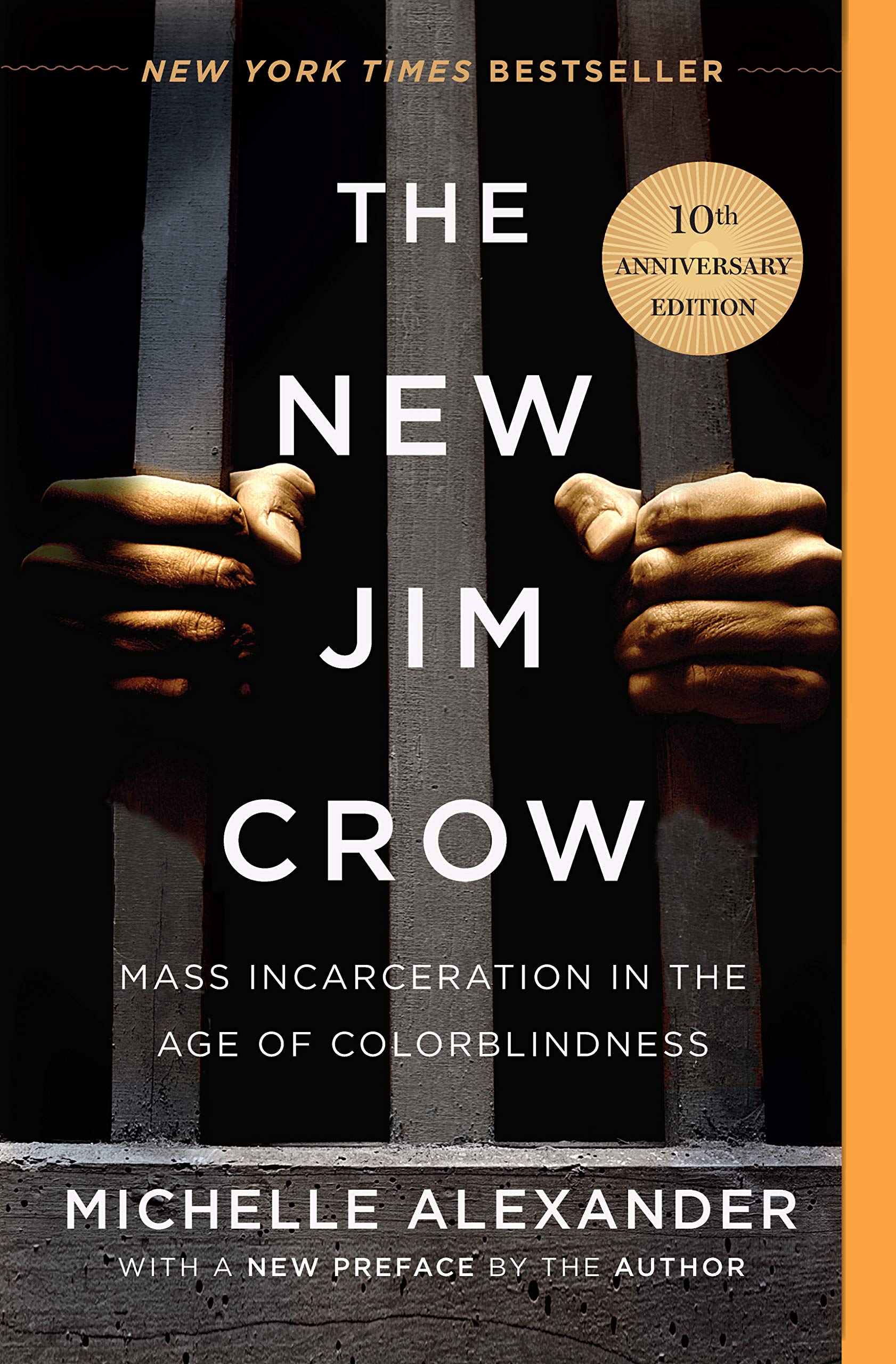
The New Jim Crow: Chapter 2
In this award-winning book, civil rights lawyer Michelle Alexander argues that the American criminal justice system unfairly targets and penalizes African Americans, resulting in long-term harm to black communities.
Here are links to our lists for the book: Introduction–Chapter 1, Chapter 2, Chapter 3, Chapter 4, Chapter 5, Chapter 6
40 words
35 learners
Learn words with Flashcards and other activities
Definition First

Other learning activities
Full list of words from this list:
-
analogous
similar or equivalent in some respectsIn subsequent chapters, we will consider how the system specifically targets people of color and then relegates them to a second-class status analogous to Jim Crow.
-
discretion
power of making choices unconstrained by external agenciesThe absence of significant constraints on the exercise of police discretion is a key feature of the drug war’s design. It has made the roundup of millions of Americans for nonviolent drug offenses relatively easy.
-
seditious
inciting action or rebellionCourts and scholars agree that the Fourth Amendment governs all searches and seizures by the police and that the amendment was adopted in response to the English practice of conducting arbitrary searches under general warrants to uncover seditious libels.
-
arbitrary
based on or subject to individual discretion or preferenceThe routine police harassment, arbitrary searches, and widespread police intimidation of those subject to English rule helped to inspire the American Revolution. Not surprisingly, then, preventing arbitrary searches and seizures by the police was deemed by the Founding Fathers an essential element of the U.S. Constitution.
-
jurisprudence
the branch of philosophy concerned with the lawWithin a few years after the drug war was declared, however, many legal scholars noted a sharp turn in the Supreme Court’s Fourth Amendment jurisprudence.
-
pecuniary
relating to or involving moneyFor our purposes here, we limit our focus to the legal rules crafted by the Supreme Court that grant law enforcement a pecuniary interest in the drug war and make it relatively easy for the police to seize people virtually anywhere—on public streets and sidewalks, on buses, airplanes, and trains, or in any other public place—and usher them behind bars.
-
dragnet
a system of procedures for apprehending criminalsBostick’s search and seizure reflected what had become an increasingly common tactic in the War on Drugs: suspicionless police sweeps of buses in interstate or intrastate travel. The resulting “interviews” of passengers in these dragnet operations usually culminate in a request for “consent” to search the passenger’s luggage.
-
culminate
end, especially to reach a final or climactic stageThe resulting “interviews” of passengers in these dragnet operations usually culminate in a request for “consent” to search the passenger’s luggage. Never do the officers inform passengers that they are free to remain silent or to refuse to answer questions.
-
chutzpah
unbelievable gall; insolence; audacityProfessor Tracey Maclin put it this way: “Common sense teaches that most of us do not have the chutzpah or stupidity to tell a police officer to ‘get lost’ after he has stopped us and asked us for identification or questioned us about possible criminal conduct.”
-
waiver
a formal written statement of relinquishmentIn Schneckloth v. Bustamonte, decided in 1973, the Court admitted that if waiver of one’s right to refuse consent were truly “knowing, intelligent, and voluntary,” it would “in practice create serious doubt whether consent searches would continue to be conducted.”
-
compliance
the act of submitting, usually surrendering power to anotherSo long as orders are phrased as a question, compliance is interpreted as consent.
-
pretext
a fictitious reason that conceals the real reasonIn other words, police officers use minor traffic violations as an excuse—a pretext—to search for drugs, even though there is not a shred of evidence suggesting the motorist is violating drug laws.
-
unequivocal
clearly defined or formulatedPretext stops, like consent searches, have received the Supreme Court’s unequivocal blessing.
-
baseless
without a foundation in reason or factAllowing the police to use minor traffic violations as a pretext for baseless drug investigations would permit them to single out anyone for a drug investigation without any evidence of illegal drug activity whatsoever.
-
unambiguous
admitting of no doubt or misunderstandingIn an effort to provide some minimal protection for motorists, the Ohio court adopted a bright-line rule, that is, an unambiguous requirement that officers tell motorists they are free to leave before asking for consent to search their vehicles.
-
statutory
prescribed or authorized by or punishable under lawIn Atwater v. City of Lago Vista, the Supreme Court held that the police may arrest motorists for minor traffic violations and throw them in jail (even if the statutory penalty for the traffic violation is a mere fine, not jail time).
-
succumb
give in, as to overwhelming force, influence, or pressureAccordingly, every year, tens of thousands of motorists find themselves stopped on the side of the road, fielding questions about imaginary drug activity, and then succumbing to a request for their vehicle to be searched—sometimes torn apart—in the search for drugs.
-
scrupulous
characterized by extreme care and great effortThe Florida Highway Patrol Drug Courier Profile cautioned troopers to be suspicious of “scrupulous obedience to traffic laws.”
-
wholesale
on a large scale without careful discriminationThe fact that police are legally allowed to engage in a wholesale roundup of people suspected of minor drug crimes does not answer the question why they would choose to do so, particularly when most police departments have far more serious crimes to prevent and solve.
-
tangible
having physical substance and intrinsic monetary valueEvery system of control depends for its survival on the tangible and intangible benefits that are provided to those who are responsible for the system’s maintenance and administration.
-
behest
an authoritative command or requestIn 1988, at the behest of the Reagan administration, Congress revised the program that provides federal aid to law enforcement, renaming it the Edward Byrne Memorial State and Local Law Enforcement Assistance Program after a New York City police officer who was shot to death while guarding the home of a drug-case witness.
-
proliferation
a rapid increase in numberThis federal grant money has resulted in the proliferation of narcotics task forces, including those responsible for highway drug interdiction.
-
interdict
command againstThe DEA has offered free training, intelligence, and technical support to state highway patrol agencies that are willing to commit their officers to highway drug interdiction.
-
buttress
make stronger or defensibleAlmost immediately after the federal dollars began to flow, law enforcement agencies across the country began to compete for funding, equipment, and training. By the late 1990s, the overwhelming majority of state and local police forces in the country had availed themselves of the newly available resources and added a significant military component to buttress their drug-war operations.
-
earmark
give or assign a resource to a particular person or causeNow that police departments were suddenly flush with cash and military equipment earmarked for the drug war, they needed to make use of their new resources. As described in a Cato Institute report, paramilitary units (most commonly called Special Weapons and Tactics, or SWAT, teams) were quickly formed in virtually every major city to fight the drug war.
-
contingent
determined by conditions or circumstances that followIn the years that followed, Presidents George Bush and Bill Clinton enthusiastically embraced the drug war and increased the transfer of military equipment, technology, and training to local law enforcement, contingent, of course, on the willingness of agencies to prioritize drug-law enforcement and concentrate resources on arrests for illegal drugs.
-
disbursement
the act of spending or distributing moneyThe size of the disbursements was linked to the number of city or county drug arrests.
-
innuendo
an indirect and usually malicious implicationThe probable cause showing could be based on nothing more than hearsay, innuendo, or even the paid, self-serving testimony of someone with interests clearly adverse to the property owner.
-
lucrative
producing a sizeable profitNot surprisingly, this drug forfeiture regime proved highly lucrative for law enforcement, offering more than enough incentive to wage the War on Drugs. According to a report commissioned by the Department of Justice, between 1988 and 1992 alone, Byrne-funded drug task forces seized over $1 billion in assets.
-
construe
make sense of; assign a meaning toAnother seizure of ninety-three cents prompted the local newspaper to observe that “once again the officers were taking whatever the suspects were carrying, even though by no stretch could pocket change be construed to be drug money.”
-
purportedly
allegedly but not definitely trueOne highly publicized case involved a reclusive millionaire, Donald Scott, who was shot and killed when a multiagency task force raided his two-hundred-acre Malibu ranch purportedly in search of marijuana plants. They never found a single marijuana plant in the course of the search. A subsequent investigation revealed that the primary motivation for the raid was the possibility of forfeiting Scott’s property.
-
preponderance
superiority in power or influenceHowever, the defense is seriously undermined by the fact that the government’s burden of proof is so low—the government need only establish by a “preponderance of the evidence” that the property was involved in the commission of a drug crime. This standard of proof is significantly lower than the “clear and convincing evidence” standard contained in an earlier version of the legislation, and it is far lower than the “proof beyond a reasonable doubt” standard for criminal convictions.
-
indigent
poor enough to need help from othersApproximately 80 percent of criminal defendants are indigent and thus unable to hire a lawyer.
-
languish
lose vigor, health, or flesh, as through griefEven when people are charged with extremely serious crimes, such as murder, they may find themselves languishing in jail for years without meeting with an attorney, much less getting a trial.
-
advent
arrival that has been awaitedThe pressure to plead guilty to crimes has increased exponentially since the advent of the War on Drugs.
-
deplorable
bringing or deserving severe rebuke or censureThe “assistance” provided by snitches is notoriously unreliable, as studies have documented countless informants who have fabricated stories about drug-related and other criminal activity in exchange for money or leniency in their pending criminal cases. While such conduct is deplorable, it is not difficult to understand. Who among us would not be tempted to lie if it was the only way to avoid a forty-year sentence for a minor drug crime?
-
pursuant
in conformance to or agreement withThe critical point is that thousands of people are swept into the criminal justice system every year pursuant to the drug war without much regard for their guilt or innocence.
-
prudent
marked by sound judgmentReferring a defendant to treatment, rather than sending him or her to prison, may well be the most prudent choice—saving government resources and potentially saving the defendant from a lifetime of addiction.
-
recidivism
habitual relapse into crimeThese sentences were imposed pursuant to California’s controversial three strikes law, which mandates a sentence of twenty-five years to life for recidivists convicted of a third felony, no matter how minor.
-
stoic
seeming unaffected by pleasure or pain; impassiveThus it was that everyone in his San Francisco courtroom watched in stunned silence as Schwarzer, known for his stoic demeanor, choked with tears as he anguished over sentencing Richard Anderson, a first offender Oakland longshoreman, to ten years in prison without parole for what appeared to be a minor mistake in judgment in having given a ride to a drug dealer for a meeting with an undercover agent.
Created on Fri Jun 19 17:45:51 EDT 2020
(updated Tue Jun 30 14:32:41 EDT 2020)
Sign up now (it’s free!)
Whether you’re a teacher or a learner,
Vocabulary.com can put you or your class
on the path to systematic vocabulary improvement.