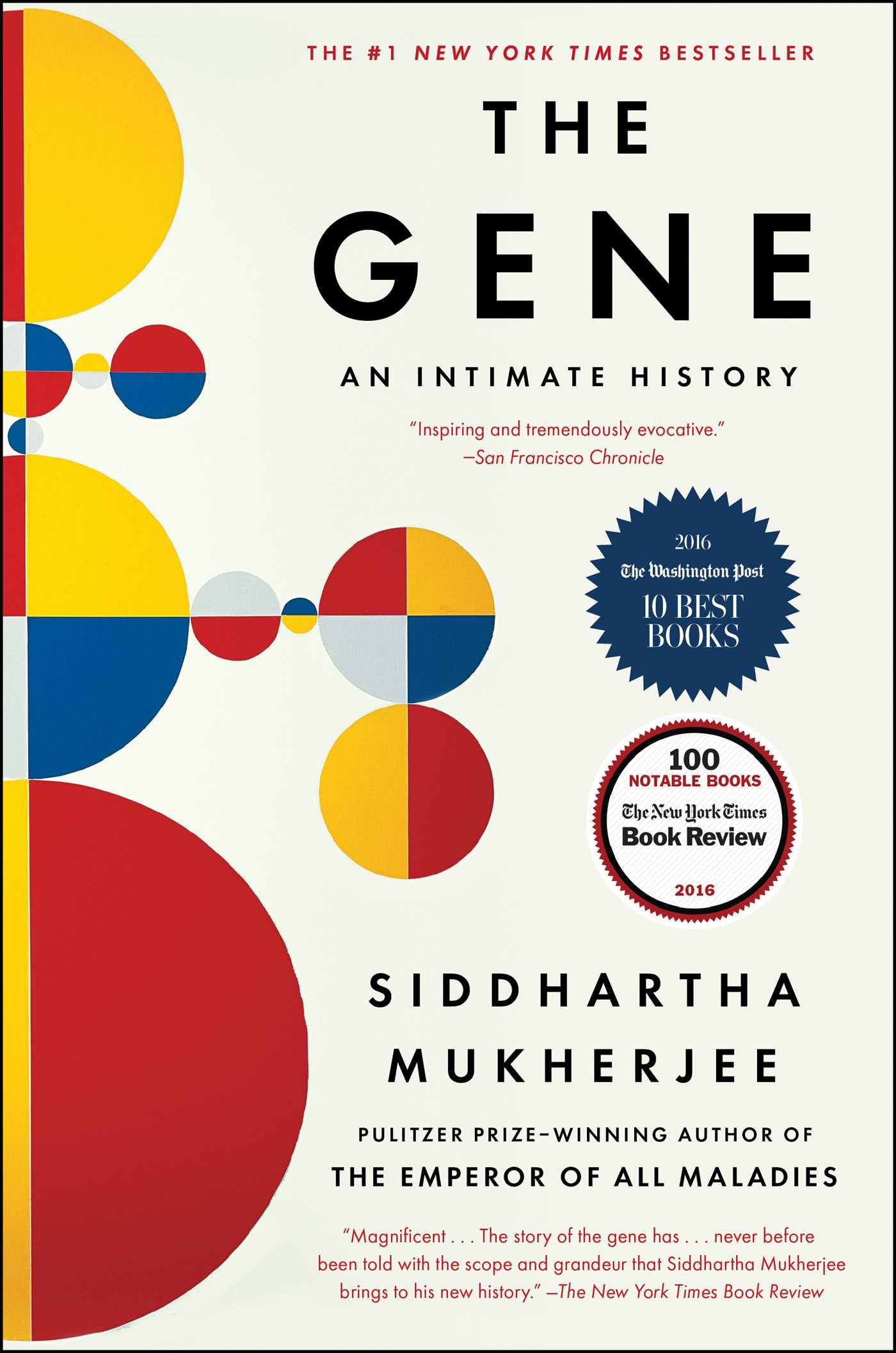
The Gene: Part Three
In this engaging work of nonfiction, Pulitzer Prize-winning author Siddhartha Mukherjee delves into genetics, tracing how our scientific understanding of genes and heredity has changed over time.
Here are links to our lists for the book: Prologue–Part One, Part Two, Part Three, Part Four, Part Five, Part Six–Epilogue
45 words
207 learners
Learn words with Flashcards and other activities
Definition First

Other learning activities
Full list of words from this list:
-
chimera
a grotesque product of the imaginationBut before he could envision modifying the human genome, Berg had to confront a technical challenge: he needed a method to insert a foreign gene into a viral genome. He would have to artificially engineer a genetic “chimera”—a hybrid between a virus’s genes and a foreign gene.
-
girder
a beam used as a main support in a structureGenes, Lobban argued in his proposal, were no different from steel girders; they could also be retooled, altered, shaped to human specifications, and put to use.
-
render
cause to becomeThey use DNA-cutting enzymes, like switchblades, to slice open the DNA of invaders, thereby rendering their hosts immune to attack.
-
contiguous
connecting without a breakThe result was a strange chimera: genes from far branches of the evolutionary tree stitched together to form a single contiguous piece of DNA.
-
canny
showing self-interest and shrewdness in dealing with othersBerg called the hybrids “recombinant DNA”. It was a cannily chosen phrase, harkening back to the natural phenomenon of “recombination,” the genesis of hybrid genes during sexual reproduction.
-
anomaly
a person who is unusualTenacious, unabashedly vocal about her opinions—“smart as all hell,” as Berg described her—Mertz was an anomaly in the world of biochemists: the second woman to join Stanford’s biochemistry department in nearly a decade.
-
cavalier
showing a lack of concern or seriousnessBut with his feet slung on the edge of a potential precipice, Berg could not afford to be cavalier. He wrote to several cancer biologists and microbiologists, asking them for independent opinions of the risk.
-
moratorium
suspension of an ongoing activityUntil he had determined the precise nature of the risk, and made a plan for containment, Berg placed a self-imposed moratorium.
-
envisage
form a mental image of something that is not presentThe initial cutting and pasting of DNA, as envisaged by Berg and Jackson, required six tedious enzymatic steps.
-
fortuitous
lucky; occurring by happy chanceMertz’s discovery, made with Ron Davis, involved a fortuitous quality of enzymes such as EcoR1.
-
providential
peculiarly fortunate or appropriateDinner had ended, but Cohen and Boyer were still hungry. With Stan Falkow, a fellow microbiologist, they strolled out of the hotel toward a quiet, dark street in a commercial strip near Waikiki beach. A New York-style deli, with bright flashing signs and neon-lit fixtures, loomed providentially out of the shadows of the volcanoes, and they found an open booth inside it.
-
conscript
enroll into service compulsorilyEvolution would be conscripted to help their experiment. Natural selection, deployed in a petri dish, would naturally select their hybrid plasmids.
-
syntax
the grammatical arrangement of words in sentencesGenetics, like any language, is built out of basic structural elements—alphabet, vocabulary, syntax, and grammar.
-
perturb
throw into great confusion or disorderEvery experimental science depends, crucially, on the capacity to perturb a system intentionally, and to measure the effects of that perturbation.
-
hackles
a feeling of anger and animosityIn 1955, two years after his discovery of the structure of DNA, Watson had moved to the Department of Biology at Harvard and instantly raised the hackles of some of its most venerated professors.
-
brusque
rudely abrupt or blunt in speech or mannerWatson borrowed this memorable phrase from Ernest Rutherford, who, in one of his characteristically brusque moments, had declared, “All science is either physics or stamp collecting.”
-
vector
a virus or other agent that is used to deliver DNA to a cellBy 1979, that same gene could be shuttled into bacteria, spliced into a viral vector, delivered into the genome of a mammalian cell, cloned, sequenced, and compared to the normal form.
-
penchant
a strong liking or preferenceBut what was the nature of the T cell receptor? Biochemists had approached the problem with their typical penchant for reduction: they had obtained vats upon vats of T cells, used soaps and detergents to dissolve the cell’s components into a gray, cellular froth, then distilled the membranes and lipids away, and purified and repurified the material into smaller and smaller parts to hunt down the culprit protein.
-
inundate
overwhelm or fill quickly beyond capacityBerg was inundated with questions, as he had expected—but the direction of the conversation surprised him.
-
ostensibly
from appearances aloneOne researcher from Chicago proposed inserting genes of the highly pathogenic human herpes virus into bacterial cells, thereby creating a human intestinal bacterium loaded with a lethal toxin gene, ostensibly to study the toxicity of herpes virus genes.
-
genus
taxonomic group containing one or more speciesGenes were being shuffled between species and genera, leaping across a million years of evolutionary rift as if casually stepping over thin lines in sand.
-
disingenuous
not straightforward or candidIt was far from an ideal solution—there was something obviously disingenuous about scientists telling scientists to restrict their scientific work—but it would at least act as a temporary stay order.
-
delineate
determine the essential quality ofSharp constraints on experiments with recombinant DNA research were essential until the risks had been delineated, and recommendations formalized.
-
indigenous
originating where it is found“It may be practical...to introduce genes specifying metabolic or synthetic functions [that are] indigenous to other biological classes, such as plants and animals.” Species, Boyer declared jokingly, “are specious.”
-
specious
plausible but false“It may be practical...to introduce genes specifying metabolic or synthetic functions [that are] indigenous to other biological classes, such as plants and animals.” Species, Boyer declared jokingly, “are specious.”
-
discursive
tending to cover a wide range of subjectsThe wood-decked pathways around the conference center allowed discursive conversations; walking on the decks or on the sand flats, biologists could trade notes on recombination, cloning, and gene manipulation.
-
sepulchral
suited to or suggestive of a grave or burialIn contrast, the central hall—a stone-walled, cathedral-like space ablaze with sepulchral California light—was the epicenter of the conference, where the fiercest debates on gene cloning would soon erupt.
-
facile
performing adroitly and without effortIn the course of investigating methods to chemically alter DNA, biochemists had recently discovered a relatively facile technique to mix and match genetic information from different organisms. The technology, as Berg put it, was so “ridiculously simple” that even an amateur biologist could produce chimeric genes in a lab.
-
Draconian
imposing a harsh code of lawsThe federal government would respond by proposing draconian regulations—not just on recombinant DNA, but on a larger swath of biological research.
-
mitigate
lessen or to try to lessen the seriousness or extent ofTo mitigate the risks, the document proposed a four-level scheme to rank the biohazard potentials of various genetically altered organisms, with recommended containment facilities for each level (inserting a cancer-causing gene into a human virus, for instance, would merit the highest level of containment, while placing a frog gene into a bacterial cell might merit minimal containment).
-
fetter
restrain with shackles“The most important lesson of Asilomar,” Berg said, “was to demonstrate that scientists were capable of self-governance.” Those accustomed to the “unfettered pursuit of research” would have to learn to fetter themselves.
-
lacuna
a blank gap or missing partLater, Berg reflected on this lacuna: “Did the organizers and participants of the Asilomar conference deliberately limit the scope of the concerns?...."
-
prescient
perceiving the significance of events before they occurJoshua Lederberg, the Nobel Prize-winning biologist and Cohen’s colleague at Stanford, was among the few who wrote, presciently, that the experiment “may completely change the pharmaceutical industry’s approach to making biological elements, such as insulin and antibiotics.”
-
broach
bring up a topic for discussionDuring their experiments, they had not even broached the idea that recombinant DNA techniques could be “patentable,” or that the technique could carry future commercial value.
-
implacable
incapable of being appeased or pacifiedTwo decades later, two surgeons, Oskar Minkowski and Josef von Mering, had surgically removed the pancreas from a dog to identify the function of the organ. The dog was struck by an implacable thirst and began to urinate on the floor.
-
labile
readily undergoing change or breakdownBut the hormone was notoriously difficult to work with: insoluble, heat-labile, temperamental, unstable, mysterious—insular.
-
ruefully
in a manner expressing pain or sorrowSwanson and Boyer suspected ruefully that they had taken a wrong turn and been left behind in the insulin race.
-
dyspeptic
suffering from indigestionDyspeptic even during the best of times, Swanson edged toward another bout of anxiety and indigestion.
-
disparage
express a negative opinion ofIronically, it was Asilomar—the very meeting that Boyer had so vociferously disparaged—that came to their rescue.
-
stringent
demanding strict attention to rules and proceduresThe conditions in the military facility were absurdly stringent. “You totally change your clothes, shower in, shower out, have gas masks available so that if the alarm goes off you can sterilize the entire laboratory,” Gilbert recalled.
-
requisition
an official form on which a request is madeAt the CDC in Atlanta, a technician was asked to fill nine requests for pentamidine, an unusual antibiotic reserved to treat Pneumocystis pneumonia. These requisitions made no sense: PCP was a rare infection that typically afflicted cancer patients with severely depleted immune systems.
-
predilection
a predisposition in favor of somethingThese were fulminant, aggressive cancers that spread rapidly through the skin and into the lungs, and they seemed to have a predilection for gay men living in New York and San Francisco.
-
preponderance
a superiority in numbers or amountNoting the preponderance of gay men afflicted, doctors began to call it GRID—gay-related immune deficiency.
-
paucity
an insufficient quantity or numberThe paucity of medicines has one principal reason: specificity.
-
indiscriminate
failing to make or recognize distinctionsNearly every drug works by binding to its target and enabling or disabling it—turning molecular switches on or off. To be useful, a drug must bind to its switches—but to only a selected set of switches; an indiscriminate drug is no different from a poison.
Created on Fri Oct 18 17:00:30 EDT 2019
(updated Wed Oct 30 08:24:26 EDT 2019)
Sign up now (it’s free!)
Whether you’re a teacher or a learner,
Vocabulary.com can put you or your class
on the path to systematic vocabulary improvement.