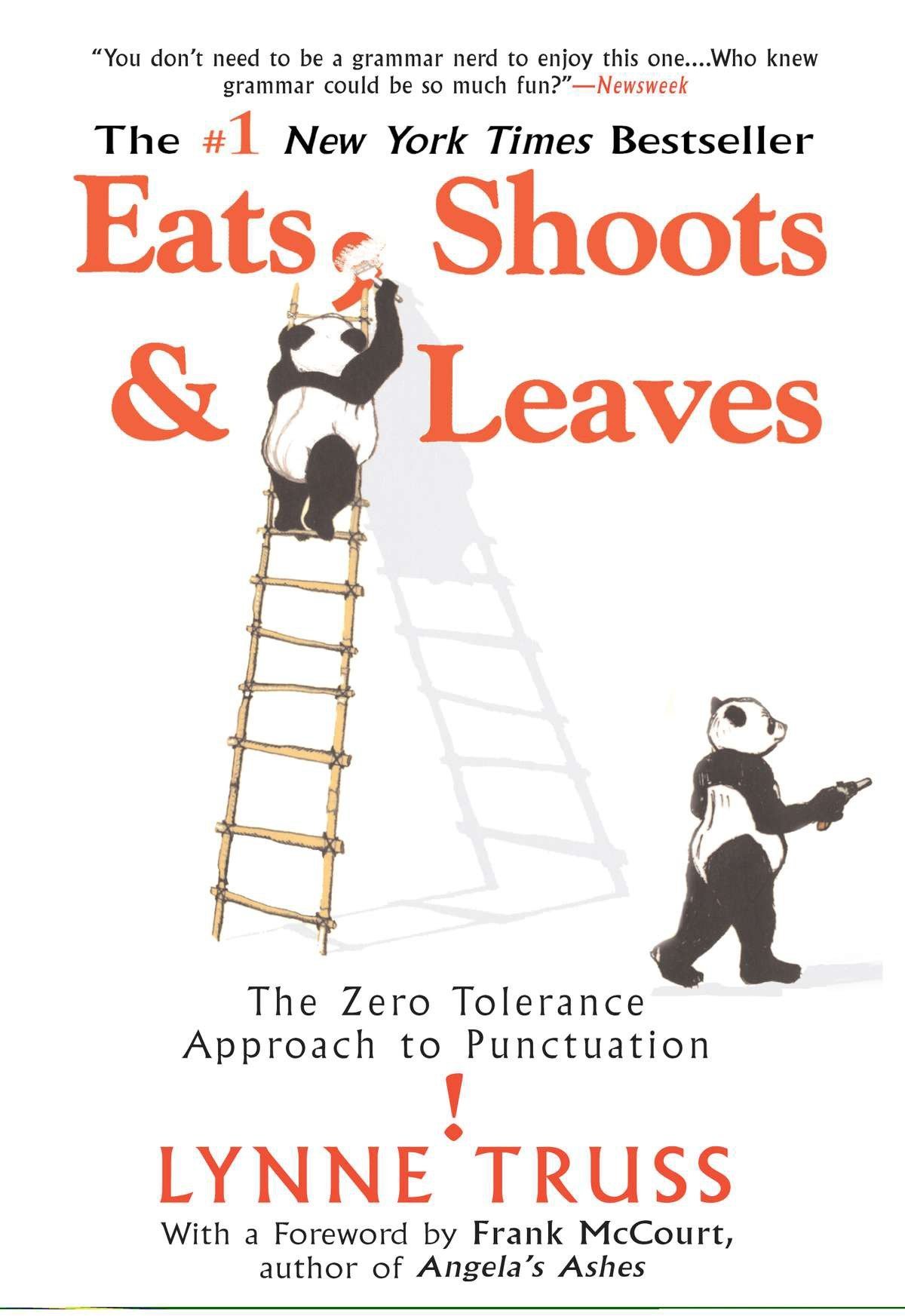
Eats, Shoots & Leaves: That'll Do, Comma–Airs and Graces
A sharp-eyed editor explains how small differences in punctuation can have enormous consequences.
Here are links to our lists for the work: Introduction–The Tractable Apostrophe, That'll Do, Comma–Airs and Graces, Cutting a Dash–Merely Conventional Signs
45 words
153 learners
Learn words with Flashcards and other activities
Definition First

Other learning activities
Full list of words from this list:
-
comma
a punctuation mark (,) indicating the separation of elementsWhen the humorist James Thurber was writing for New Yorker editor Harold Ross in the 1930s and 1940s, the two men often had very strong words about commas.
-
clarification
an interpretation that removes obstacles to understandingAccording to Thurber’s account of the matter (in The Years with Ross [1959]), Ross’s “clarification complex” tended to run somewhat to the extreme: he seemed to believe there was no limit to the amount of clarification you could achieve if you just kept adding commas.
-
particular
unique or specific to a person or thing or categoryThurber was once asked by a correspondent: “Why did you have a comma in the sentence, ‘After dinner, the men went into the living-room’?” And his answer was probably one of the loveliest things ever said about punctuation. “This particular comma,” Thurber explained, “was Ross’s way of giving the men time to push back their chairs and stand up.”
-
literary
relating to or characteristic of creative writingMore than any other mark, the comma draws our attention to the mixed origins of modern punctuation, and its consequent mingling of two quite distinct functions:
1 To illuminate the grammar of a sentence
2 To point up - rather in the manner of musical notation - such literary qualities as rhythm, direction, pitch, tone and flow -
dichotomy
a classification into two opposed parts or subclassesWhen Ross and Thurber were threatening each other with ashtrays over the correct way to render the star-spangled banner, they were reflecting a deep dichotomy in punctuation that had been around and niggling people for over four hundred years.
-
discrete
constituting a separate entity or partA comma, at that time, was the name of the relatively short bit (the word means in Greek “a piece cut off”); and in fact when the word “comma” was adopted into English in the 16th century, it still referred to a discrete, separable group of words rather than the friendly little tadpoley number-nine dot-with-a-tail that today we know and love.
-
syntax
the study of the rules for forming admissible sentencesFor a millennium and a half, punctuation’s purpose was to guide actors, chanters and readers-aloud through stretches of manuscript, indicating the pauses, accentuating matters of sense and sound, and leaving syntax mostly to look after itself.
-
exegesis
an explanation or critical interpretationOf course, if Hebrew or any of the other ancient languages had included punctuation (in the case of Hebrew, a few vowels might have been nice as well), two thousand years of scriptural exegesis need never have occurred, and a lot of clever, dandruffy people could definitely have spent more time in the fresh air.
-
transcription
something written, copied from one medium to anotherFor a considerable period in Latin transcriptions there were no gaps between words either, if you can credit such madness.
-
intone
recite musically; recite as a chant or a psalmMost significantly of all, however, they ignored the old marks that had aided the reader-aloud. Books were now for reading and understanding, not intoning.
-
semantic
of or relating to meaning or the study of meaningAs we shall shortly see, the comma has so many jobs as a “separator” (punctuation marks are traditionally either “separators” or “terminators”) that it tears about on the hillside of language, endlessly organising words into sensible groups and making them stay put: sorting and dividing; circling and herding; and of course darting off with a peremptory “woof” to round up any wayward subordinate clause that makes a futile bolt for semantic freedom.
-
eschew
avoid and stay away from deliberatelyMeanwhile, lawyers eschew the comma as far as possible, regarding it as a troublemaker; and readers grow so accustomed to the dwindling incidence of commas in public places that when signs go up saying “No dogs please”, only one person in a thousand bothers to point out that actually, as a statement, “no dogs please” is an indefensible generalisation, since many dogs do please, as a matter of fact; they rather make a point of it.
-
havoc
violent and needless disturbanceThe fun of commas is of course the semantic havoc they can create when either wrongly inserted (“What is this thing called, love?”) or carelessly omitted (“He shot himself as a child”).
-
moniker
a familiar name for a personWell, start waving and yelling, because it is the so-called Oxford comma (also known as the serial comma) and it is a lot more dangerous than its exclusive, ivory-tower moniker might suggest.
-
consider
give thought to for exemplifying purposesConsider the difference between:
The people in the queue who managed to get tickets were very satisfied.
and:
The people in the queue, who managed to get tickets, were very satisfied. -
painstaking
characterized by extreme care and great effortA passage peppered with commas - which in the past would have indicated painstaking and authoritative editorial attention - smacks simply of no backbone.
-
discretion
the trait of judging wisely and objectivelyMore than any other mark, the comma requires the writer to use intelligent discretion and to be simply alert to potential ambiguity.
-
intrusive
tending to enter uninvitedThe society decided not to prosecute the owners of the Windsor Safari Park, where animals, have allegedly been fed live to snakes and lions, on legal advice.
The comma after “animals” is not only ungrammatical and intrusive, but throws the end of the sentence (“on legal advice”) into complete semantic chaos. -
adherent
sticking fastIf a man be adherent to the king’s enemies in his realm giving to them aid and comfort in the realm or elsewhere ...
Casement’s defence argued that, since Casement had not been adherent to the king’s enemies “in the realm” (indeed, on the contrary, had scrupulously conducted all his treasonous plotting abroad), he was not guilty. -
palaver
loud and confused and empty talkIt is worth pointing out here, by the way, that legal English, with its hifalutin efforts to cover everything, nearly always ends up leaving itself semantically wide open like this, and that if Greene had been allowed to write either “Let Norman Sherry see the stuff and no one else” or, “Don’t let other biographers quote from it, but otherwise all are welcome”, none of this ridiculous palaver would have transpired.
-
precocious
characterized by exceptionally early developmentThe trouble was, Kerry-Anne was an everyday teenager with no literary pretensions - and for some reason this made the precocious blue-stocking in me feverishly uncomfortable.
-
vapid
lacking significance or liveliness or spirit or zestIn hind-sight I see it was unrealistic to expect a pen-pal from the 8th grade in Detroit to write like Samuel Johnson. But on the other hand, what earthly use to me was this vapid mousey moron parading a pigmentational handicap?
-
epiphany
a usually sudden insight, perception, or understanding of somethingThe main reason I recall this shameful teenage epiphany, however, is that in my mission to blast little Kerry-Anne out of the water, I pulled out (literally) all the stops: I used a semicolon.
-
jabber
talk in a noisy, excited, or declamatory mannerAsk professional writers about punctuation and they will not start striking the board about the misuse of the apostrophe; instead they will jabber in a rather breathless manner about the fate of the semicolon.
-
utilitarian
having a useful functionThe comma, while less subject to universal rules, is still a utilitarian mark, racing about with its ears back, trying to serve both the sense and the sound of the sentence - and of course wearing itself to a frazzle for a modest bowl of Chum.
-
benign
kind in disposition or mannerBut the thermals that benignly waft our sentences to new altitudes - that allow us to coast on air, and loop-the-loop, suspending the laws of gravity- well, they are the colons and semicolons.
-
apocryphal
being of questionable authenticityAnd I say it’s wonderful that when Umberto Eco was congratulated by an academic reader for using no semicolons in The Name of the Rose (1983) he cheerfully explained (so the apocryphal story goes) that the machine he typed The Name of the Rose on simply didn’t have a semicolon, so it was slightly unwise of this earnest chap to make too much of it.
-
rarefied
of high moral or intellectual valueNon-writers are wary of both the colon and the semicolon, though, partly because all this rarefied debate rages above their heads.
-
gusto
vigorous and enthusiastic enjoymentBut it is worth remarking that Fleet Street style gurus fly the flag for most of the prejudices listed above - especially as applied to the semicolon, a mark they increasingly strike out with puritanical gusto.
-
fastidious
giving careful attention to detailThe great theatre critic James Agate, in his diary for 1935, recorded how a notoriously fastidious fellow journalist “once telephoned a semicolon from Moscow”.
-
contention
a dispute where there is strong disagreementFor many years grammarians were a bit cagey about the difference between the colon and semi-colon. Perhaps the colon was more “literary” than the semicolon? One grammarian, writing in 1829, lamented the two marks as “primeval sources of improfitable contention”.
-
hierarchical
classified by various criteria into successive levelsBy and large, however, it was decided that the way to satisfy the punters was to classify the marks hierarchically, in terms of weight. Thus the comma is the lightest mark, then the semi-colon, then the colon, then the full stop.
-
missive
a written message addressed to a person or organizationThis superb missive starts with the peremptory, “My dear Luruns [sic], Confound you and your book: you are no more to be trusted with a pen than a child with a torpedo” - and then gets even more offensive and hilarious as it goes on.
-
cavalier
showing a lack of concern or seriousnessShaw explains that, having worked out his own system for colons and semicolons, he has checked it against the Bible, and seen that the Bible almost got it right. With such authority behind him, he is offended by Lawrence’s cavalier attitude.
-
idiosyncratic
peculiar to the individualShaw is quite famous for his idiosyncratic punctuation.
-
illustrate
make clear or understandable by giving an exampleShaw explains to Lawrence that when the second statement reaffirms, explains or illustrates the first, you use a colon; also when you desire an abrupt “pull-up”: “Luruns was congenitally literary: that is, a liar.”
-
antithetical
sharply contrasted in character or purposeA classic use of the colon is as a kind fulcrum between two antithetical or oppositional statements
-
colon
a punctuation mark used after a word introducing a seriesSo colons introduce the part of a sentence that exemplifies, restates, elaborates, undermines, explains or balances the preceding part.
-
ellipsis
a mark indicating that words have been omittedSo it is true that we must keep an eye on the dash - and also the ellipsis (...), which is turning up increasingly in emails as shorthand for “more to come, actually... it might be related to what I’ve just written ... but the main thing is I haven’t finished ... let’s just wait and see ... I could go on like this for hours ...”
-
polyglot
a person who speaks more than one languageHe had made good money, for the smart set of Jacksonburg were always hard put to get through the rainy season; the polyglot professional class had made it their rendezvous; even attaches from the legislations and younger members of the Jackson family had come there.
-
indispensable
essentialThere are times, however, when the semicolon is indispensable in another capacity: when it performs the duties of a kind of Special Policeman in the event of comma fights.
-
structure
the complex composition of knowledge as elementsSometimes - and I’ve never admitted this to anyone before - I adopt a kind of stream-of-consciousness sentence structure; somewhat like Virginia Woolf; without full sentences; but it feels OK to do this; rather worrying.
-
decry
express strong disapproval ofMuch as I decry the old count-to-two system, there is an obvious take-a-breath thing going on here.
-
automatic
without volition or conscious controlWhen you read the sentence, “He woke up in his own bed, and he felt fine”, you don’t draw breath before the “and”. You rattle on. Whereas when you read, “He woke up in his own bed; nevertheless, he was OK”, an inhalation is surely automatic.
-
perspicuity
clarity as a consequence of being easily understandable“The art of punctuation is of infinite consequence in writing; as it contributes to the perspicuity, and consequently to the beauty, of every composition.”
Created on Fri Mar 10 20:54:13 EST 2017
(updated Tue Sep 25 15:33:57 EDT 2018)
Sign up now (it’s free!)
Whether you’re a teacher or a learner,
Vocabulary.com can put you or your class
on the path to systematic vocabulary improvement.