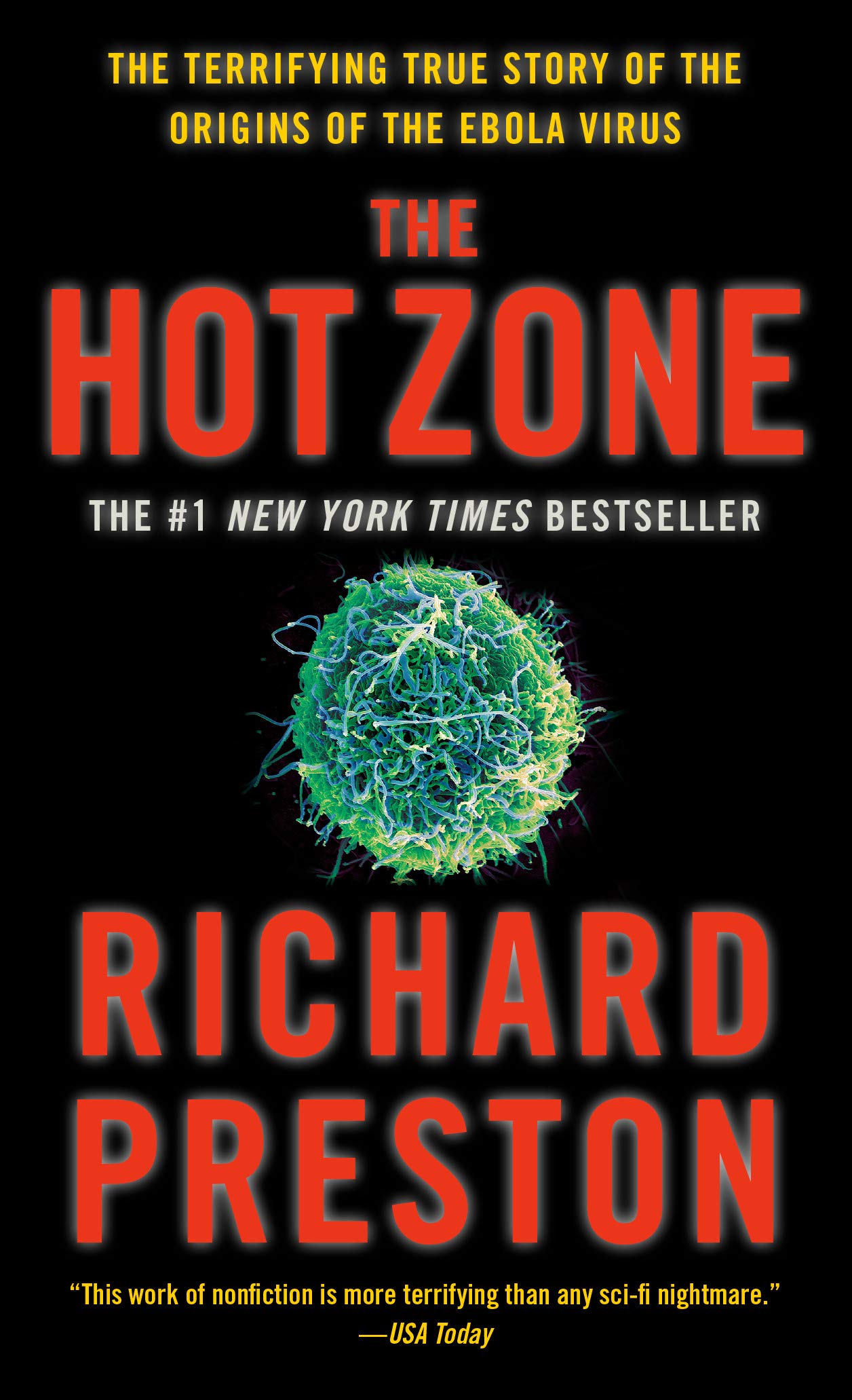
The Hot Zone: Part One
In this riveting nonfiction account, Richard Preston traces the emergence and spread of the deadly Ebola virus.
Here are links to our lists for the book: Part One, Part Two, Part Three, Part Four
40 words
1044 learners
Learn words with Flashcards and other activities
Definition First

Other learning activities
Full list of words from this list:
-
lethal
of an instrument of certain deathHRV is a highly lethal but not very infective Biosafety Level 2 agent.
-
regurgitate
pour or rush backHe coughs a deep cough and regurgitates something into the bag.
-
hemorrhage
the flow of blood from a ruptured blood vesselIt is hemorrhage, and it smells like a slaughterhouse.
-
liquefy
make a solid substance into a fluid, as by heatingThe transformation is not entirely successful, however, and the end result is a great deal of liquefying flesh mixed with virus, a kind of biological accident.
-
automaton
someone who acts or responds in a mechanical wayHis personality is being wiped away by brain damage. This is called depersonalization, in which the liveliness and details of character seem to vanish. He is becoming an automaton.
-
coagulate
change from a liquid to a thickened or solid stateA flight attendant gives him some paper towels, which he uses to stop up his nose, but the blood still won’t coagulate, and the towels soak through.
-
fluid
a substance that is liquid at room temperature and pressureThe black vomit blew up around the scope and out of Monet’s mouth. Black-and-red fluid spewed into the air, showering down over Dr. Musoke.
-
splatter
dash a liquid upon or againstIt splattered over his white coat and down his chest, marking him with strings of red slime dappled with dark flecks.
-
dehydrate
lose water or moistureHe had lost so much blood that he was becoming dehydrated.
-
sluggish
moving slowlyThere wasn’t enough blood left to maintain circulation, so his heartbeat was very sluggish, and his blood pressure was dropping toward zero.
-
transfusion
the introduction of blood or plasma into a vein or arteryHe needed a blood transfusion.
-
autopsy
an examination and dissection of a dead bodyThey opened him up for an autopsy and found that his kidneys were destroyed and that his liver was destroyed.
-
cadaver
the dead body of a human beingIt was yellow, and parts of it had liquefied—it looked like the liver of a cadaver.
-
corpse
the dead body of a human beingIt was as if Monet had become a corpse before his death.
-
slough
cast off hair, skin, horn, or feathersSloughing of the gut, in which the intestinal lining comes off, is another effect that is ordinarily seen in a corpse that is several days old.
-
fulminate
come on suddenly and intenselyLacking words, categories, or language to describe what had happened, they called it, finally, a case of “fulminating liver failure.”
-
abdominal
relating to or near the middle region of the bodyThen he developed abdominal pain, and that made him think that he might have typhoid fever, so he gave himself a course of antibiotic pills, but that had no effect on his illness.
-
febrile
of or relating to or characterized by feverWhen Peter came to me, he was febrile, but he was very with it, very alert and communicative.
-
jaundice
yellowing of the skin and the whites of the eyesThe pain in his stomach and in his muscles grew unbearable, and he developed jaundice.
-
abscess
a localized collection of pus surrounded by inflamed tissueShe examined him, observed his fever, his red eyes, his jaundice, his abdominal pain, and came up with nothing definite, but wondered if he had gallstones or a liver abscess.
-
incision
the cutting of or into body tissues or organsThey made an incision over his liver and pulled back the abdominal muscles.
-
biopsy
the removal and examination of tissue from a living bodyThey cut a wedge out of his liver—a liver biopsy—and dropped the wedge into a bottle of pickling fluid and closed up Musoke as quickly as they could.
-
epidemiology
science dealing with the transmission and control of diseaseThe fact that the team apparently never spoke with him, the monkey inspector, “was bad epidemiology but good politics,” he remarked to me.
-
epicenter
a point on the Earth's surface directly above an earthquakeEpidemiologists have since discovered that the northwestern shore of Lake Victoria was one of the initial epicenters of AIDS.
-
wizened
lean and wrinkled by shrinkage as from age or illnessShe was a wizened old lady, come to have a look around her old place, and she fixed a blue eye on Nancy and said, “Little girl, you are going to hate this house. I did.”
-
recurrent
happening again and againGene Johnson had suffered recurrent nightmares about Ebola virus ever since he began to work with it.
-
psychosis
severe mental disorder in which contact with reality is lostSome of its effects resemble rabies—psychosis, madness. Other of its effects look eerily like a bad cold.
-
primordial
having existed from the beginningThe earth’s primordial ocean, which came into existence not long after the earth was formed, about four and a half billion years ago, may well have contained microscopic life forms based on RNA.
-
diatribe
thunderous verbal attackAnd he went into a ten-minute diatribe about the dangers of doing hot work in a space suit, especially with Ebola.
-
dementia
mental deterioration of organic or functional originThere is no doubt that Ebola damages the brain and causes psychotic dementia.
-
detonation
the act of setting off an explosiveWhat happened in Sudan could be compared to the secret detonation of an atomic bomb. If the human race came close to a major biological accident, we never knew it.
-
smolder
burn slowly and without a flameIn any case, the Ebola Sudan virus destroyed a few hundred people in central Africa the way a fire consumes a pile of straw—until the blaze burns out at the center and ends in a heap of ash—rather than smoldering around the planet, as AIDS has done, like a fire in a coal mine, impossible to put out.
-
virus
infectious agent that replicates itself within living hostsThe mother was dying of Ebola and had given the virus to her unborn baby.
-
fetus
an unborn vertebrate in the later stages of developmentThe fetus had evidently crashed and bled out inside the mother’s womb.
-
mosaic
a pattern resembling small pieces of colored stone or glassThis is known as pavementing, because the clots fit together in a mosaic.
-
capillary
a minute blood vessel connecting arterioles with venulesThe mosaic thickens and throws more clots, and the clots drift through the bloodstream into the small capillaries, where they get stuck.
-
inexorably
in a manner impervious to change or persuasionIt keeps on multiplying until areas of tissue all through the body are filled with crystalloids, which hatch, and more Ebola particles drift into the bloodstream, and the amplification continues inexorably until a droplet of the host’s blood can contain a hundred million individual virus particles.
-
vector
any agent that carries and transmits a diseaseOfficials at the WHO began to fear that Nurse Mayinga would become the vector for a world-wide plague.
-
antibody
a protein that produces an immune responseNone of the local people or the cattle tested positive for Marburg antibodies
-
expose
put in a dangerous, disadvantageous, or difficult positionif they had tested positive, it would have shown that they had been exposed to Marburg.
Created on Sat Jun 18 20:11:05 EDT 2016
(updated Mon Sep 24 13:20:52 EDT 2018)
Sign up now (it’s free!)
Whether you’re a teacher or a learner,
Vocabulary.com can put you or your class
on the path to systematic vocabulary improvement.