Building Mastery and Motivation in a Word Study Class
When Leslie Green, a 31-year veteran English teacher at John F. Kennedy Middle School, took over her school’s Word Study program, she set out to make vocabulary learning more engaging, effective, and lasting. Using Vocabulary.com as the foundation, she built a structured program that reaches every 7th-grade and many 8th-grade students. In just 10 weeks, 169 students mastered more than 36,000 words, an average of 217 per student. Beyond measurable growth, students develop confidence, stay highly engaged, and carry stronger vocabulary skills into other classes and grade levels.

John F. Kennedy Middle School
About the school
- Location:
- Bethpage, New York
- Grades:
- 6-8
- Number of students:
- ~800
- Characteristics:
- Suburban Public
How they use Vocabulary.com
- Teacher:
- Leslie Green
- Grades:
- 7-8
- Subjects:
- English Language Arts
The challenges
When Leslie Green was asked to take over the Word Study program, the goal was clear: strengthen students’ vocabulary to better prepare them for standardized tests like the SAT and ACT. District leaders had identified vocabulary as a gap, and Green saw the same issue in her own classroom; students often lacked the word knowledge needed to fully understand what they were reading.
At the same time, vocabulary instruction was difficult to prioritize. The English teachers at JFK Middle School do a commendable job trying to enhance vocabulary instruction. They simply do not have the time to do so on a regular basis. Ms. Green is utilizing Word Study and Vocabulary.com to bridge that gap.
Green also worked with a wide range of learners, including students with IEPs and those who struggled with language acquisition. She needed an approach that could engage all students, support different learning levels, and build confidence—not just for high performers, but for those who found language challenging.
Compounding the challenge, Word Study is an elective that meets every other day for only half the school year, with new groups of students rotating in each semester. Limited time and constant turnover made it difficult to build consistency and momentum.

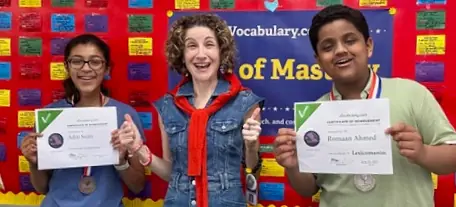
Word Study students at John F. Kennedy Middle School in front of their Wall of Mastery
The solution
To address these challenges, Leslie Green reimagined Word Study as a structured, student-centered program built around consistent practice, shared content, and visible progress. At the center of that model is Vocabulary.com, which she uses not as a supplement, but as the foundation for how students learn and master new words.
Green provides clear instructional structure through curated word lists, including Greek and Latin roots (what she calls her “Gratin Lists”), core academic vocabulary, and terms connected to topics they are covering in other academic classes. These shared lists ensure that all students are building vocabulary that is academically relevant and grade-appropriate. Within that structure, students work toward mastery at their own pace, receiving immediate feedback and reinforcing what they’ve learned over time.

A key driver of the program is the Vocabulary Bowl, which gives students a clear goal and a reason to keep going. Students track their standing, follow school rankings, and push themselves to contribute, often going beyond assigned work to master more words. “The kids get really excited about it,” says Green. “The kids are obsessed with watching the rankings. They come in every morning asking if we passed another school.”
The program balances this shared motivation with individual progress. Because practice is adaptive and self-paced, it supports a wide range of learners. Students who struggle can build confidence through steady gains, while more advanced students remain challenged. Over time, this creates a classroom environment where students are highly engaged and consistently on task.
Here’s how Ms. Green is using Vocabulary.com in her Word Study class:
- Students work from curated word lists based on Greek and Latin roots, academic vocabulary, and terms connected to literature and other subject areas.
- She begins each class by focusing on an individual word from their current list, which students define, explore, and add to a running list.
- Students spend dedicated time in each class working toward mastery on assigned lists, typically for about 20 minutes.
- Classes work toward shared goals for words mastered, reinforcing both individual effort and group accountability.
- Students track their progress and proficiency during each session and reflect on their growth over time.
The results
In the first 10 weeks of the 2026 spring semester, 169 students mastered more than 36,000 words—an average of 217 words per student. Many students exceeded 100 words individually during the Vocabulary Bowl season, with top performers mastering hundreds or even more than 1,000 words. The game-like elements and prizes keep students focused and motivated—including students who have a history of struggling academically. “They’ll come in every morning and show me their progress,” says Green. “These are kids who don’t typically do that in other classes.”
Engagement in the classroom is consistently high, with the vast majority of students actively participating during practice sessions. Students frequently track their progress, compete with peers, and continue learning outside of class. Green says, “I would say their time on task in Vocabulary.com exceeds 85%—which is unheard of in a middle school classroom!”

Green has also seen strong evidence of transfer beyond her classroom. High school teachers report that students who have completed the program demonstrate stronger vocabulary knowledge and are able to recall and apply words they mastered in earlier grades. Students are also walking into standardized tests better prepared for the vocabulary they will face.
Just as important, students leave the program with greater confidence in their ability to learn and use new words, an outcome that supports their success across subjects and over time.