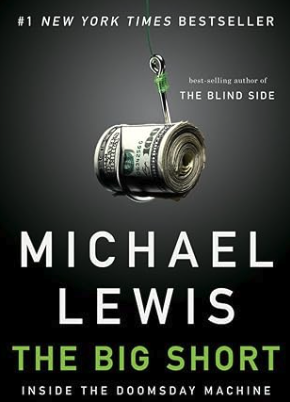
The Big Short: Chapters 2–3
This nonfiction narrative focuses on the people who were affected by the global financial crisis of 2007–2008, especially those who profited from betting against the risky loans to low-income Americans who couldn't pay for their homes.
Here are links to our lists for the book: Prologue–Chapter 1, Chapters 2–3, Chapters 4–5, Chapters 6–8, Chapter 9–Epilogue
40 words
55 learners
Learn words with Flashcards and other activities
Definition First

Other learning activities
Full list of words from this list:
-
tedious
so lacking in interest as to cause mental wearinessEvery mortgage bond came with its own mind-numbingly tedious 130-page prospectus.
-
prospectus
a document that sets forth a plan for a business enterpriseYou could pull these prospectuses, and just quickly check the pulse of what was happening in the subprime mortgage portion of the originate-and-sell industry.
-
premium
payment for insuranceA credit default swap was confusing mainly because it wasn’t really a swap at all. It was an insurance policy, typically on a corporate bond, with semiannual premium payments and a fixed term.
-
abstruse
difficult to understandOn March 19, 2005, alone in his office with the door closed and the shades drawn, reading an abstruse textbook on credit derivatives, Michael Burry got an idea: credit default swaps on subprime mortgage bonds.
-
speculation
an investment that is risky but could yield great profitsVery quickly, however, the new derivatives became tools for speculation: A lot of people wanted to make bets on the likelihood of GE’s defaulting.
-
precipitate
bring about abruptlyInside of three years, credit default swaps on subprime mortgage bonds would become a trillion-dollar market and precipitate hundreds of billions of dollars’ worth of losses inside big Wall Street firms.
-
ambiguity
unclearness by virtue of having more than one meaningHe couldn’t stand the unfairness of coaches who favored their own kids. Umpires who missed calls drove him to distraction. He preferred swimming, as it required virtually no social interaction. No teammates. No ambiguity. You just swam your time and you won or you lost.
-
supersede
take the place or move into the position ofAs you know there are some select people that just find a drive in certain activities that supersedes EVERYTHING else.
-
uncanny
surpassing the ordinary or normalBut we’re losing money. We’re losing clients. All of a sudden he goes on this tear. He’s up fifty percent. It’s uncanny. He’s uncanny.
-
volatility
the trait of being unpredictableThey measured risk by volatility: how much a stock or bond happened to have jumped around in the past few years.
-
acerbic
harsh or corrosive in toneWarren Buffett had an acerbic partner, Charlie Munger, who evidently cared a lot less than Buffett did about whether people liked him.
-
incentive
extra pay or reward given to employees for good performanceIf you wanted to predict how people would behave, Munger said, you only had to look at their incentives. FedEx couldn’t get its night shift to finish on time; they tried everything to speed it up but nothing worked—until they stopped paying night shift workers by the hour and started to pay them by the shift.
-
cohort
a group of people having approximately the same ageI think I’ve been in the top five percent of my age cohort all my life in understanding the power of incentives, and all my life I’ve underestimated it.
-
forgo
do without or cease to hold or adhere to“The guy has no money and he chooses to forgo a fee that any other hedge fund takes for granted. It was unheard of.”
-
apparatus
equipment designed to serve a specific functionScion Capital’s decision-making apparatus consisted of one guy in a room, with the door closed and the shades drawn, poring over publicly available information and data on 10-K Wizard.
-
unprecedented
novel; having no earlier occurrence“You just have to watch for the level at which even nearly unlimited or unprecedented credit can no longer drive the [housing] market higher,” he wrote.
-
derivative
a financial instrument with value based on another securityIn retrospect, the amazing thing was just how quickly Wall Street firms went from having no idea what Mike Burry was talking about when he called and asked them about credit default swaps on subprime mortgage bonds, to reshaping their business in a way that left the new derivative smack at the center.
-
collateral
a security pledged for the repayment of a loanAs the value of the insurance contract changed—say, as floodwaters approached but before they actually destroyed the building—he wanted Goldman Sachs and Deutsche Bank to post collateral, to reflect the increase in value of what he owned.
-
dodgy
of uncertain outcome; especially fraught with riskHe’d read dozens of prospectuses and scoured hundreds more, looking for the dodgiest pools of mortgages, and was still pretty certain even then (and dead certain later) that he was the only human being on earth who read them, apart from the lawyers who drafted them.
-
lien
the right to take and hold the property of a debtorHe analyzed the relative importance of the loan-to-value ratios of the home loans, of second liens on the homes, of the location of the homes, of the absence of loan documentation and proof of income of the borrower, and a dozen or so other factors to determine the likelihood that a home loan made in America circa 2005 would go bad.
-
amortize
pay off a debt by making periodic paymentsHe found one mortgage pool that was 100 percent floating-rate negative- amortizing mortgages—where the borrowers could choose the option of not paying any interest at all and simply accumulate a bigger and bigger debt until, presumably, they defaulted on it.
-
shrewd
marked by practical hardheaded intelligence“I’m educating the experts here,” Burry crowed in an e-mail.
He wasn’t wasting a lot of time worrying about why these supposedly shrewd investment bankers were willing to sell him insurance so cheaply. -
esoteric
understandable only by an enlightened inner circleMost of them still had no idea that their champion stock picker had become so diverted by these esoteric insurance contracts called credit default swaps.
-
hallmark
a distinctive characteristic or attributeThere are specific identifiers that are entirely recognizable during the bubble’s inflation. One hallmark of mania is the rapid rise in the incidence and complexity of fraud.
-
salient
conspicuous, prominent, or importantBad behavior was no longer on the fringes of an otherwise sound economy; it was its central feature. “The salient point about the modern vintage of housing-related fraud is its integral place within our nation’s institutions,” he added.
-
integral
existing as an essential constituent or characteristicBad behavior was no longer on the fringes of an otherwise sound economy; it was its central feature. “The salient point about the modern vintage of housing-related fraud is its integral place within our nation’s institutions,” he added.
-
recourse
act of turning to for assistanceAs their funds were contractually stuck inside Scion Capital for some time, the investors’ only recourse was to send him disturbed-sounding e-mails asking him to justify his new strategy.
-
restive
impatient especially under restriction or delayOddly, as Mike Burry’s investors grew restive, his Wall Street counterparties took a new and envious interest in what he was up to.
-
placate
cause to be more favorably inclinedCould Mike Burry sell them $25 million of the stuff, at really generous prices, on the subprime mortgage bonds of his choosing? Just to placate Goldman management, you understand.
-
exploit
use or manipulate to one's advantageBond traders could exploit inside information without worrying that they would be caught.
-
security
financial instrument documenting ownership of an investmentThe bigger, more liquid end of the bond market—the market for U.S. Treasury bonds, for example—traded on screens, but in many cases the only way to determine if the price some bond trader had given you was even close to fair was to call around and hope to find some other bond trader making a market in that particular obscure security.
-
dub
give a nickname toLippmann himself described it more bluntly to a Deutsche Bank colleague who had seen the presentation and dubbed him “Chicken Little.”
-
alacrity
liveliness and eagernessThe alacrity with which subprime borrowers paid off their loans was yet another strange aspect of this booming market. It had to do with the structure of the loans, which were fixed for two or three years at an artificially low teaser rate before shooting up to the “go-to” floating rate.
-
rejigger
put into a new order or arrangementLike the credit default swap, the CDO had been invented to redistribute the risk of corporate and government bond defaults and was now being rejiggered to disguise the risk of subprime mortgage loans.
-
launder
transfer funds to hide the source of money gotten illegallyThe CDO was, in effect, a credit laundering service for the residents of Lower Middle Class America. For Wall Street it was a machine that turned lead into gold.
-
yield
give or supplyA billion dollars of crappy home loans might yield just $20 million of the crappiest triple-B tranches.
-
dicey
of uncertain outcome; fraught with riskThe details were complicated, but the gist of this new money machine was not: It turned a lot of dicey loans into a pile of bonds, most of which were triple-A-rated, then it took the lowest-rated of the remaining bonds and turned most of those into triple-A CDOs.
-
constraint
a limitation or restrictionThe market for “synthetics” removed any constraint on the size of risk associated with subprime mortgage lending. To make a billion-dollar bet, you no longer needed to accumulate a billion dollars’ worth of actual mortgage loans. All you had to do was find someone else in the market willing to take the other side of the bet.
-
anathema
something that is detested or that inspires dislikeTrades where you fork over 2 percent a year just to be in them were anathema. Other sorts of investors found other sorts of objections.
-
contempt
lack of respect accompanied by a feeling of intense dislikeAnother group packaged the most repellent, unsalable tranches of those bonds, and CDSs on the bonds, into CDOs. The bigger Lippmann’s short position grew, the greater the implicit expression of contempt for these people and their industry—an industry quickly becoming Wall Street’s most profitable business.
Created on Mon Sep 09 09:05:11 EDT 2024
(updated Tue Sep 10 10:55:41 EDT 2024)
Sign up now (it’s free!)
Whether you’re a teacher or a learner,
Vocabulary.com can put you or your class
on the path to systematic vocabulary improvement.