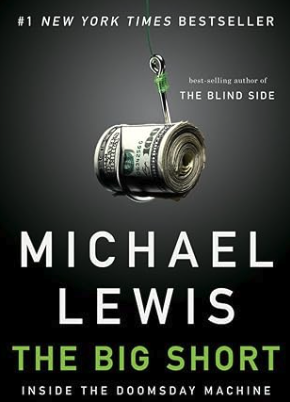
The Big Short: Prologue–Chapter 1
This nonfiction narrative focuses on the people who were affected by the global financial crisis of 2007–2008, especially those who profited from betting against the risky loans to low-income Americans who couldn't pay for their homes.
Here are links to our lists for the book: Prologue–Chapter 1, Chapters 2–3, Chapters 4–5, Chapters 6–8, Chapter 9–Epilogue
40 words
177 learners
Learn words with Flashcards and other activities
Definition First

Other learning activities
Full list of words from this list:
-
reckoning
a time or act of being held accountable; a settling of accountsSooner rather than later would come a Great Reckoning, when Wall Street would wake up and hundreds, if not thousands, of young people like me, who had no business making huge bets with other people’s money or persuading other people to make those bets, would be expelled from finance.
-
dividend
earnings of a corporation distributed to its shareholdersOn that day she predicted that Citigroup had so mismanaged its affairs that it would need to slash its dividend or go bust.
-
seditious
in opposition to a civil authority or governmentNow, obviously, Meredith Whitney didn’t sink Wall Street. She’d just expressed most clearly and most loudly a view that turned out to be far more seditious to the social order than, say, the many campaigns by various New York attorneys general against Wall Street corruption.
-
pundit
an expert who publicly gives opinions via mass mediaBy then there was a long and growing list of pundits who claimed they predicted the catastrophe, but a far shorter list of people who actually did.
-
finagle
achieve something by means of trickery or devious methodsMy parents worked as brokers at Oppenheimer securities. They managed to finagle me a job.
-
consensus
agreement in the judgment reached by a group as a wholeEisman turned out to have a special talent for making noise and breaking with consensus opinion. He started as a junior equity analyst, a helpmate, not expected to offer his own opinions.
-
hedge
minimize loss or riskEisman stuck to his sell rating on Lomas Financial, even after the Lomas Financial Corporation announced that investors needn’t worry about its financial condition, as it had hedged its market risk.
-
incipient
only partly in existence; imperfectly formedHis other features all arranged themselves, almost dutifully, around the incipient thought.
-
deference
a courteous expression of esteem or regardImportant men who might have expected from Eisman some sign of deference or respect, on the other hand, often came away from encounters with him shocked and outraged.
-
solicit
request urgently or persistentlyHe’d sent Eisman his company’s financial statements and then followed, with an interpreter, to solicit Eisman’s investment.
-
solvent
capable of meeting financial obligationsAt first the new bond market machine concerned itself with the more solvent half of the American population. Now, with the extension of the mortgage bond market into the affairs of less creditworthy Americans, it found its fuel in the debts of the less solvent half.
-
mortgage
a conveyance of property as security for repaying a loanThe mortgage bond was different in important ways from old-fashioned corporate and government bonds. A mortgage bond wasn’t a single giant loan for an explicit fixed term. A mortgage bond was a claim on the cash flows from a pool of thousands of individual home mortgages. These cash flows were always problematic, as the borrowers had the right to pay off any time they pleased.
-
tranche
a portion of something (especially money)They took giant pools of home loans and carved up the payments made by homeowners into pieces, called tranches. The buyer of the first tranche was like the owner of the ground floor in a flood: He got hit with the first wave of mortgage prepayments. In exchange, he received a higher interest rate. The buyer of the second tranche—the second story of the skyscraper—took the next wave of prepayments and in exchange received the second highest interest rate, and so on.
-
default
fail to pay upThe loans carried, in effect, government guarantees; if the homeowners defaulted, the government paid off their debts.
-
equity
difference between value of a property and claims against itThe purpose was to extend credit to less and less creditworthy homeowners, not so that they might buy a house but so that they could cash out whatever equity they had in the house they already owned.
-
liability
an obligation to pay money to another partyOne man’s liability had always been another man’s asset, but now more and more of the liabilities could be turned into bits of paper that you could sell to anyone.
-
hock
leave as a guarantee in return for moneyTo invent a new market was only a matter of finding a new asset to hock. The most obvious untapped asset in America was still the home.
-
stigma
a symbol of disgrace or infamy“The thinking in subprime,” says Jacobs, “was there was this social stigma to being a second mortgage borrower and there really shouldn’t be. If your credit rating was a little worse, you paid a lot more—and a lot more than you really should. If we can mass market the bonds, we can drive down the cost to borrowers. They can replace high interest rate credit card debt with lower interest rate mortgage debt. And it will become a self-fulfilling prophecy.”
-
fraught
filled with or attended withBecause the lenders sold many—though not all—of the loans they made to other investors, in the form of mortgage bonds, the industry was also fraught with moral hazard.
-
seamy
morally degraded“Any business where you can sell a product and make money without having to worry how the product performs is going to attract sleazy people. That was the seamy underbelly of the good idea. Eisman and I both believed in the big idea and we both met some really sleazy characters. That was our job: to figure out which of the characters were the right ones to pull off the big idea.”
-
skewed
favoring one person or side over another“The distribution of income in this country was skewed and becoming more skewed, and the result was that you have more subprime customers.”
-
proponent
a person who argues for a cause or puts forward an ideaOf course, Eisman was paid to see the sense in subprime lending: Oppenheimer quickly became one of the leading bankers to the new industry, in no small part because Eisman was one of its leading proponents.
-
brazen
not held back by conventional ideas of behaviorEisman was brazen and grandiose and focused on the big kill.
-
poised
marked by balance or equilibrium and readiness for actionHe was young and fit, with thick, dark hair and handsome features, but his appearance was overshadowed by his concerned expression—mouth ever poised to frown, eyebrows ever ready to rise.
-
opacity
incomprehensibility resulting from obscurity of meaningHe was instantly struck by the opacity of an investment bank’s books. None of his fellow accountants was able to explain why the traders were doing what they were doing.
-
parse
analyze in detail in order to discover essential featuresHe handed Vinny’s resume in to human resources, and it made its way to Steve Eisman, who turned out to be looking for someone to help him parse the increasingly arcane accounting used by subprime mortgage originators.
-
delinquent
past due; not paid at the scheduled timeWhile the Moody’s database did not allow you to examine individual loans, it offered a general picture of the pools of loans underlying individual mortgage bonds: how many were floating-rate, how many of the houses borrowed against were owner-occupied. Most importantly: how many were delinquent.
-
indictment
an accusation of wrongdoingTheir failure was interpreted as an indictment of their accounting practices, which allowed them to record profits before they were realized.
-
arcane
requiring secret or mysterious knowledgeBecause if the market catches on to everything, I probably have the wrong job. You can’t add anything by looking at this arcane stuff, so why bother?
-
relegate
assign to a lower position“The whole thing about Steve,” said a Chilton colleague, “was, ‘Yeah, he’s a really smart guy. But can he pick stocks?’” Chilton decided that he couldn’t and relegated him to his old role of analyzing companies for the guy who actually made the investment decisions.
-
conglomerate
a group of diverse companies under common ownershipThe following year it sold itself, and its giant portfolio of subprime loans, for $15.5 billion to the British financial conglomerate the HSBC Group.
-
blatant
without any attempt at concealment; completely obviousThis wasn’t just another company—this was the biggest company by far making subprime loans. And it was engaged in just blatant fraud.
-
implication
a relation by virtue of involvement or close connectionHis pessimism toward high finance was becoming tinged with political ideas. “That’s when I started to see the social implications,” he said.
-
strident
being sharply insistent on being heardIn his youth, Eisman had been a strident Republican. He joined right-wing organizations, voted for Reagan twice, and even loved Robert Bork.
-
fatalistic
accepting that everything that happens is inevitableRaised in Georgia, the son of a finance professor, Danny was less openly fatalistic than Vinny or Steve, but he nevertheless shared a general sense that bad things can and do happen, especially on Wall Street.
-
unadulterated
without qualificationWe both know that unadulterated good things like this trade don’t just happen between little hedge funds and big Wall Street firms.
-
underwrite
guarantee financial support ofBear Stearns, Merrill Lynch, Goldman Sachs, and Morgan Stanley all had what they termed “shelves” for their subprime wares, with strange names like HEAT and SAIL and GSAMP, that made it a bit more difficult for the general audience to see that these subprime bonds were being underwritten by Wall Street’s biggest names.
-
debacle
a sudden and complete disasterThey knew most of the subprime lenders—the guys on the ground making the loans. Many were the very same characters who had created the late 1990s debacle.
-
predisposed
made susceptibleEisman was predisposed to suspect the worst of whatever Goldman Sachs might be doing with the debts of lower-middle-class Americans.
-
remittance
a payment of money sent to a person in another placeOn the twenty-fifth of each month, the remittance reports arrived on his computer screen, and he scanned them for any upticks in delinquencies.
Created on Mon Sep 09 09:04:54 EDT 2024
(updated Tue Sep 10 09:46:58 EDT 2024)
Sign up now (it’s free!)
Whether you’re a teacher or a learner,
Vocabulary.com can put you or your class
on the path to systematic vocabulary improvement.