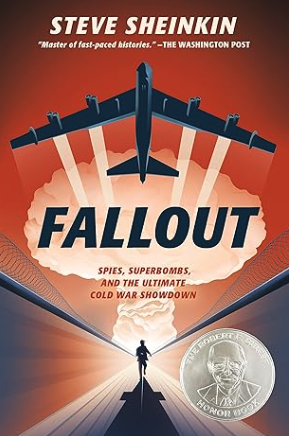
Fallout: Part 3
In this follow-up to Bomb, the award-winning author shows how the development of the atomic bomb led to tensions between the United States and the Soviet Union that threatened massive destruction for nearly fifty years after World War II.
Here are links to our lists for the book: Prologue–Part 1, Part 2, Part 3, Epilogue
40 words
7 learners
Learn words with Flashcards and other activities
Definition First

Other learning activities
Full list of words from this list:
-
debris
the remains of something that has been destroyedThe asteroid’s impact blasted debris high into the atmosphere, creating a blanket of soot that blocked sunlight and caused the planet to cool by a global average of fifteen degrees Fahrenheit.
-
colonnade
structure consisting of a row of evenly spaced columnsAfter breakfast in bed with a stack of newspapers, he dressed in one of his hand-tailored suits and walked with his four-year-old daughter, Caroline, down the outdoor colonnade to the West Wing.
-
ail
be unwellBefore lunch he’d swim laps in the White House pool, originally installed so Franklin D. Roosevelt could exercise muscles damaged by polio. Kennedy kept the water heated to ninety degrees to soothe his ailing back.
-
convoy
a collection of merchant ships with an escort of warshipsThe convoys of Soviet ships continued across the Atlantic through summer and into the fall of 1962. American military planes circled overhead, taking pictures. As far as the pilots could see, the ships really did carry farm supplies.
-
capsize
overturn accidentally“Soon the storm will break loose,” he said to Oleg Troyanovsky, one of his top foreign policy aides, when they were back in the premier’s office in Moscow.
Troyanovsky took the storm analogy one disturbing step further. “Let’s hope,” he said, “the boat will not capsize altogether.” -
engagement
a hostile meeting of opposing military forcesSo, yes, with such a weapon, a single submarine really could start the next world war. Which brought up the obvious matter of rules of engagement. Under what conditions, asked the commanders, were the weapons to be used?
-
weld
join together by heatingBefore the reactor could melt down and explode, volunteers crawled into the reactor compartment and welded together a backup cooling system.
-
ballast
any heavy material used to stabilize a ship or airshipThe crew opened the boat’s ballast tanks, allowing seawater to rush in. The sub’s bow dipped, and the boat slid beneath the surface.
-
maintain
state or assert“Ray, our worst fears are coming to pass in Cuba.”
“Are you fellows sure?”
“Yes, I am sorry to have to maintain it, but we are sure.” -
intact
undamaged in any wayThe riskiest move he could make would be an air strike that left some of the missile sites intact. One danger was that those weapons could be fired at the United States.
-
assumption
a hypothesis that is taken for grantedLeMay’s view of the Cold War was driven by the assumption that the Soviet Union and the United States were on a collision course. At some point, he believed, the United States was going to face a choice: surrender to the Soviet Union or destroy it.
-
blunder
commit a faux pas or a fault or make a serious mistakeKhrushchev, he argued, had blundered by picking a fight in a part of the world where America was stronger.
-
contempt
lack of respect accompanied by a feeling of intense dislikeNormally, LeMay at least tried to hide his contempt for the young president. That was out the window now. A blockade was weak, he charged. It would only invite the Soviets to attack. It was the act of a coward.
-
unanimous
in complete agreementKennedy wanted a unanimous recommendation, but the team was divided between advising a blockade or an air strike.
-
proponent
a person who argues for a cause or puts forward an ideaIn the White House’s second-floor Oval Room, air strike and blockade proponents battled it out for three hours.
-
speculate
reflect deeply on a subjectAmerican tanks, artillery, and thousands of soldiers headed to Florida by truck, railroad, and airplane. The American press speculated about the meaning of these developments.
-
incur
make oneself subject to“My fellow citizens,” Kennedy said, “let no one doubt that this is a difficult and dangerous effort on which we have set out. No one can see precisely what course it will take or what costs or casualties will be incurred.”
-
imminent
close in time; about to occurDEFCON 5 is normal peacetime readiness, while DEFCON 4 is an increased state of readiness. At DEFCON 3, nuclear missile and bomber crews are ready to go in fifteen minutes.
DEFCON 2, one step short of war, had never been reached to this point in the Cold War.
DEFCON 1 means imminent nuclear war. -
radical
markedly new or introducing extreme changeAt television stations, which normally went off the air overnight, executives considered the radical idea of broadcasting news twenty-four hours a day.
-
ultimatum
a final peremptory demand“Just imagine, Mr. President,” the message began, “that we had presented you with the conditions of an ultimatum which you have presented us.”
-
don
put on clothesIn case Washington had already been hit, the soldiers would don radiation suits, smash down the bunker door, and wrap the president in protective clothing before heading out.
-
grim
not to be placated or appeased or moved by entreatyHe found a range of emotions: fear, anger, and most of all, grim determination.
-
trajectory
the path followed by an object moving through spaceOnly after racing to calculate the trajectories of the fragments could Air Force personnel report that the flying objects were not coming over the North Pole toward American cities.
-
pithy
concise and full of meaning“It seems that Kennedy went to sleep with a wooden knife.”
Nothing. Crickets.
Soviet officials were used to Nikita’s pithy proverbs, but no one got this one. -
bluff
pretense that your position is stronger than it really isThe missiles in Cuba had always been a bluff.
The goal was to give the Americans a taste of their own medicine, to make them live with a bit more fear. -
saboteur
someone who deliberately destroys or disrupts somethingBack at Duluth Airport, soldiers searched for the saboteur. They inspected the damaged fence he’d tried to climb.
-
sextant
an instrument for measuring angular distanceThe trouble began as he approached Earth’s magnetic north pole. The needle of his compass started to swing and spin, unable to point north since north was straight down. Expecting this, the pilot was prepared to navigate as sea captains had done for centuries, using star charts and a sextant.
-
clobber
strike violently and repeatedlyCharges began to hit the boat directly, clobbering the hull like a hammer on a pail.
-
delicate
difficult to handle; requiring great tactThis was a delicate issue. This was why Bobby wanted to meet, to deliver a private message about the American missiles in Turkey.
-
devolve
pass on or delegate to another“I have received your message of October 27. I express satisfaction and thank you for the sense of proportion you have displayed and for realization of the responsibility which now devolves on you for the preservation of peace throughout the world.”
-
induce
cause to act in a specified manner“I regard with respect and trust the statement you made in your message of October 27, that there will be no attack, no invasion,” read Levitan. “In that case, the motives which induced us to render assistance of such a kind to Cuba disappear.”
-
render
give or supply“I regard with respect and trust the statement you made in your message of October 27, that there will be no attack, no invasion,” read Levitan. “In that case, the motives which induced us to render assistance of such a kind to Cuba disappear.”
-
earnest
characterized by a firm, sincere belief in one's opinions“It is my earnest hope that the governments of the world can, with a solution of the Cuban crisis, turn their urgent attention to the compelling necessity for ending the arms race and reducing world tension.”
-
compelling
driving or forcing“It is my earnest hope that the governments of the world can, with a solution of the Cuban crisis, turn their urgent attention to the compelling necessity for ending the arms race and reducing world tension.”
-
appeal
be attractive toHe talked about Abraham Lincoln, who’d gone to a play right after winning the Civil War—and everyone knows how that turned out. Something about the gory image appealed to Kennedy’s dark sense of humor.
-
archivist
a person in charge of a repository of documents and recordsJacob pulled out his diplomatic ID, which showed that he was a secretary and archivist at the American embassy.
-
initiate
set in motion, start an event or prepare the way forWhat if the Americans in Moscow had relayed this information straight to the White House? What if Kennedy had initiated an American response?
-
disciplined
trained mentally or physically by instruction or exerciseWhen the news reached Britain, the public was particularly intrigued by the spy’s alleged connection with a British citizen named Janet Chisholm. Reporters surrounded Chisholm’s home in England, begging for juicy details. She was far too disciplined to offer any.
-
reprimand
rebuke formallyPromptly ordered to Moscow, the sub commanders were reprimanded for “allowing” themselves to be detected by the Americans.
-
rankle
make resentful or angryMost of the world saw Khrushchev’s retreat as a sign of weakness. Soviet officials considered the entire episode a national humiliation. This really rankled Khrushchev—one setback was not the end of the world.
Created on Tue Sep 03 10:53:01 EDT 2024
(updated Wed Sep 04 16:12:03 EDT 2024)
Sign up now (it’s free!)
Whether you’re a teacher or a learner,
Vocabulary.com can put you or your class
on the path to systematic vocabulary improvement.