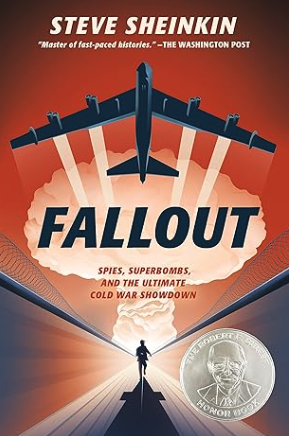
Fallout: Prologue–Part 1
In this follow-up to Bomb, the award-winning author shows how the development of the atomic bomb led to tensions between the United States and the Soviet Union that threatened massive destruction for nearly fifty years after World War II.
Here are links to our lists for the book: Prologue–Part 1, Part 2, Part 3, Epilogue
40 words
35 learners
Learn words with Flashcards and other activities
Definition First

Other learning activities
Full list of words from this list:
-
espionage
the systematic use of spies to obtain secretsWhen Carolyn’s father came home, his wife told him that a red-haired kid named Jimmy Bozart had come by with a hollow nickel and some kind of coded message he’d found inside. Detective Lewind growled at her for letting the kid leave with potentially explosive evidence of espionage.
-
pivotal
being of crucial importanceIt’s the story of the most intense years of the Cold War, building to the single most dangerous moment in human history. But even in such an epic struggle, small details and seemingly ordinary people play pivotal roles, shoving events in one direction or another.
-
novelty
a small inexpensive mass-produced articleHolding the separate sides of the coin in his hands, the salesman explained that he’d never seen anything like it. This was no cheap novelty, nothing mass produced in any factory.
-
socialist
advocating the state ownership of industryCommunists had just taken over the country and would rename it the Union of Soviet Socialist Republics.
-
doctrine
a stated government policyIn what became known as the Truman Doctrine, the president committed the United States to the goal of stopping the further spread of Soviet power.
-
tradecraft
the techniques and skills used in espionageAbel followed Cohen to the zoo, to make sure she wasn’t being tailed. He saw right away he was dealing with someone trained in tradecraft—the tricks and techniques of espionage.
-
virtually
slightly short of or not quite accomplished; all butHe could see why a hydrogen bomb’s power would be virtually unlimited.
-
fission
splitting a massive nucleus with the release of energyScientists realized that if they could break apart an atom’s nucleus, it would release energy as it split, a process they named fission.
-
conventional
conforming with accepted standardsIf they could cause enough atoms to split rapidly enough, they’d have a new kind of bomb, one far more powerful than conventional explosives such as TNT.
-
revere
regard with feelings of respectMany wrestled with regret over having used the laws of physics, which they revered, to devise a weapon of mass destruction.
-
abstract
not representing or imitating external realityFrançoise was used to seeing him lost in thought, his mind wandering through some abstract idea maybe ten people on earth might understand.
-
evasive
deliberately vague or ambiguousThere had been some sort of colossal explosion on a coral island in the South Pacific. The U.S. government was evasive about exactly what had happened, saying only that “the test program included experiments contributing to thermonuclear weapons research.”
-
fawning
attempting to win favor from influential people by flatteryLavrenty Beria, the ruthless head of Stalin’s secret police and the dictator’s most fawning sidekick, fully expected to take the reins.
-
bleak
providing no shelter or sustenanceAll of this was surrounded by a bleak, treeless landscape of mud—while clearly visible in the distance, like a taunt, wealthy mine owners lived in grand houses on leafy lanes.
-
ideal
a principle or value that one hopes to attain or conform toKhrushchev and his allies took turns attacking Beria, accusing him of betraying the ideals of communism.
-
consolidate
make firm or secure; strengthenWhile Nikita Khrushchev consolidated power in Moscow, Rudolf Abel continued to prepare for a more active phase of his mission in America.
-
eccentric
a person with an unusual or odd personalityHe bought paints and brushes and threw himself into the work. Striking up friendships with other artists in the building, Abel became known as an amusing eccentric.
-
hallmark
a distinctive characteristic or attributeLamphere recognized the hallmarks of a message coded by Soviet spies using what’s called a one-time pad.
-
gritty
made up of or resembling a collection of small particlesPale gray flakes started falling from the sky. The sticky clumps coated the ship and the men. It stung their eyes and felt gritty in their mouths.
-
atoll
an island consisting of a coral reef surrounding a lagoonTo the west, about eighty miles, was Bikini Atoll, a group of small coral islands.
-
steppe
an extensive plain without treesThe bomb’s blast wave cut a visible path in the steppe, flattening the tall grass as it sped toward the platform.
-
covert
secret or hiddenWhen they met again, Collins explained to Powers that he worked for the Central Intelligence Agency, a government agency tasked with gathering and interpreting secret information from around the world and running covert operations against enemies of the United States.
-
aerial
existing, living, growing, or operating in the airA career military man, commander of Allied forces in Europe during World War II, he’d seen plenty of aerial reconnaissance photos. But never anything like these U-2 images. The views were so sharp you could identify Soviet planes on the ground, count the tanks and missiles.
-
seedy
shabby and untidyHe checked into a seedy Manhattan hotel under yet another false name.
-
reconnaissance
the act of scouting, especially to gain informationLife in Turkey was, in Barbara’s words, a “marriage of three”—husband, wife, and the strange plane in which Frank conducted what he described as “weather reconnaissance flights.”
-
fuselage
the central body of an airplane holding crew and passengersThe plane tipped into a nosedive. Its long wings sheared off. The fuselage swung nose-up and dropped like a spent rocket.
-
premier
the person who is head of stateThe Soviet premier strode onto the stage. He spoke of economic plans and labor policy, then moved on to international affairs.
-
prone
having a tendency“Such a pirate, prone to dizziness, may in fact drop a hydrogen bomb on foreign soil. And this means that the peoples of the land where this pirate was born will unavoidably and immediately get a more destructive hydrogen bomb in return!”
-
stenographer
someone skilled in the transcription of speechA group of military officers and men in business suits sat with the American prisoner at a long table in the KGB’s Lubyanka prison. An interpreter translated. A stenographer took notes.
-
ordeal
a severe or trying experiencePowers had tossed aside the hollow silver dollar while drifting down to Soviet soil—he was going to survive this ordeal, if possible.
-
bedlam
a state of extreme confusion and disorderMembers of the press shouted questions over the bedlam.
-
adversary
someone who offers oppositionIke defended the U-2 flights as necessary when dealing with a secretive and unpredictable adversary.
-
inevitably
in such a manner as could not be otherwiseThroughout human history, rival powers had built weapons and moved inevitably toward the next war.
-
shambles
a condition of great disorder“Whether started deliberately or accidentally, global war would leave civilization in a shambles,” Eisenhower warned the nation.
-
moor
secure in or as if in a berth or dockLongshoremen were supposed to help moor incoming ships—instead, they shouted curses.
-
caricature
represent a person with comic exaggerationWell, Khrushchev was used to such rudeness. The way American newspapers caricatured his portly build and bald head, portraying him like some stubby supervillain sprung from the pages of one of their ludicrous comic books.
-
portly
fairly largeWell, Khrushchev was used to such rudeness. The way American newspapers caricatured his portly build and bald head, portraying him like some stubby supervillain sprung from the pages of one of their ludicrous comic books.
-
fatigues
military uniform worn by personnel when doing menial laborAt the United Nations, before an audience of world leaders in dark suits, Fidel Castro strode to the front of the room in green army fatigues.
-
chide
scold or reprimand severely or angrilyLaunching into the longest speech in U.N. history, he chided the United States for supporting dictators around the world, just because they sided with America in the Cold War.
-
devise
come up with after a mental effortWith the full knowledge and support of the president, CIA planners and gadget-makers began devising plots to humiliate the Cuban leader.
Created on Tue Sep 03 10:52:40 EDT 2024
(updated Tue Oct 15 16:38:16 EDT 2024)
Sign up now (it’s free!)
Whether you’re a teacher or a learner,
Vocabulary.com can put you or your class
on the path to systematic vocabulary improvement.