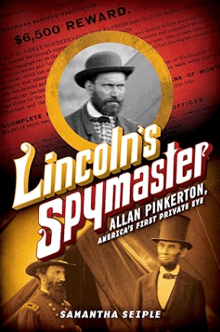
Lincoln's Spymaster: Prologue–Chapter 2
Hunted by Scottish authorities for fighting for workers' rights, Allan Pinkerton fled in 1842 to America, where he enforced the law as a Chicago police officer before founding both a private detective agency and the federal Secret Service.
Here are links to our lists for the book: Prologue–Chapter 2, Chapters 3–6, Chapters 7–9, Chapters 10–12, Chapter 13–Epilogue
40 words
68 learners
Learn words with Flashcards and other activities
Definition First

Other learning activities
Full list of words from this list:
-
secessionist
a person who wants to break free from a larger groupFor the past two and a half weeks, Pinkerton had been working undercover, posing as a secessionist.
-
impending
close in time; about to occurOver the course of the conversation, Pinkerton brought up Lincoln’s impending presidential inauguration.
-
solidarity
a union of interests or purposes among members of a groupTo gain Luckett’s trust and show solidarity to the Southern cause, Pinkerton took out his wallet and gave him a twenty-five-dollar donation—a very generous amount of money for the time.
-
apprehend
understand or perceive the meaning of something“Our plans are fully arranged and they cannot fail. We shall show the North that we fear them not,” said Ferrandini.
“But about the authorities,” Pinkerton asked. “Is there no danger to be apprehended from them?” -
boon
something that is desirable, favorable, or beneficialBut Pinkerton had discovered that there was an abundance of trees, free for the taking. This was a real boon to his barrel-making business, where a hand-painted sign hung over the entrance of his cooperage that read, THE ONLY AND ORIGINAL COOPER OF DUNDEE.
-
deduce
conclude by reasoningHe easily deduced that somebody was up to no good.
-
prevail
be larger in number, quantity, power, status or importanceQueen Victoria and Parliament feared a revolution and considered Glasgow as “one of the places where treasonable practices prevailed to the greatest degree.”
-
tenement
a run-down apartment house barely meeting minimal standardsAllan, who was a serious and quiet child, lived in a run-down two-room tenement with his parents and older brother, Robert.
-
treason
a crime that undermines the offender's governmentTwo years later, the police were hunting him down for being a Chartist, determined to arrest him for treason.
-
treacherous
dangerously unstable and unpredictableIt was a treacherous trip. The ship sank off the coast of Nova Scotia, Canada, and when they rowed their lifeboat to shore, they were robbed.
-
determination
firmness of purposeNearly penniless, there were a few things Pinkerton still had—determination, ambition, and a friend.
-
ethic
the principles of right and wrong for an individual or groupHis reputation quickly grew for his honesty and strong work ethic.
-
detest
dislike intenselyAn outspoken abolitionist, Pinkerton detested slavery.
-
posse
a temporary police forceSoon after, in the dead of night, Pinkerton and the sheriff, along with his posse, raided the island.
-
shirk
avoid one's assigned dutiesThey also had a bad reputation for shirking their duties and drinking on the job. As a result, the police force couldn’t keep up with the widespread crime.
-
corruption
use of a position of trust for dishonest gainTo make matters worse, the police force was controlled by the local politicians. The mayor decided who was hired and fired. Corruption was widespread.
-
uncompromising
not willing to make concessionsDriven by a strong sense of “bare-knuckle” justice, Pinkerton chased after criminals and never backed down—using his fists, if needed, to get the job done. Once Pinkerton zeroed in on a criminal, there was no stopping him; he was uncompromising.
-
hardy
invulnerable to fear or intimidation“The detective should be hardy, tough, and capable of laboring unknown to those about him,” he said. “I shall not give up the fight with criminals until the bitter end.”
-
reproach
disgrace or shame“The profession of the Detective is a high and honorable calling…he is an officer of justice, and must himself be pure and above reproach,” Pinkerton wrote.
-
integrity
moral soundness“The public have a right to expect this from their officers…they have a right to know that their lives and property are to be guarded by persons, male or female, of whose integrity there can be no question.”
-
infiltrate
enter a group or organization in order to spy on the membersPinkerton, who was the first to call his detectives “operatives,” pioneered the technique of going undercover—using a disguise and acting a part—so he could secretly infiltrate situations to gain access to the suspect of the crime without raising suspicion.
-
relentless
not willing or able to stop or yieldA hard-nosed boss, Pinkerton expected all of his detectives to follow his code of ethics and be relentless in their pursuit of criminals.
-
notorious
known widely and usually unfavorably“I hated the Pinkertons as thoroughly as the corrupt police did because of their interference… Nevertheless, I had to acknowledge that they were honest, and it was dangerous for a crook when a Pinkerton was on his trail,” George White, a notorious safecracker, stated.
-
embezzle
appropriate fraudulently to one's own useIn 1860, Pinkerton made headlines in the newspapers for the capture and conviction of an Adams Express railroad employee who’d stolen $40,000, an enormous amount for the time. Pinkerton and his undercover detectives recovered nearly all of the embezzled money.
-
impartial
free from undue bias or preconceived opinionsAll suspicions must be verified by facts. Always be impartial and guard against prejudices. The goal of every investigation is the whole truth.
-
insurgent
a person who takes part in an armed insurrectionThe rebels planned to destroy the railroad lines so Northern troops couldn’t be transported to Washington, D.C., “to wrest the capital from the hands of the insurgents.”
-
conspirator
a member of a plot to carry out some harmful or illegal actPinkerton told Felton that he and his team of operatives would find out if conspirators even existed and if they were really planning to destroy Felton’s railroad line.
-
garner
acquire or deserve by one's efforts or actionsBangs had been a New York City police officer before garnering headlines for Pinkerton’s National Detective Agency when he tracked down and captured the famous French counterfeiter Jules Imbert.
-
alias
a name that has been assumed temporarilyKate Warne, the first-ever woman detective, was assigned to live in Baltimore and pose as a rich Southern lady from Montgomery, Alabama, using the alias Mrs. Barley.
-
prominent
conspicuous in position or importanceShe was to blend in, befriend prominent ladies in society, and find out anything about the conspiracy.
-
instrumental
serving or acting as a means or aidA brilliant conversationalist and a good listener, Warne had been instrumental in helping Pinkerton recover the $40,000 for the Adams Express Company, and she had recently been promoted to manage Pinkerton’s newly created Female Detective Department.
-
shrewd
good at tricking people to get somethingHe was not only good with a gun but also a shrewd and daring spy.
-
derive
obtain“He had a thorough knowledge of the South, its localities, prejudices, customs, and leading men, which had been derived from several years’ residence in New Orleans and other Southern cities, and was gifted with the power of adaptation,” said Pinkerton.
-
sentiment
a personal belief or judgment“There every night as I mingled among them, I could hear the most outrageous sentiments enunciated,” said Pinkerton.
-
provocation
unfriendly behavior that causes anger or resentmentThose Bullies were all armed and would not hesitate on the slightest provocation to use these arms to shoot down a Union man.
-
distinguished
standing above others in character or attainmentI am informed that a son of a distinguished citizen of Maryland said that he had taken an oath with others to assassinate Mr. Lincoln before he gets to Washington, and they may attempt to do it while he is passing over our road.
-
inevitably
in such a manner as could not be otherwiseHe knew that “coolness, courage and skill could save the life of Mr. Lincoln, and prevent the revolution which would inevitably follow his violent death.”
-
confidential
given in secret“We have taken a solemn oath, which is to obey the orders of our captain, without asking questions, and in no case, or under any circumstances reveal any orders received by us, or entrusted to us, or anything that is confidential,” said Hillard.
-
broach
bring up a topic for discussionHe met with Hillard that day, and very carefully, he broached the idea of joining the Palmetto Guards.
-
diversion
an attack that draws an enemy's attention awayWhen Lincoln got off the train, several secessionists would create a diversion by getting into a large fight outside the depot. This would divert attention away from Lincoln, and the police would abandon him to go break up the fight.
Created on Thu Jul 04 09:23:35 EDT 2024
(updated Fri Jul 05 10:42:21 EDT 2024)
Sign up now (it’s free!)
Whether you’re a teacher or a learner,
Vocabulary.com can put you or your class
on the path to systematic vocabulary improvement.