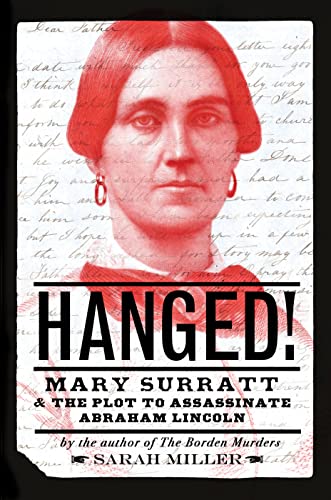
Hanged!: Chapter 23–Epilogue
This nonfiction narrative highlights the controversies surrounding the court-martial and hanging of boardinghouse owner Mary Surratt, who was convicted for being a part of the treasonous post-Civil War conspiracy to assassinate key members of the victorious government led by President Abraham Lincoln.
Here are links to our lists for the book: Chapters 1–5, Chapters 6–10, Chapters 11–15, Chapters 16–22, Chapter 23–Epilogue
40 words
70 learners
Learn words with Flashcards and other activities
Definition First

Other learning activities
Full list of words from this list:
-
overarching
including, affecting, or dominating everythingThe murder of Abraham Lincoln had not been mentioned until the close of the argument. Nor had Mary Surratt figured into it. Reverdy Johnson’s argument was so overarching, it might have been applied interchangeably to any one of the prisoners in the dock.
-
sequester
set apart from othersWhen court reconvened the next day, Mary Surratt did not return to her chair at the end of the prisoners dock, but remained sequestered in the semi-privacy of the side room.
-
duplicity
the act of deceiving or acting in bad faithSo much of the incriminating information against Mary came from Louis Weichmann and John Lloyd, Aiken said, that their testimony must be rigorously dissected in order that “error and duplicity may be exposed, and innocence protected.”
-
maudlin
very sentimental or emotionalWhy on earth was the court willing to take the word of a drunk who had tangled himself in the plot by hiding John Surratt’s rifles, then denied any and all knowledge for two days before implicating Mary Surratt while in a condition of “maudlin terror”?
-
summarily
quickly and without following customary proceduresSamuel Arnold, Samuel Mudd, and Michael O’Laughlen were also summarily convicted and sentenced to life imprisonment for their secondary roles in the conspiracy.
-
clemency
leniency and compassion shown toward offendersDeliberations stretched from Thursday into Friday, when Judge Advocate General Holt suggested a compromise: sentence Mary Surratt to death, but also submit a clemency plea to President Johnson.
-
commute
exchange a penalty for a less severe oneThis document would formally petition the president to commute Mary’s punishment to life imprisonment, thus shifting the burden of responsibility for her fate from their shoulders to Johnson’s.
-
portent
a sign of something about to happen“She had faith…that it was impossible for a Court to find her guilty of what she was guiltless of. To hear herself condemned to be hung from a gallows must have been to her like listening to some horrible strange portent conveyed in an unknown tongue. The sound of it clanged against her brain; the vague terror of it bruised her heart.”
-
inundate
overwhelm or fill quickly beyond capacityMary’s neighbors sat in their windows and doorways, watching as hundreds of people wandered past. For weeks the neighborhood had been inundated with curiosity seekers and their eager questions.
-
gibbet
an instrument of public execution“The intellectual resources and will that has sustained this dark and sinister woman throughout this session of the court of inquisition completely forsook her when hope vanished and the gibbet from which she was to swing was already reared scarce fifty paces from the portals of her cells.”
-
reprieve
a warrant granting postponementIf the president miraculously issued a reprieve or pardon at the last instant, the news would be relayed at a gallop.
-
solicitude
a feeling of excessive concern“He expresses the deepest regret that Mrs. Surratt is to be a sufferer by reason of any act of his, and evinces a solicitude for her not unlike that of a tender child for its parent.”
-
upbraid
express criticism towardsHe never ceased to upbraid himself for seeking the shelter of her home, as in that lay the misfortune of her doom.
-
debilitate
make weak“Mrs. Surratt was lying full length upon her mattress, clothed in some white undress garment, looking very pale and debilitated,” the New York Herald wrote.
-
mawkish
very sentimental or emotional“A mawkish sort of sympathy seems to be expressed in some quarters for Mrs. Surratt, on account of her sex,” the Philadelphia Inquirer marveled, “but the same sort of people, I dare say, would sympathize with Satan himself, if there was any possibility of bringing him to justice.”
-
emanate
proceed or issue forth, as from a sourceTen minutes later, the remaining relatives and friends of the condemned were ordered to say their goodbyes. “The sounds of grief which emanated therefrom were so loud as to be distinctly heard outside.”
-
cordon
a series of sentinels or posts enclosing some place or thingAn officer summoned the reporters and led them out to the yard, where they would be permitted to stand just outside the cordon of soldiers.
-
intermittent
stopping and starting at irregular intervalsOnly the sight of the crucifix, which she kissed “fervently, several times,” had the power to quiet the intermittent wails that welled up within her.
-
unbecoming
not in keeping with accepted standards of what is proper“Gentlemen,” he called out over the crowd, “the prisoner Lewis Thornton Powell, known as Payne, requests me, on this occasion, to say for him that he thus publicly and sincerely thanks General Hartranft and all the other officers and soldiers who have had charge of him, and all who have ministered to his wants, for their unvarying kindness and attention to him. Not an unkind word was ever spoken, not an unbecoming gesture has ever been made toward him.”
-
reprimand
censure severely or angrilyThough the corporal was soundly reprimanded for his disrespect, discipline remained shaky.
-
derision
the act of treating with contempt“When Mrs. Surratt was being taken down, as the rope was cut, her head of course fell over upon her breast, and an individual standing by made the heartless remark, ‘She makes a good bow.’” As if it had all been nothing but a performance.
This was precisely the kind of derision Captain Rath had hoped to avoid. -
litany
any long and tedious address or recitalDuring the course of their conversation, a troubled Weichmann confessed a litany of undisclosed information so important that Brophy wrote it all down and submitted it in an affidavit to the War Department.
-
clandestine
conducted with or marked by hidden aims or methodsBrophy swore Weichmann had told him that Mary “wept bitterly and constantly” over her son’s clandestine missions to the Confederate capital, “and that she begged and implored [John] not to go to Richmond, but to stop at home, and not bring trouble upon himself and upon the family.”
-
licentious
lacking moral disciplineWhen Louis asked what she meant, Mary replied “that after sunshine there was always a storm, and that the people were too proud and licentious, and that God would punish them.”
-
condescend
do something that one considers to be below one's dignity“Now, will Mr. Weichmann condescend to tell us where, in the wide world, he found, since the 16th of April, enough of EXTRA charges against Mrs. Surratt to fill a whole column of very fine print!”
-
pretext
a fictitious reason that conceals the real reasonThe notion that his coworkers were “seeking to overthrow me” because they disagreed with his political views was only a pretext, he told Holt.
-
disdain
lack of respect accompanied by a feeling of intense dislikeThe real cause of their disdain, Weichmann was sure, was “because I was a witness against the assassins of Abraham Lincoln, and especially against the woman Surratt whom copperheads and traitors revere as a martyr.”
-
ex parte
(law) on behalf of or involving only one partyIn 1866, the United States Supreme Court had ruled in Ex parte Milligan that subjecting civilians to military tribunals while civil courts are in operation is unconstitutional.
-
deliberation
(usually plural) discussion of all sides of a questionJustice Davis included a silent nod to Mary Surratt and her co-defendants, acknowledging that “during the late wicked Rebellion, the temper of the times did not allow that calmness in deliberation and discussion so necessary to a correct conclusion of a purely judicial question.”
-
pernicious
exceedingly harmfulNothing had “more pernicious consequences” than the idea that the Constitution’s protection does not apply during a crisis or emergency.
-
vindicate
maintain, uphold, or defendWhere John Lloyd had sought to diminish his role in the verdict against Mary Surratt, Weichmann seemed intent on vindicating his prior testimony against her. Everything he had testified to in 1865, he repeated—and more.
-
culpable
deserving blame or censure as being wrong or injuriousWith every fresh revelation, Mary Surratt appeared more culpable. Which raises the question of whether Weichmann had been holding back information in hopes of protecting his landlady or had invented it to protect himself.
-
docket
the calendar of a courtJudge Fisher dismissed the first treason charge. He had no choice. By the time the indictments finally reached his docket in the summer of 1868, over three years had passed since the president had been assassinated, and District of Columbia law carried a two-year statute of limitations on every crime except fraud and murder.
-
unequivocal
admitting of no doubt or misunderstandingShortly thereafter, “an unequivocal denial” from the president appeared in the papers, disavowing himself of any knowledge of the clemency petition.
-
calumny
a false accusation of an offense“A more groundless calumny was never conceived or proclaimed against any public officer,” Holt fumed.
Efforts to exonerate himself from this mortifying charge would consume General Holt for the rest of his life. -
ingratiate
gain favor with somebody by deliberate effortsIn 1901, Oldroyd published The Assassination of Abraham Lincoln. Yet again, Weichmann had ingratiated himself with the author and succeeded in ghostwriting chapter 9 of Oldroyd’s history.
-
disparage
express a negative opinion of“Probably no one has suffered more persecution and misrepresentation because of his testimony and his duty to the Government at the trial of the conspirators than has Mr. Weichmann. It has been almost continuous, and has been done for the purpose of striking him down and disparaging him before the country, so that the people who were in sympathy with the conspirators could claim that the Commission was wrong in its verdict of 1865.”
-
exhume
dig up for reburial or for medical investigationNearly four years passed before Andrew Johnson saw fit to honor Anna’s request to claim her mother’s body. In early February 1869, she finally received permission to exhume Mary’s remains from the arsenal yard.
-
regale
occupy in an agreeable, entertaining or pleasant fashionIn 1870, John Surratt embarked on a lecture tour to regale audiences with his thrilling adventures.
-
chasten
correct by punishment or disciplineAfter paying a $1,500 bail, he discovered that even Richmond, the former capital of the Confederacy, had no taste for his “brazen-faced impudence,” and a chastened John permanently retreated from public life.
Created on Tue Jul 02 11:09:24 EDT 2024
(updated Wed Jul 03 19:29:33 EDT 2024)
Sign up now (it’s free!)
Whether you’re a teacher or a learner,
Vocabulary.com can put you or your class
on the path to systematic vocabulary improvement.