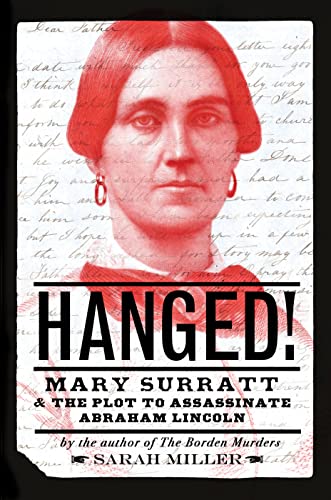
Hanged!: Chapters 16–22
This nonfiction narrative highlights the controversies surrounding the court-martial and hanging of boardinghouse owner Mary Surratt, who was convicted for being a part of the treasonous post-Civil War conspiracy to assassinate key members of the victorious government led by President Abraham Lincoln.
Here are links to our lists for the book: Chapters 1–5, Chapters 6–10, Chapters 11–15, Chapters 16–22, Chapter 23–Epilogue
40 words
28 learners
Learn words with Flashcards and other activities
Definition First

Other learning activities
Full list of words from this list:
-
prevailing
most frequent or common“No, sir: she did not ask even for what she was arrested; expressed no surprise and no feeling at all,” the major said, reinforcing the prevailing notion that an innocent woman ought to have been simultaneously confused, shocked, and horrified.
-
awry
away from the correct or expected courseWith that question gone awry, Mary endeavored to make the court aware that the last thing she had done before being escorted from her home in police custody was to kneel down to pray.
-
piety
righteousness by virtue of being religiously devout“She knelt down,” Wermerskirch answered slyly. “Whether she prayed or not, I cannot tell.”
Sniggers rippled through the court. The captain might as well have stabbed Mary Surratt, such was the effect of his casting doubt upon her piety in public. -
corroborate
support with evidence or authority or make more certainThe officers’ stories were not ironclad, however. Nor did they fully corroborate one another. Both Morgan and Smith claimed to have been the one who questioned Powell in Mary Surratt’s entryway, for instance.
-
disavowal
denial of any connection with or knowledge ofEven the two men who had testified to Mary Surratt’s disavowal of Powell did not fully agree on the particulars.
-
ineffable
defying expression or description“We read in unmistakable letters upon her still features the record of some ineffable woe,” the Washington Chronicle reported on Tuesday, May 23. “It is not fear, not the excitement of a mighty doubt, but withering, blasting woe.”
-
bleak
offering little or no hopeThe bleak prison regime, combined with the dread of what lay ahead, formed a mental burden at least as heavy as the iron balls chained to Powell and Atzerodt.
-
blanch
turn pale, as if in fearMary blanched white at the insult, and an indignant Mrs. Swisshelm burst out, “She does not look like a devil! She looks like a good, kind-hearted woman, and you are a mean coward for insulting a prisoner.”
-
vitriol
abusive or venomous language to express blame or censureThe same open vitriol permeated the newspapers.
-
tacitly
by unexpressed agreementThe press plainly betrayed its opinions in their headlines, tacitly encouraging the public to do the same.
-
abject
of the most contemptible kindWith his “dingy and sallow” complexion and pathetically small tufts of beard, the boyish David Herold struck the Boston Daily Advertiser as having “no sense of mental or moral force, and has every appearance of abject cowardice.”
-
sallow
unhealthy lookingGeorge Atzerodt had the misfortune to be born with the low brow, short neck, “sallow complexion,” and “dull, dark” eyes that consigned a man to a life of constant mistrust.
-
swarthy
naturally having skin of a dark colorThe New York Times informed its readers that Mary was “a large, Amazonian class of woman, square built, masculine hands, rather full face, dark gray, lifeless eye, hair not decidedly dark, complexion swarthy; altogether, her face denotes more than usual intelligence.”
-
inception
an event that is a beginning“Mrs. Surratt appears to have been cognizant of the intended crime almost from its inception,” the New York Times announced, “and became an active participant in overt acts.”
-
concise
expressing much in few wordsIn the Boston Daily Advertiser’s estimation, the concise daily summaries the public relied upon were not “complete or always trustworthy.”
-
circumstantial
suggesting that something is true without proving itEven the Associated Press was guilty of “unintentionally slurring over the most important facts” and “omitting…indispensable links in the grand chain of circumstantial evidence.”
-
perusal
the act of examining or reading carefully“But the perusal of testimony at best is not like hearing it,” the Boston Daily Advertiser would observe, “and when one loses the hesitations, the emphasis, the gestures of the witness, and has to judge of his credibility by what he says without the aid of knowing how he says it, the process of following the course of the trial becomes much like groping in the dark.”
-
phalanx
any closely ranked crowd of peopleAiken and Clampitt aimed to open their defense of Mary Surratt as strongly as Holt had begun his case against her, with a phalanx of witnesses no one would dare to doubt.
-
estimable
deserving of honor and respectFather Boyle, too, knew her by reputation as “an estimable lady” but could neither prove nor disprove her loyalty, for such matters had never entered into their brief conversations.
-
incremental
increasing gradually by regular degrees or additionsShe, too, seemed disengaged from the trial, despite a few incremental improvements in her case.
-
dovetail
fit together tightly or easily“No, sir. She gave me a letter to give to Mr. Nothe [sic].”
Again, this testimony dovetailed with Louis Weichmann’s information regarding Mary’s trip to Surrattsville: “She said, when she rapped at my room on that afternoon, that she had received a letter from [George] Calvert with regard to this money that was due her by Mr. Nothe [sic].” -
bluster
act in an arrogant, overly self-assured, or conceited manner“No business?” he blustered. “As my witness, had I not a right to have the truth from you?”
-
disclose
make known to the public information previously kept secretIn “the most striking and extraordinary event of the proceedings,” Frederick Aiken had been tricked into disclosing testimony that directly harmed his client.
-
throng
a large gathering of peopleThe usual throng of women was crowded around Mary that afternoon, too, making it nearly impossible for Anna to glimpse her.
-
haughty
having or showing arrogant superiorityAt first Anna’s testimony “was quite haughty and had an air of insulted dignity.”
-
delicacy
subtly skillful handling of a situationFor the first time the prosecution did not object incessantly, treating Anna with “marked consideration and delicacy…allowing her to tell her story in her own way.”
-
animus
a feeling of ill will arousing active hostilityAnna’s contempt for the very name of “Weichmann” reared up. “Yes, sir; I have seen him and heard of him,” she said in a tone that made the Philadelphia Inquirer note that “her animus was unmistakable.”
-
paroxysm
a sudden uncontrollable attackMary’s emotions bent her double. Covering her face with her hands, she lowered her head to the rail and “wept like a child,” loudly enough for more than one reporter to hear. Outside the courtroom, Anna, too, “burst into a violent paroxysm of grief.”
-
nonplussed
filled with bewilderment“I was nonplussed,” Rath remembered, “for, though I had fought in twenty battles, had heard the shot and shell, and had faced death a score of times, I had never seen anyone faint.”
-
imbue
give qualities or abilities to; endowMoments like these imbued Rath with a certain respect and sympathy for his sole female prisoner.
-
pestilential
likely to spread and cause an epidemic diseaseTo make matters worse, they also hailed from southern Maryland, “a noxious and pestilential place for patriotism,” which left them vulnerable to the ticklish question of loyalty to the Union.
-
bolster
support and strengthenBy the second week in June, Mary’s case, feeble from the start, was eroding. No evidence worse than what had already been heard would enter into the record. Nor would any significantly helpful testimony bolster her case.
-
prostrate
render helpless or defenselessBut now even those without medical training could see that she was beginning to look as shaky as her case. When she entered the courtroom, she leaned heavily on the arm of her attendant, “apparently almost prostrated,” reported the Washington Evening Star.
-
fare
the food and drink regularly served or consumedWhen prompted, Mr. Hawkins described how Mary had always given the soldiers the best fare her pantry could provide. To his knowledge, she had never been paid for any of that food, either.
-
opprobrious
expressing offensive reproach“Like a herd of deer gathering around a wounded companion to gore it to death in its disabled state, some of these people feast their eyes…and unfeelingly heap upon the prisoner’s head and heart, the fiercest denunciation and most opprobrious terms!” Many journalists had described the crush of gawkers around Mary, but few had acknowledged the people’s cruelty, much less openly shamed them for it.
-
malign
speak unfavorably aboutBut worse yet was the press, Mary’s defender emphasized, which “has hunted and maligned this unfortunate woman with the unrelenting ferocity of the sleuth-hound and the venom of asps. Prejudged, condemned, sentenced in advance by every scribbler who can pen a sensation paragraph and stab a defenseless female with impunity.”
-
forbearance
good-natured tolerance of delay or incompetence“What has she to ask of her fellow-citizens and fellow-Christians?” the author demanded. Just three simple things: “Charity, forbearance, suspension of judgement.”
-
injudicious
lacking or showing lack of judgment or discretion; unwiseThe press took offense, as might have been expected after such a tirade. The Washington Evening Star branded it “An Injudicious Publication,” predicting that with its florid style and dramatic fervor it “cannot fail of working a contrary effect on the public mind to that intended by the writer.”
-
florid
elaborately or excessively ornamentedThe Washington Evening Star branded it “An Injudicious Publication,” predicting that with its florid style and dramatic fervor it “cannot fail of working a contrary effect on the public mind to that intended by the writer.” The Bath Daily Times and Sentinel remarked that “certain parties are trying to make it out that Mrs. Surratt is a model of Christian excellence. Few will believe it.”
-
diatribe
thunderous verbal attackWhat effect Amator Justitiae’s diatribe ultimately had on public opinion, the press did not deign to mention.
Created on Tue Jul 02 11:09:13 EDT 2024
(updated Wed Jul 03 19:29:11 EDT 2024)
Sign up now (it’s free!)
Whether you’re a teacher or a learner,
Vocabulary.com can put you or your class
on the path to systematic vocabulary improvement.