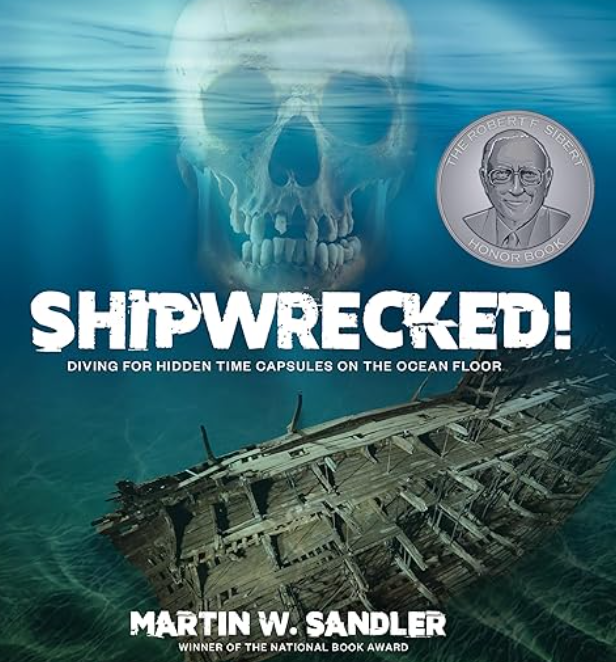
Shipwrecked!: Introduction–Chapter One
The award-winning historian traces how marine archaeology has been developing since 1900 to explore ships on the ocean floor and recover clues for understanding ancient civilizations.
Here are links to our lists for the book: Introduction–Chapter One, Chapter Two, Chapter Three, Chapters Four–Five, Chapter Six–"For Further Exploration"
40 words
161 learners
Learn words with Flashcards and other activities
Definition First

Other learning activities
Full list of words from this list:
-
expanse
a wide and open space or area, as of land, sea, or sky“Before there were farmers or shepherds,” wrote George Bass, the world’s first marine archaeologist, “there were seafarers. Before people could make pottery or work metals, before they even lived in houses, they could cross expanses of open water.”
-
endeavor
a purposeful or industrious undertakingAt the same time, seafaring is one of the most dangerous endeavors. Some three million shipwrecks lie on the ocean floor, and along with them, much of human history hides beneath the waves.
-
relic
an antiquity that has survived from the distant pastOn the ocean floor, relics of civilizations that have long since disappeared lie, awaiting discovery.
-
pristine
immaculately clean and unusedUnlike land sites, where the invaluable evidence of past cultures and people are often covered over or mingled with the relics of succeeding eras, an ancient shipwreck is a pristine historic time capsule.
-
inaccessible
capable of being reached with great difficulty or not at allNot that long ago, most fascinating wrecks lay beyond our reach. But amazing advances in underwater discovery and excavation technology have made the finding and recovery of even the most seemingly inaccessible wrecks more possible than previously thought.
-
plunder
steal goods; take as spoilsAt the heart of this book is another vital saga of its own, the story of how shipwreck excavations advanced from the “seek and grab” plunder techniques of the earliest salvagers to the precise and orderly science-driven excavations, leading to greater underwater discoveries and the emergence of one of the newest, most dynamic, and most rewarding of all the sciences—marine archaeology.
-
industry
the people engaged in a kind of commercial enterpriseDivers harvesting sponges on the ocean floor using only a hollow reed to breathe through remained a prime industry on the Greek islands.
-
grueling
characterized by effort to the point of exhaustionSo successful, in fact, that after six months of grueling and dangerous work, the decks of two vessels were so filled with drying sponges that there was little room left to move about.
-
shoal
a sandbank in a stretch of water that is visible at low tideThis was one of the main shipping routes between the eastern and western Mediterranean, and it was also an extremely dangerous body of water, filled with shoals, sandbars, and suddenly shifting currents.
-
barren
providing no shelter or sustenanceDriven off course, the captain sought shelter next to a rocky, barren, almost totally uninhabited small island that in ancient times had been called both Aeigilia and Cerigotto, but which now was called Antikythera.
-
treacherous
dangerously unstable and unpredictableDespite the storm and the treacherous waters, Kontos, a skilled mariner, managed to guide his two boats to shelter in Antikythera’s only harbor, a small cove on its northern coast called Potamos.
-
hoard
a secret store of valuables or moneyAs he glanced briefly at the magnificently crafted statues of gods, kings, and warriors and colored-glass bowls and cups, Kontos had no way of knowing he was gazing upon the largest hoard of Greek treasure that had ever been found.
-
expedition
a journey organized for a particular purposeIt was customary for those who completed a profitable sponge-diving expedition to spend weeks, even months, celebrating their success.
-
concerted
involving the joint activity of two or moreThe Greek government had made a public announcement calling for a concerted effort to locate and retrieve the artifacts of the ancient world so that they could be put on display.
-
disposal
the power to use something or someoneThe government placed a Greek Navy ship at their disposal along with all the equipment needed to haul heavy objects such as statues from the seabed.
-
primitive
belonging to an early stage of technical developmentBecause the wreck was located so far down on the ocean floor and because the diving equipment of the day was still so primitive, they could dive down only twice a day and remain on the bottom for no more than five minutes.
-
cumbersome
difficult to handle or use, especially because of size or weightAdded to their difficulties was the fact that it became immediately obvious that the Mykali was far too large for their purpose. As powerful as the cumbersome vessel was, it was not the easiest ship to steer, which made it dangerous to operate in such a windy site so close to shore.
-
schooner
sailing vessel used in former timesOn November 27, the Mykali returned to its homeport near Athens and was replaced by the smaller, more maneuverable steam schooner Syros, which hurried to the wreck site in time for the divers to resume work on December 4, 1900.
-
determine
establish after a calculation, investigation, or experimentDespite the fact that the winds never stopped blowing and the seas kept continuously churning, the earliest dives yielded rich rewards, including two small marble statues, an exquisite bronze head (thought at first to be that of a boxer but later determined to be that of a philosopher), and fragment after fragment of bronze marble statues.
-
curator
the custodian of a collection, as a museum or libraryCurators at the National Archaeological Museum of Athens, where all the recovered items were taken, were also captivated by the many delicate objects that Kontos and his men were able to salvage intact.
-
antiquity
an artifact surviving from the pastNo wonder that Angeliki Simosi, the director of the Hellenic Ephorate of Underwater Antiquities, exclaimed, “The ship that sank at Antikythera was not merely a cargo ship. It was essentially a floating museum.”
-
chasm
a deep opening in the earth's surfaceWhen it was completed, the ends of the ropes that surrounded a boulder were then attached to the Mykali, which, using its full power, steamed so that once in open waters, the ropes attached to the boulder could be cut away and the boulder allowed to descend harmlessly into one of the several deepwater chasms.
-
capsize
overturn accidentallyIf the ropes snapped while the Mykali was steaming out to sea, the shock might capsize the vessel, sturdy as it was.
-
commission
charge with a taskAmong the Greek officials who gathered at the wreck site to observe the progress was Minister Spyridon Stais, the man who commissioned Kontos and his crew to conduct the excavation.
-
elicit
call forth, as an emotion, feeling, or responseOne can also only imagine the feelings elicited by the realization that several other priceless statues had been deliberately sent to a watery grave.
-
enterprise
a purposeful or industrious undertakingOne diver died from the bends, two others had become permanently disabled, and the rest involved in the grueling enterprise were exhausted.
-
prelude
something that introduces what followsIt had been an extraordinary endeavor, beginning with the discovery of the oldest shipwreck ever found and evolving into the first deliberate excavation of a shipwreck, work that was the prelude to what would become a brand-new science known as marine archaeology.
-
archaeology
the branch of anthropology that studies prehistoric peopleUnlike what would become the very essence of marine archaeology, none of the archaeologists at Antikythera dove down themselves to the wreck to survey the scene firsthand or record the exact location of the ship, its artifacts, and the possible locations of other buried objects.
-
haphazard
marked by great carelessnessIt was perhaps the haphazard approach to cataloging that allowed one of the most impressive artifacts to sit unnoticed—first in an open courtyard and then in a remote corner of the museum.
-
sophistication
being advanced or expert in some technical subjectBy 2008, these researchers had collectively identified the purpose of the device, succeeded in translating 95 percent of the ancient inscriptions upon it, and had built a replica of the mechanism so advanced that no other device of comparable technological sophistication would appear anywhere in the world for at least another one thousand years after it was created.
-
casual
hasty and without attention to detail; not thoroughBut there is one thing archaeologists, scientists, historians, and even casual observers agree on: the astonishing gearwork is far more technologically sophisticated than anyone had expected from an artifact of this time.
-
ambitious
requiring full use of your abilities or resourcesThen, in 2014, a much more ambitious expedition headed by Brendan Foley of the Woods Hole Oceanographic Institution and director Angeliki Simosi was armed with the most advanced underwater discovery equipment yet developed, including a new diving suit that allowed them to dive to unprecedented depths and to stay on the ocean floor for longer than had been once imagined.
-
residue
matter that remains after something has been removedBeginning with the 2014 expedition, DNA began to play an important role in understanding the origins of artifacts other than human remains. In the ceramics discovered, residues preserved within them for thousands of years held DNA.
-
prohibitive
tending to discourage, especially of pricesReluctantly, Foley, Simosi, and their teams concluded that the cost of extracting these statues would be prohibitive.
-
humble
low or inferior in station or qualityMany of the world’s first shipwreck discoveries were made by people who practiced one of the oldest of all professions—sponge diving. As humble a product as it was, sponges were extremely important to those who bought them and profitable to those who harvested them. This was because of the wide variety of their uses.
-
synthetic
not of natural origin; prepared or made artificiallyThen in the 1980s, most of the sponges in parts of the Mediterranean and the Aegean Sea became infected with pollution. The final blow came with the development of synthetic sponges.
-
excavation
the site of an archeological explorationThe excavations of the Antikythera shipwreck, in 1900, marked the beginnings of underwater excavations carried out in what is regarded as a technologically primitive manner. Ironically, the 2014 excavations that took place in a return to the site introduced the world to one of the most sophisticated pieces of underwater exploration and recovery equipment ever developed.
-
inspire
supply the idea forThe Exosuit—inspired by the space suit but with hard casing—allows divers to descend one thousand feet and to remain under the sea for up to fifty hours.
-
configuration
an arrangement of parts or elementsMade of aluminum alloy, and, depending on its configuration, weighing between five hundred and six hundred pounds, the Exosuit is pressurized in such a manner that a wearer does not have to go through the long process of decompression when returning to the surface.
-
practical
having or put to an actual purpose or useBecause that’s an area too deep for scuba diving and not deep enough to justify the expense of using a submersible, the Exosuit presents the first practical solution to exploring in many of the ocean’s least-studied places.
Created on Thu May 23 09:49:52 EDT 2024
(updated Fri May 24 08:58:28 EDT 2024)
Sign up now (it’s free!)
Whether you’re a teacher or a learner,
Vocabulary.com can put you or your class
on the path to systematic vocabulary improvement.