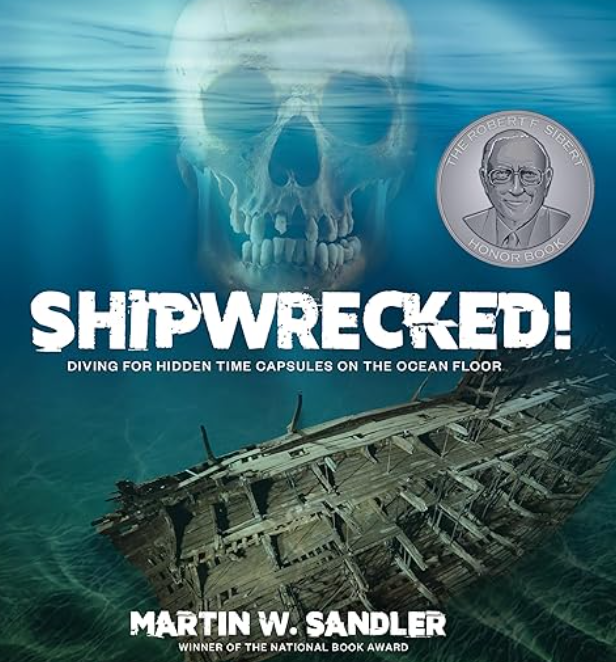
Shipwrecked!: Chapter Six–"For Further Exploration"
The award-winning historian traces how marine archaeology has been developing since 1900 to explore ships on the ocean floor and recover clues for understanding ancient civilizations.
Here are links to our lists for the book: Introduction–Chapter One, Chapter Two, Chapter Three, Chapters Four–Five, Chapter Six–"For Further Exploration"
40 words
18 learners
Learn words with Flashcards and other activities
Definition First

Other learning activities
Full list of words from this list:
-
porthole
a window in a ship or airplaneIt also had two watertight hatches for entering and leaving the vessel, one at the front and another at the rear, and two short conning towers equipped with small portholes.
-
affix
attach toInstead, a twenty-two-foot pole was affixed to the submarine’s bow. At the end of the pole sailors affixed a copper cylinder containing 135 pounds of black powder designed to explode on contact as it was pushed against the hull of a ship at close range.
-
privateer
a ship commissioned to prey on other shipsThere, Horace Hunley and his partners intended to operate the submarine as a privateer, helping the Confederacy break the blockade the North had placed on Southern ports.
-
moor
secure with cables or ropesOn August 29, 1863, while the Hunley was moored to a steamship prior to making a test dive, Payne accidentally stepped on the device that controlled the ship’s diving mechanism, causing the Hunley to dive beneath the surface with her hatches still open.
-
sloop
a sailing vessel with a single mastOn the clear, cold, moonlit night of February 17, 1864, John Crosby, the officer of the deck aboard the Union’s mightiest sloop of war, the USS Housatonic, stood gazing across the waters of Charleston Harbor.
-
reminiscent
serving to bring to mindOn August 8, 2000, in a scene reminiscent of what had taken place when the Mary Rose had been raised, church bells rang, cannons boomed, and vessels large and small sounded their horns and rang their bells.
-
painstakingly
in a very careful mannerEver since the Hunley was placed in this tank, researchers and scientists have been painstakingly cleaning a century-and-a-half of sand, sediment, corrosion, and encrustation from the world’s first successful combat submarine.
-
prospect
the possibility of future successBut the prospect of solving the mystery of what happened to the Hunley and its crew drives the restorers on.
-
relentless
never-ceasingThe relentless cleaning of the vessel uncovered, hidden beneath the layers of concretion, a water tube that ran the length of the forty-foot sub.
-
speculation
a hypothesis that has been formed by conjecturingArchaeologists, historians, scientists, and other scholars have never lacked speculations as to why the Hunley met its fate.
-
garner
acquire or deserve by one's efforts or actionsIn what has garnered a great deal of publicity, Lance and her fellow Duke researchers have come up with what they are convinced is the most plausible explanation of what happened to the crew of the Hunley.
-
plausible
apparently reasonable, valid, or truthfulIn what has garnered a great deal of publicity, Lance and her fellow Duke researchers have come up with what they are convinced is the most plausible explanation of what happened to the crew of the Hunley.
-
demise
the event of departure from lifePerhaps we will never know the cause for the demise of the submarine and its crew.
-
articulate
put into words or an expressionCussler articulated a simple explanation of what motivated him. “I have never made claim to being an archaeologist,” he stated. “I’m purely an [adventurer] who loves the challenge of solving a mystery; and there is no greater mystery than a lost shipwreck.”
-
distinction
high status importance owing to marked superiorityThe Hunley was the first submarine to sink an enemy ship, but it was not the first sub to be used in wartime, nor was it the first to attack an enemy vessel. That distinction belongs to an American Revolutionary War submersible craft named the Turtle (also called American Turtle).
-
accommodate
have room for; hold without crowdingConvinced that the best way to deliver his mines during wartime would be by submarine, he constructed a hand-powered, wooden, underwater vessel large enough to accommodate one operator.
-
stealthily
in a manner marked by quiet and caution and secrecyA Colonial soldier named Ezra Lee was chosen to operate the sub and carry out the attack, which called for him to stealthily make his way up to the Eagle and attach a time bomb to its hull.
-
inglorious
deserving or bringing disgrace or shameDuring the next week the Turtle made several more attempts to sink British ships, but none were successful. Two months later, it met an inglorious end when, during the Battle of Fort Lee, the American ship that was transporting it was sunk by the British.
-
coveted
greatly desiredFinding the Passage, they knew, would save hundreds of millions of pounds and countless lives by enabling British merchants to trade directly with East Asia, with its coveted spices and other riches, rather than taking the long, dangerous water route around Asia.
-
grail
the object of any prolonged search or endeavorGreat Britain’s desire to find what became known as the “Arctic Grail,” became so intense that between 1818 and 1850 dozens of Passage-seeking expeditions were sent into the frozen North.
-
floe
a flat mass of ice drifting at seaIt had first come to national attention in 1836 when, despite being battered about by ice floes for almost a year, it had enabled explorer George Back to complete one of the most harrowing of all Arctic searches for the Northwest Passage.
-
harrowing
causing extreme distressIt had first come to national attention in 1836 when, despite being battered about by ice floes for almost a year, it had enabled explorer George Back to complete one of the most harrowing of all Arctic searches for the Northwest Passage.
-
succumb
give in, as to overwhelming force, influence, or pressureIn order to keep Franklin’s officers and men from succumbing to boredom during their long winter months in the ice, the Erebus and the Terror each had libraries containing some three thousand books.
-
instigate
serve as the inciting cause ofLady Jane Franklin, Franklin’s wealthy and determined wife, instigated and even financed several of the searches.
-
synthesize
combine so as to form a more complex productParks Canada is also taking advantage of another technological development called stereophotogrammetry, which produces pictures in pairs and then synthesizes hundreds of these pairings to produce extraordinarily clear images of whatever object is being studied.
-
anthropologist
a social scientist specializing in the study of humanityFor historians, anthropologists, and marine archaeologists, the most important use of side-scan sonar is in the location and excavation of shipwrecks.
-
indispensable
essentialIt was also in 1967 that side-scan sonar proved indispensable in helping George Bass find what was then the world’s oldest shipwreck off the coast of Uluburun, Turkey.
-
acclaim
enthusiastic approvalBut despite the attention Robert McClure, his men, and their ship received, they never got the acclaim they would have if their nation’s attention had not been so completely focused on the various searches for Franklin.
-
magnitude
relative importanceNo one understood the magnitude of the accomplishment more than George Bass. What has been assembled, he proclaimed, “is by far the greatest collection of Islamic glass in the world.”
-
striking
having a quality that thrusts itself into attentionThe most striking discovery of all was that the ship was carrying almost one thousand amphorae (huge ancient jugs), most of which contained wine.
-
amphora
an ancient jar with two handles and a narrow neckMany of the amphorae were covered with written notations, which indicated previous uses such as storing olives or lentils.
-
munition
weapons considered collectivelyThe ships were loaded with guns and other munitions, gold, silver, foodstuffs, livestock, and nearly a thousand sailors and Protestant colonists called Huguenots seeking freedom in the New World.
-
venture
an undertaking with an uncertain outcomeThe goals of the venture were to restock the settlement at Fort Caroline and, equally important, to enable France to establish a foothold in America, much of which had already been claimed by France’s archrival Spain.
-
foothold
an area in a hostile territory that has been capturedThe goals of the venture were to restock the settlement at Fort Caroline and, equally important, to enable France to establish a foothold in America, much of which had already been claimed by France’s archrival Spain.
-
oppression
the state of being kept down by unjust use of authorityBy 1697, when the Portuguese ship Santo Antonio de Tanna sank off the coast of Africa, the British and the Dutch were successfully challenging Portugal’s sea trading monopoly, and the Omani Arabs were rebelling against more than one hundred years of Portuguese oppression.
-
frigate
a warship larger than a destroyer and smaller than a cruiserOn Christmas Day, 1696, a Portuguese relief force in the form of four ships, led by the heavily armed frigate the Santo Antonio de Tanna, arrived in the waters directly in front of the fort.
-
herald
foreshadow or presageThere is no more famous nor arguably more important American naval vessel than the USS Monitor, which in its historic battle with the Confederate ironclad, the CSS Virginia, heralded the end of combat at sea between wooden ships.
-
turbulent
agitated vigorouslyAlso notable for its revolutionary revolving turret that, for the first time, allowed a warship to fire in every direction, the Monitor sank in turbulent waters off Cape Hatteras, North Carolina, on December 31, 1862, as she headed to join a Union fleet assembling for an attack on the Confederate stronghold of Charleston, South Carolina.
-
ironclad
a wooden warship of the 19th century plated with armorYet, for more than 100 years it lay undetected at the bottom of the ocean. Then, in 1973, a team of scientists from Duke University’s Maritime Laboratory found the historic ironclad.
-
turret
a self-contained weapons platform housing gunsSince then, vital sections of the Monitor, most notably its revolving turret, have been brought to the surface.
Created on Thu May 23 09:44:27 EDT 2024
(updated Fri May 24 11:57:19 EDT 2024)
Sign up now (it’s free!)
Whether you’re a teacher or a learner,
Vocabulary.com can put you or your class
on the path to systematic vocabulary improvement.