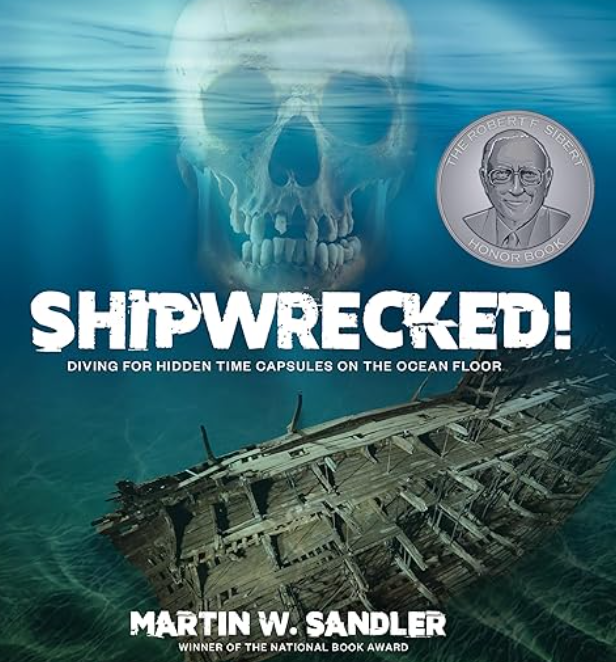
Shipwrecked!: Chapter Two
The award-winning historian traces how marine archaeology has been developing since 1900 to explore ships on the ocean floor and recover clues for understanding ancient civilizations.
Here are links to our lists for the book: Introduction–Chapter One, Chapter Two, Chapter Three, Chapters Four–Five, Chapter Six–"For Further Exploration"
40 words
20 learners
Learn words with Flashcards and other activities
Definition First

Other learning activities
Full list of words from this list:
-
ingot
a piece of metal cast in the shape of a blockAras had said that within the wreck he had seen a number of large copper ingots and that he had actually recovered a bronze knife. “What if those copper ingots and that bronze knife were from…a sea trader of the time of Odysseus and the Trojan wars?”
-
conviction
an unshakable belief in something without need for proofAnd he had a unique conviction. He was certain that a shipwreck could be excavated with the same scientific care and precision as archaeologists working on land.
-
maritime
bordering on or living near the sea“I was convinced,” he stated, “that the seabed contained memories of maritime civilizations that had never been recorded. What historians had missed, the sea remembered.”
-
undertake
enter upon an activity or enterpriseHe then contacted Professor Rodney Young at the University of Pennsylvania Museum of Archaeology and Anthropology and asked him if the museum would undertake an excavation of the Gelidonya shipwreck.
-
overwhelm
overcome, as with emotions or perceptual stimuliBass, whose main interest was the Mediterranean Bronze Age, was at first overwhelmed by the opportunity. “Here I am,” he recalled, “sent out from [the University of Pennsylvania] never having dived before, and…I’m the director.” He might have been a bit dumbfounded but Bass never hesitated in accepting the challenge.
-
execute
carry out or perform an action“Nothing much could be preserved underwater,” they declared, adding that “it’s not possible to execute proper archaeological plans underwater.”
-
inkling
a slight suggestion or vague understandingBut instead of being discouraged, he left for the shipwreck site determined to prove the “experts” wrong. “I had no inkling,” he would write, “that my life was changing forever.”
-
sweltering
excessively hot and humid; marked by sweating and faintnessThe camp, set up on a narrow strip of beach that ran beneath Gelidonya’s high cliffs, was sweltering hot and primitive, to say the least.
-
scrounge
obtain or seek to obtain by begging, pleading, or flatteringIt had been difficult to attract funding. So our camp for eight people was mostly what Peter and I scrounged from a US Air Force base near Istanbul: part of a canvas mess tent, some discarded cot mattresses, torn parachutes we strung up for shade.
-
pioneer
take the lead or initiative inMade up of archaeologists and divers from France, England, and the United States, this multinational group included Frederic Dumas, on loan from Jacques Cousteau’s team of divers, and the pioneering archaeologist Honor Frost.
-
principle
rule of personal conductThe one guiding principle that Bass established in the first days of the expedition, Throckmorton would recall, “was that we were there to understand the site, not recover a lot of stuff. Until something on the bottom was understood in its relationship to everything else, it stayed on the bottom. Recovery could take place only when everything on the site was well recorded.…”
-
meticulous
marked by precise accordance with detailsIn the first meticulous mapping of an ancient shipwreck on the ocean floor, one that would become a model for all future successful underwater excavations, Bass’s team began by making precise measurements and detailed drawings of everything in and around the wreck.
-
conventional
conforming with accepted standardsEventually, the entire area looked like a conventional land excavation with areas that needed to be explored staked out in squares, poles inserted next to spots that had been thoroughly examined, and plastic tags with numbers on them attached to all visible artifacts.
-
thoroughly
in an exhaustive mannerEventually, the entire area looked like a conventional land excavation with areas that needed to be explored staked out in squares, poles inserted next to spots that had been thoroughly examined, and plastic tags with numbers on them attached to all visible artifacts.
-
preliminary
preceding or in preparation for something more importantOnce ashore, preliminary removal of the concretion that covered most of the artifacts from their centuries-long home on the ocean floor was begun.
-
array
an impressive display or assortmentAnd it revealed an amazing array of Bronze Age objects.
-
alloy
a mixture containing two or more metallic elementsThe discovery that copper and tin could be combined to form a new and stronger metal, called bronze, changed the course of human history. Tools and weapons made of this extraordinary alloy began to replace those previously made of wood, stone, bone, and copper.
-
hull
the frame or body of a shipBecause bronze was so much stronger than metals previously used, shipbuilders could now construct hulls carrying more cargo than ever before.
-
yield
give or supplyIt also meant that the discovery of the shipwreck at Cape Gelidonya was extraordinarily important, not only because of the age of the sunken vessel and the groundbreaking way it was excavated but also because of the artifacts it yielded.
-
remnant
a small part remaining after the main part no longer existsThey lay on the ocean floor, still stacked as they had been in the ship’s hull, and next to them lay the remnants of tin ingots.
-
proximity
the property of being close togetherIt was the first time in history that the twin ingredients of bronze—copper and tin—had ever been found in close proximity to each other, on land or at the bottom of the sea.
-
wicker
flexible branches or twigs that can be woven togetherAlong with the copper and tin ingots, the ship was also carrying a large number of wicker baskets filled with several hundred bronze tools, several of which had signs scratched on them indicating that they had been made in Cyprus.
-
implement
a piece of equipment or a tool used for a specific purposeIncluded were broken parts of picks, hoes, shovels, and axes. Bass and the other archaeologists concluded the merchant captain of the ship used these broken implements as scrap bronze, which he or someone else could melt down to make brand-new tools.
-
scarab
a beetle considered to be divine by ancient EgyptiansOther items recovered from the Gelidonya wreck included four scarabs (gems containing a carved image of a beetle held sacred in the ancient Mediterranean world), a stone seal used by Near Eastern merchants to sign documents, two stone mortars, an oil lamp, a bronze razor, a cooking spit, several whetstones, and the bones of animals, fish, and fowl.
-
fowl
a domesticated birdOther items recovered from the Gelidonya wreck included four scarabs (gems containing a carved image of a beetle held sacred in the ancient Mediterranean world), a stone seal used by Near Eastern merchants to sign documents, two stone mortars, an oil lamp, a bronze razor, a cooking spit, several whetstones, and the bones of animals, fish, and fowl.
-
foundry
a factory where metal castings are producedHe would probably go ashore often, set up a portable foundry on the beach, and fashion the tools and weapons that had been ordered using the scrap bronze that he had onboard.
-
perception
a way of conceiving somethingOf the greatest importance of all is the fact that what was discovered ninety feet beneath the sea at Cape Gelidonya dramatically changed ages-old archaeologists’ and historians’ theories and perceptions about who had dominated the trading waters of the Mediterranean during the middle to late Bronze Age.
-
monopolize
have or exploit an exclusive control of somethingBefore the Cape Gelidonya excavation took place, historians and archaeologists believed that Bronze Age Greeks known as Mycenaeans had monopolized merchant seafaring along the Mediterranean from about 1400 to 1200 BCE.
-
pore
direct one's attention on somethingThere they pored through every book and journal on Egyptian art and found sixteen illustrations of reliefs and tomb paintings that showed Bronze Age workers carrying ingots shaped exactly like the main cargo of the Gelidonya ship.
-
mortar
a vessel in which substances can be ground with a pestleFor Bass, this evidence was supported by the fact that none of the objects recovered were Mycenaean. The scarabs, oil lamp, mortars, and seal were all Canaanite.
-
effects
property of a personal character that is portable“Why,” asked Bass, “does a Mycenaean ship have nothing but [Canaanite] weights? Why were the personal effects all [Canaanite]? All of this pointed to the fact that whoever sailed this ship was Canaanite.”
-
notion
a general inclusive conceptNational Geographic stated it best: what had taken place at Cape Gelidonya, it proclaimed, was like nothing “that came before it—it would literally change our notion of archaeology and the ocean forever.”
-
fabled
famous or legendaryHis previous work included helping excavate a land site at Gordion, Turkey, which, in the eighth century BCE, had been the capital of King Midas’s fabled golden empire.
-
nautical
relating to ships or navigationIn 1972, in order to both develop and promote marine archaeology, Bass founded the Institute of Nautical Archaeology, the first organization of its kind in the world.
-
flourish
make steady progressOriginally located on the island of Cyprus, the Institute of Nautical Archaeology soon moved to the campus of Texas A&M, where it has flourished ever since.
-
discipline
a branch of knowledgeLed by Bass and staffed by scientists, researchers, engineers, and people from many other disciplines, the INA has been a leading force in underwater archaeology.
-
groundbreaking
introducing new ideas or creative methodsIn carrying out their underwater discoveries and excavations, Bass and his colleagues introduced groundbreaking inventions and techniques that greatly advanced how marine archaeology is conducted.
-
innovation
a creation resulting from study and experimentationAmong the most spectacular of their early innovations was a plastic dome called a “telephone booth” that contained air pumped from the surface and a telephone that enabled divers at various ocean depths to enter it, remove their masks, and communicate with those aboard the dive boat on the ocean surface.
-
prolific
intellectually productiveAlong with everything else he accomplished, Bass was a prolific author and the recipient of many scientific awards.
-
apparatus
equipment designed to serve a specific functionTogether, they created a deluxe valve system that supplies divers with compressed air. This invention, which enabled safer and deeper dives than ever before possible, became known as the Aqualung (self-contained underwater breathing apparatus or SCUBA).
Created on Thu May 23 09:42:27 EDT 2024
(updated Fri May 24 10:11:57 EDT 2024)
Sign up now (it’s free!)
Whether you’re a teacher or a learner,
Vocabulary.com can put you or your class
on the path to systematic vocabulary improvement.