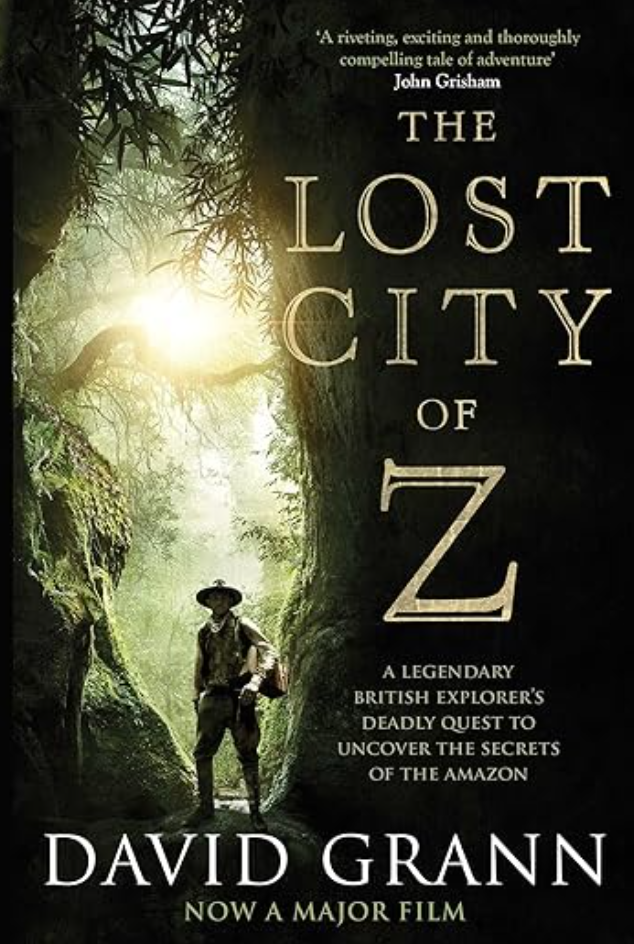
The Lost City of Z: Chapters 14–17
This nonfiction narrative traces the journey of the author through the Amazon to investigate the 1925 disappearance of the British explorer Percy Harrison Fawcett, who was on a quest to prove the existence of an ancient civilization within a harsh environment.
Here are links to our lists for the book: Chapters 1–4, Chapters 5–8, Chapters 9–13, Chapters 14–17, Chapters 18–25
40 words
18 learners
Learn words with Flashcards and other activities
Definition First

Other learning activities
Full list of words from this list:
-
inexorable
impossible to prevent, resist, or stopAt Fort Frederick, Fawcett had first learned that it was possible for a great kingdom to seclude itself in the jungle and, after time had taken its inexorable toll, for its palaces and thoroughfares to vanish under creeping vines and roots.
-
barrage
the heavy fire of artillery to saturate an areaFawcett ordered his men to drop their rifles, but the barrage of arrows persisted.
-
fusillade
rapid simultaneous discharge of firearmsFawcett then did something that shocked Costin so much that he would recall it vividly even as an old man: the major untied the handkerchief around his neck and, waving it above his head, waded into the river, heading directly into the fusillade of arrows.
-
emaciated
very thin, especially from disease or hunger or coldHe was struck by the fact that, unlike the emaciated explorers, they had substantial resources of food.
-
paradigm
the generally accepted perspective of a disciplineThere was not even evidence of dense populations in the Amazon. And the notion of a complex civilization contradicted the two main ethnological paradigms that had prevailed for centuries and that originated with the first encounter between Europeans and Native Americans more than four hundred years earlier.
-
treatise
a formal text that treats a particular topic systematicallyIn a famous debate with Sepúlveda and in a series of treatises, Las Casas tried to prove, once and for all, that Indians were equal humans (“Are these not men? Do they not have rational souls?”), and to condemn those “pretending to be Christians” who “wiped them from the face of the earth.”
-
deplore
express strong disapproval ofAfter he witnessed a tribe cannibalize one of its dead as part of a religious ceremony—the body “roasted over a big fire” and “cut up and divided amongst the various families”—Fawcett beseeched Europeans not to deplore the “elaborate ritual.” He hated to classify unacculturated Indians as “savages”—then the common terminology—and he noted that the kind, decent Echojas were “plain proof of how unjustified is the general condemnation of all the wild forest people.”
-
mores
the conventions embodying the fundamental values of a groupAlong with adopting Indian mores, he learned to speak myriad indigenous languages.
-
pernicious
working or spreading in a hidden and usually injurious wayHe escaped virtually every kind of pathology in the jungle, but he could not rid himself of the pernicious disease of race.
-
eclectic
combining or composed of elements drawn from a variety of sourcesAs Fawcett was developing his theory of an ancient Amazonian civilization, he was conscious of growing competition from other explorers, who were racing into the interior of South America to survey one of the last uncharted realms. They were an eclectic, fractious, monomaniacal bunch, each with his own pet theory and obsession.
-
debonair
having a sophisticated charmBut perhaps the rival Fawcett most feared was Alexander Hamilton Rice, a tall, debonair American doctor who, like Fawcett, had trained under Edward Ayearst Reeves at the Royal Geographical Society.
-
impetuous
characterized by undue haste and lack of thoughtWhereas Fawcett was impetuous and daring, Dr. Rice approached his mission with the calm precision of a surgeon.
-
denigrate
attack the good name and reputation of someoneAt the same time, the explorers were quick to cast doubt upon, and even denigrate, a rival’s accomplishments.
-
charlatan
a flamboyant deceiverBranding Roosevelt a “charlatan,” he accused the former president of plagiarizing events from the narrative of Landor's own journey: “I see he even has had the same sickness as I experienced and, what is more extraordinary, in the very same leg I had trouble with. These things happen very often to big explorers who carefully read the books of some of the humble travelers who preceded them.”
-
deprecate
cause to seem or feel unimportant; belittle“I do not wish to deprecate other exploration work in South America,” Fawcett told the RGS, “only to point out the vast difference between river journeys with their freedom from the great food problem, and forest journeys on foot—when one has perforce to put up with circumstances and deliberately penetrate Indian sanctuaries.”
-
acquisitive
eager to attain and possess material possessionsIf these reports were not enough to excite the conquistadores’ acquisitive hearts, it was believed that the kingdom contained vast swaths of cinnamon trees—a spice that was then nearly as precious as gold.
-
destitution
a state without money or prospectsFinancial ruin, destitution, starvation, cannibalism, murder, death: these seemed to be the only real manifestations of El Dorado.
-
palisade
a strong fence made of stakes driven into the groundThe conquistadores observed “cities that glistened in white,” with temples, public squares, palisade walls, and exquisite artifacts.
-
effigy
a representation of a personHe had some golden effigies or idols the size of boys, and a woman all made of gold who was their goddess.
-
erudite
having or showing profound knowledgeI had arranged an appointment with the head of the manuscript division, Vera Faillace, an erudite woman with shoulder-length dark hair and glasses.
-
peregrination
traveling or wandering aroundAfter a long and troublesome peregrination...and almost lost for many years...we discovered a chain of mountains so high that they seemed to reach the ethereal regions, and they served as throne for the Wind or for the Stars themselves.
-
ethereal
of heaven or the spiritAfter a long and troublesome peregrination...and almost lost for many years...we discovered a chain of mountains so high that they seemed to reach the ethereal regions, and they served as throne for the Wind or for the Stars themselves.
-
flourish
make steady progress“The ruins well showed the size and grandeur which must have been there, and how populous and opulent it had been in the age when it flourished,” the bandeirante wrote.
-
bigotry
intolerance and prejudice“It was difficult for an administration steeped in the narrow bigotry of an all-powerful Church to give much credence to such a thing as an old civilization,” Fawcett wrote.
-
causeway
a road that is raised above water, marshland, or sandHe was sure that he had found proof of archaeological remains, including causeways and pottery, scattered throughout the Amazon.
-
polarize
cause to divide into conflicting positionsAs always, Fawcett was an electric and polarizing figure, and his men fell into two camps: the Costins and the Murrays.
-
elan
enthusiastic and assured vigor and livelinessThe Costins gravitated toward him, relishing his daring and élan, while the Murrays despised his ferocity and unforgivingness.
-
apprise
inform somebody of somethingNina kept Keltie and the Royal Geographical Society apprised of his activities.
-
missive
a written message addressed to a person or organizationToward the end of the war, Fawcett described some of the carnage that he had witnessed in a missive published in an English newspaper under the headline “British Colonel in Letter Here Tells of Enormous Slaughter.”
-
imbibe
receive into the mind and retainHe imbibed Madame Blavatsky’s most outlandish teachings about Hyperboreans and astral bodies and Lords of the Dark Face and keys to unlocking the universe—the Other World seemingly more tantalizing than the present one.
-
bereft
lacking or deprived of somethingAn article in Geographical Review concluded that the Amazon basin was so bereft of humankind that it was like “one of the world's great deserts...comparable with the Sahara.”
-
pique
a sudden outburst of angerAfter reports circulated within the Society that he was too intemperate, too uncontrollable, Fawcett grumbled to members of its council, “I don’t lose my temper. I am not naturally tempestuous”—though his protestations suggested that he was being thrown into yet another pique.
-
virile
characterized by energy and vigorIn 1920, following the New Year, Fawcett used what little savings he had to move his family to Jamaica, saying that he wanted his children to have “an opportunity to grow up in the virile ambiente of the New World.”
-
incandescent
characterized by ardent emotion, intensity, or brillianceAt night, the two boys would often get together and plot their incandescent futures: how they would dig up the Galla-pita-Galla treasure in Ceylon and crawl through the Amazon in search of Z.
-
parley
a negotiation between enemiesIn a missive to the RGS, Dr. Rice wrote, “There was no alternative, they being the aggressors, resenting all attempts at parley or truce, and compelling a defensive that resulted disastrously for them and was a keen disappointment to me.”
-
reprehensible
bringing or deserving severe rebuke or censureFawcett, however, was appalled, and told the RGS that to shoot indiscriminately at the Indians was reprehensible.
-
untoward
contrary to your interests or welfareFawcett asked a local intermediary that if his family or friends “get alarmed at no news please soothe them with the confident assertion we shall come to no untoward end and shall be heard of in due course.”
-
prostrate
lie face downward, as in submissionFinally, Holt prostrated himself and said, “Never mind me, Colonel. You go on—just leave me here.”
-
beseech
ask for or request earnestlyThe wife of the American vice-consul in Rio, who was a friend of the ornithologist’s, sent Holt a letter beseeching him not to go:
You are a strong, able-bodied young man, so why do you...deliberately throw your life away as you will if you go back to Mato Grosso? -
vagabond
wandering aimlessly without ties to a place or communityHe lamented that, instead of earning fame, he remained a “vagabond ornithologist—or perhaps ‘tramp birdskinner’ would be nearer a true title.”
Created on Mon Mar 04 08:51:48 EST 2024
(updated Mon Mar 04 15:46:07 EST 2024)
Sign up now (it’s free!)
Whether you’re a teacher or a learner,
Vocabulary.com can put you or your class
on the path to systematic vocabulary improvement.