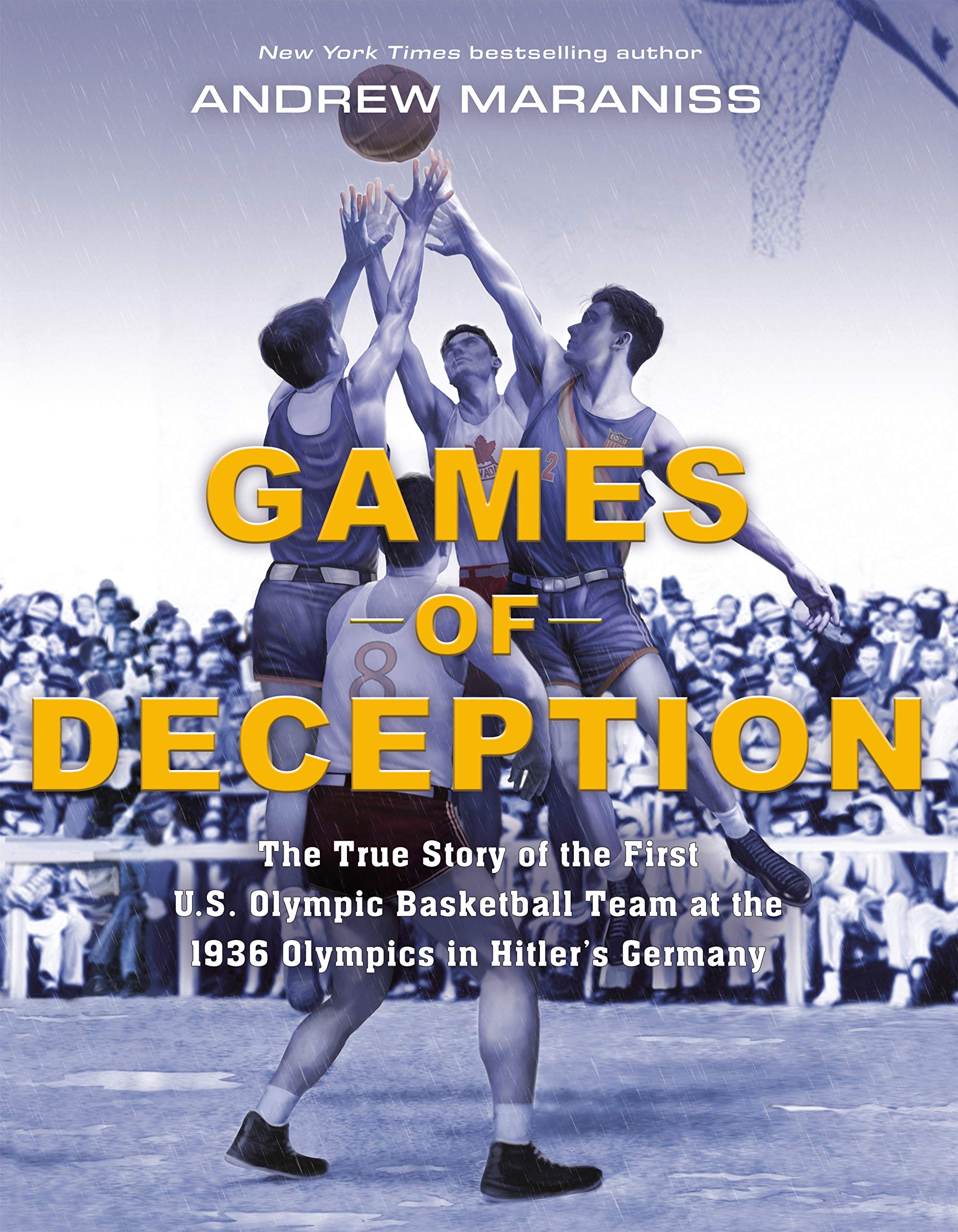
Games of Deception: Chapters 19–25
This nonfiction account traces the history of basketball through the U.S. team's first Olympic competition, in pre-World War II Germany.
Here are links to our lists for the book: Chapters 1–6, Chapters 7–12, Chapters 13–18, Chapters 19–25
40 words
35 learners
Learn words with Flashcards and other activities
Definition First

Other learning activities
Full list of words from this list:
-
zealot
a fervent and even militant proponent of something“Bands play German national hymns and a hundred thousand zealots...stretch out their arms and sing,” reported Matthew Halton of the Toronto Star.
-
ecstasy
a state of being carried away by overwhelming emotion“Something like religious ecstasy, rather than...sporting enthusiasm, is the spirit abroad here today.”
-
repercussion
a remote or indirect consequence of some action“I have an idea these Olympic Games will have repercussions that will not help toward the amity of nations as they are supposed to. There will be dark trouble clouds along the horizon. They may develop into thunderstorms.”
-
amity
a state of friendship and cordiality“I have an idea these Olympic Games will have repercussions that will not help toward the amity of nations as they are supposed to. There will be dark trouble clouds along the horizon. They may develop into thunderstorms.”
-
mobilize
get ready for warPolish diplomat Józef Lipski shared a similar concern: people who could be so well choreographed for a sporting event could also be mobilized just as smoothly for war.
-
respite
an interruption in the intensity or amount of somethingWhile the sixteen days of the Olympic Games provided a temporary respite from the most egregious acts of anti-Semitism, it was no secret that the Nazis were preparing to unleash a new round of terror once the Games were over.
-
egregious
conspicuously and outrageously bad or reprehensibleWhile the sixteen days of the Olympic Games provided a temporary respite from the most egregious acts of anti-Semitism, it was no secret that the Nazis were preparing to unleash a new round of terror once the Games were over.
-
dignitary
an important or influential personIn his private box adjacent to Nazi leaders and dignitaries, American novelist Thomas Wolfe jumped out of his seat, screaming with joy.
-
perpetuate
cause to continue or prevailPerpetuating the idea that Owens alone shined not only robs others of their due but leaves the impression that African American greatness at the ’36 Games was an exception rather than the rule.
-
detractor
one who disparages or belittles the worth of somethingIn the minds of legions of detractors, there was no way for black people to win; the truth didn’t matter.
-
ingrained
deeply rooted; firmly fixed or heldStereotypes and hate were so deeply ingrained that any fact or fiction could be used to confirm them.
-
akin
similar in quality or character“The best the Nazis have been able to do with the racial problem created by Jesse Owens & Co is to theorize that these represent a race of American helots, more nearly akin to the panther and the jack rabbit than to their Aryan competitors,” he wrote.
-
breach
a failure to perform some promised act or obligationEither way, sports had provided a venue for a breach in ethics and fairness.
-
laud
praise, glorify, or honorWhite teammate Babe Didrikson, often lauded as the first superstar American female athlete and therefore a champion for women's rights, poured a pitcher of cold water on Stokes and black teammate Tidye Pickett on the train to LA.
-
obscurity
an unimportant and not well known standingFour-tenths of a second too slow, he lived out the rest of his life in obscurity.
-
indifference
the trait of remaining calm and seeming not to care“And thus a contest that drew the largest crowd in history,” lamented the New York Herald Tribune, “was played out to the most colossal indifference any baseball game has ever known.”
-
ingenuity
the property of showing inventiveness and skillTeams from twenty-one nations had arrived in Germany to play a game that would not have existed if not for Naismith's ingenuity.
-
protege
a person who receives support from an influential patronNaismith's journey to Europe was made possible by his protégé and the man who had worked hardest for basketball’s inclusion in the Olympic Games, Kansas coach Phog Allen.
-
earmark
give or assign a resource to a particular person or causeAllen convinced fellow members of the National Association of Basketball Coaches to organize a “Pennies for Naismith” campaign in the winter of 1936, with high school, collegiate, and AAU teams earmarking one cent of each ticket sold during the week of February 9–15 for Naismith's travel fund.
-
instill
teach and impress by frequent repetitions or admonitions“Germany not only builds up its youth physically, but in the process instills in them a national spirit,” he wrote.
-
impervious
not admitting of passage or capable of being affectedFour of the twelve tree-lined outdoor courts had been modified to accommodate the debut of Olympic basketball, with temporary wooden backboards erected on the endlines and a layer of loam (a mix of sand, silt and clay) worked into the red clay courts to provide a harder surface supposedly impervious to rain.
-
oversight
an unintentional omission from failure to notice somethingNaismith showed up expecting a guest pass courtesy of the American Olympic Committee, but his name could not be found on the list. It was no oversight, but an intentional decision on the part of Avery Brundage and his staff.
-
peripheral
related to the key issue but not of central importanceThis slight by American Olympic officials was compounded by the fact that the German hosts, who considered basketball a peripheral sport at best, paid no mind to Naismith, nor had they planned any sort of ceremony to welcome the game of basketball into the Olympic lineup.
-
antiquated
so extremely old as seeming to belong to an earlier periodThe rules were antiquated by American standards, with no center-court line, a jump ball after each made basket, and no ten-second rule for crossing half-court or three-second rule for standing in the free-throw lane.
-
rout
an overwhelming defeatStill, Estonia was considered the best team in Europe and many expected them to give the U.S. team a good game. Instead, it was a rout from the beginning, with the Americans taking a 26–7 lead at halftime.
-
flamboyant
tending to attract attention; marked by ostentatious displayEver the flamboyant showman, Gene Johnson was forced to grin and bear it when his Wild Men had to play their August 12 game against the Philippines in makeshift uniforms; his players’ red, white, and blue Spalding silks had been stolen out of their lockers the night before.
-
derisive
expressing contempt or ridiculeThe Sure Passers (whom Gene Johnson derisively dubbed “The Humdrums”) limited the Mexicans to just two points in the first half, both coming on free throws.
-
humdrum
not challenging; dull and lacking excitementThe Sure Passers (whom Gene Johnson derisively dubbed “The Humdrums”) limited the Mexicans to just two points in the first half, both coming on free throws.
-
apotheosis
model of excellence or perfection of a kind“The Nazi mentality, supposedly the apotheosis of detail and organization,” Balter concluded, “had misfired badly.”
-
inept
not elegant or graceful in expressionNaismith despised slow play, and so did Coach Johnson, but the second half of the most significant basketball game in the forty-five-year history of the sport turned into one long, inept game of keep-away, with the Americans passing the ball back and forth just to run out the clock.
-
travesty
a distorted, debased, or absurd imitation of somethingBalter considered the game a “hilarious travesty” with “hardly a recognizable pivot, dribble, jump shot, fast break, or anything else resembling basketball. The Big Game had been a Big Joke.”
-
galling
causing irritation or annoyanceFirst, he knew he was out of a job when he got back to Los Angeles, a galling reality considering he worked for the federal government.
-
paganism
a religion outside of mainstream monotheismThe whole affair, he knew, had been one huge sales convention promoting the product of Nazism and its “byproducts of paganism, militarism, anti-Semitism and Fascism.”
-
fanfare
a gaudy outward displayThe man who arrived in Berlin with no fanfare spent his last hours in the city celebrating a colossal achievement with friends, an Olympic wreath resting atop his head.
-
interlude
a brief show between the sections of a longer performanceThey enjoyed an array of spectacular entertainment: the Wallenda acrobats bounced off springboards and hung from ropes, ballerinas twirled, a cyclist performed tricks, and a band composed of members of a military unit known as the Leibstandarte SS Adolf Hitler provided musical interludes.
-
grandiose
impressive because of unnecessary largeness or magnificenceHis grandiose words sounded impressive.
-
hedge
minimize loss or riskOn September 7, wealthy Jewish Germans were required to give the Nazis 25 percent of their assets, outright theft billed as a “deposit” to hedge against emigration.
-
lament
express grief verbally“It’s a hell of a note to come back home with a world championship basketball team and have to disband it,” Johnson lamented.
-
fanciful
indulging in or influenced by the imagination“The field where the Olympic youth had once assembled, the buildings and monumental grounds that had once delighted the world, had become a deadly battlefield, revealing nothing but sickening remains and gruesome debris wherever one looked,” reported Carl Diem. “It struck me that not even the most fanciful poet could have imagined such a mad contradiction.”
-
tribunal
an assembly to conduct judicial businessOn the other end of the ropes hung two Nazis, sentenced to death by an international tribunal following World War II for crimes against humanity.
Created on Mon Nov 08 11:42:38 EST 2021
(updated Wed Nov 17 09:30:15 EST 2021)
Sign up now (it’s free!)
Whether you’re a teacher or a learner,
Vocabulary.com can put you or your class
on the path to systematic vocabulary improvement.