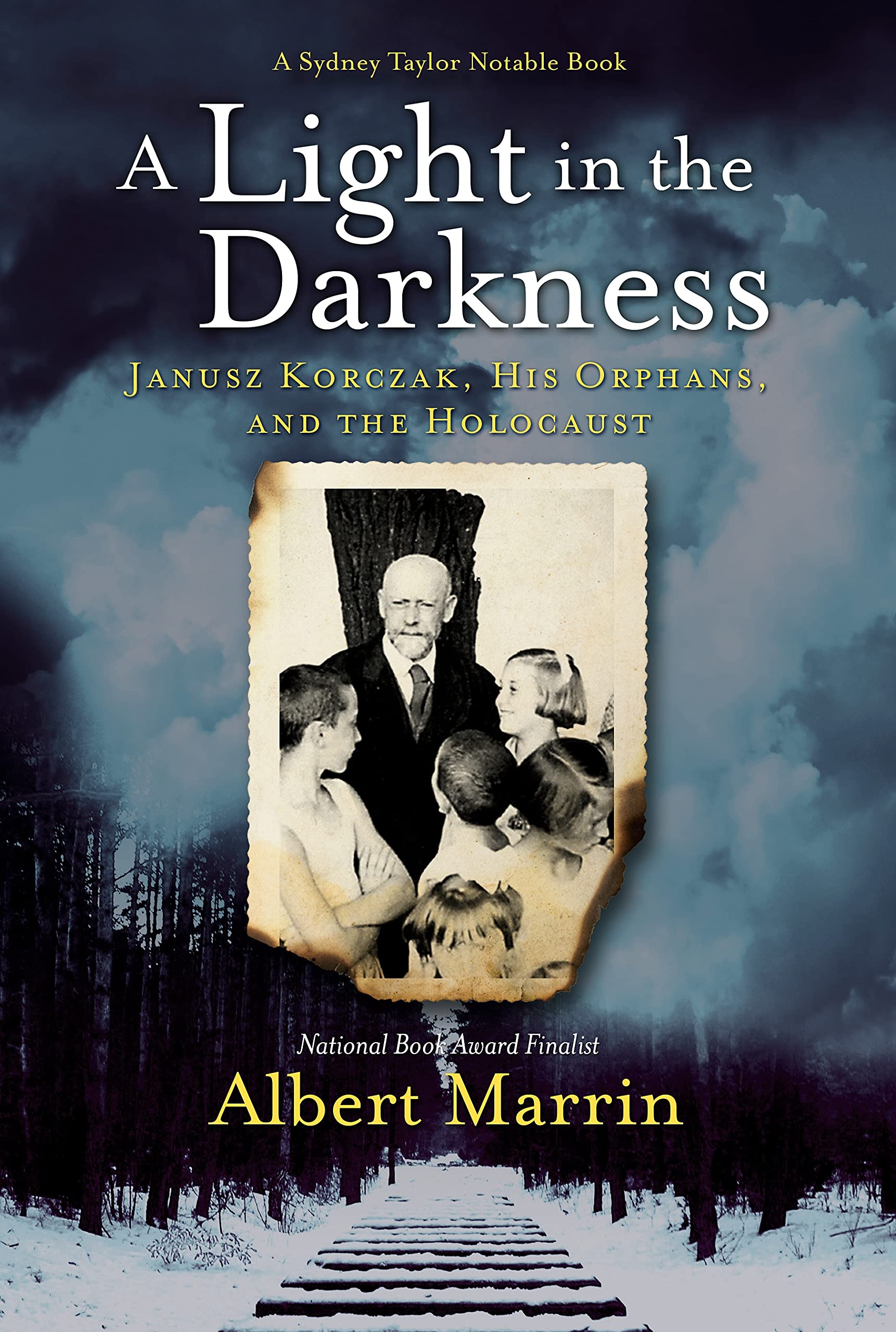
A Light in the Darkness: Parts V–VI
This biography details the life of Janusz Korczak, a Polish doctor who refused to abandon the orphaned children in his care during the Holocaust.
Here are links to our lists for the book: Prologue–Part I, Part II, Part III, Part IV, Parts V–VI
40 words
19 learners
Learn words with Flashcards and other activities
Definition First

Other learning activities
Full list of words from this list:
-
rapt
feeling great delight and interestOn July 18, the audience watched The Post Office with rapt attention. The children saw themselves in little Amal, for they, too, were in a dark room—the ghetto—longing for freedom and beauty.
-
impart
transmit, as knowledge or a skillThe play was the Old Doctor’s “way of imparting to the little helpless ones the calm wisdom in the moment of tragedy which in his faith did not mean the end.”
-
straggle
go, come, or spread in a rambling or irregular wayGroups of children from orphanages across the ghetto straggled into the Umschlagplatz throughout the day.
-
contempt
lack of respect accompanied by a feeling of intense dislikeThey were going to their death with eyes full of contempt for the murderers.
-
beset
annoy continually or chronicallyFrom that day forward, Szwajger was not the same person, constantly beset by pangs of guilt: “I was always different from everybody else. And nobody ever understood this.”
-
denizen
a person who inhabits a particular placeThe SS called them “wild people,” denizens of the “wild houses” in the “wild ghetto.”
-
clandestine
conducted with or marked by hidden aims or methodsDefying tradition, some men shaved their beards, put away their prayer books, and left the clandestine synagogues.
-
docile
willing to be taught or led or supervised or directedNow we are ashamed of ourselves, disgraced in our own eyes, and in the eyes of the world, where our docility earned us nothing.
-
militant
disposed to warfare or hard-line policiesZionists were the most militant. For years, they had run training camps to prepare young men and women to immigrate to Palestine. A major part of their training involved learning to farm the land. Another part, as important, taught the use of firearms to defend settlements against Arab raiders.
-
waylay
wait in hiding to attackAn assassin would waylay an informer and shoot him.
-
placid
not easily irritatedDenied any worth or dignity as human beings, Jews, in Nazi minds, were merely “meat,” placid beasts easily led to slaughter.
-
rabble
the common people or lower classesThe general vowed to stamp out “this rabble and subhumanity,” his term for ghetto Jews.
-
bleak
offering little or no hopeWarsaw’s sewers go on for miles, forming a maze under the city. To enter them without knowledge of underground geography meant almost certain death. Those who ventured into this bleak underworld without a guide might wander for days before succumbing to starvation, thirst, disease, or poison gas pumped in by the Germans.
-
herald
foreshadow or presageThat realization heralded another tragedy, one that befell the city of Warsaw itself. An old saying was to prove all too true: “If you take a handful of Warsaw soil and squeeze it, the blood will run from it.”
-
poise
great coolness and composure under strainTeenage girls learned first aid; a select few became messengers, risky work requiring poise, daring, and the ability to make split-second decisions.
-
crony
a close friend or associateMeanwhile, having driven the German Army out of North Africa, Allied forces invaded Italy, ruled by Hitler’s crony Benito Mussolini.
-
barrage
the heavy fire of artillery to saturate an areaIt began with ground-shaking barrages from thousands of cannons.
-
beseech
ask for or request earnestlyKill the German—that is what your children beseech you to do.
-
pervade
spread or diffuse through“Pervading everything is the nauseating stench of corruption, a stench that neither fire, nor sunshine, rain, snow, or wind have been able to overcome.”
-
partisan
a fervent and even militant proponent of somethingAs a reward, Hitler had put him in charge of the campaign against Soviet partisans, bands of armed civilians who attacked isolated German outposts.
-
insurgent
a member of an irregular force that fights a stronger forceSeveral Germans praised the Poles. A lieutenant wrote his mother: “Let us not deceive ourselves. Warsaw fell thanks to our heavy weapons, not to the courage of our units....The insurgents deserved to be treated like soldiers....They marched by in step, four abreast...without a sign of despair, heads held high with national pride. Exemplary!”
-
exemplary
worthy of imitationSeveral Germans praised the Poles. A lieutenant wrote his mother: “Let us not deceive ourselves. Warsaw fell thanks to our heavy weapons, not to the courage of our units....The insurgents deserved to be treated like soldiers....They marched by in step, four abreast...without a sign of despair, heads held high with national pride. Exemplary!”
-
ebb
fall away or declineA French Catholic priest told how a mortally wounded boy refused religious comfort; instead, he asked for a photo of his Führer to look upon as his life ebbed away.
-
fodder
soldiers regarded as expendable under artillery fireAs ever, the big idea—racist ideology—meant everything to the Führer; members of the Hitler Youth were merely tools, cannon fodder, not people precious in themselves.
-
forensic
used in the investigation of facts or evidence in courtSS guards carried their bodies to the garden, doused them with gasoline, set them on fire, and buried the charred remains in a shell hole. Soviet forensic experts later identified fragments of Hitler’s skull through dental X-rays.
-
meticulous
marked by extreme care in treatment of detailsBecause the Nazis were meticulous record-keepers, much of the evidence against them came from captured documents, photos, films, and the testimony of eyewitnesses.
-
tribunal
an assembly to conduct judicial businessA group known as the International Military Tribunal held the first and most important trial, which lasted from November 1945 to October 1946. Twenty-one men sat in the dock as “major war criminals.”
-
treacherous
tending to betrayDuring a short break, he smirked when Göring shouted: “Why, that dirty, bloody, treacherous swine!...He was the bloodiest murderer in the whole goddamned setup!” The general, that “Schweinhund,” that filthy “pig-dog,” was “selling his soul to save his stinking neck!”
-
rabid
marked by excessive enthusiasm for a cause or ideaAt Nuremberg, the rabid anti-Semite must have known the judges would condemn him, because every scrap of evidence confirmed his guilt.
-
glutton
a person who is devoted to eating and drinking to excessThe evidence included his diary, all forty-two volumes of it, in which he called Jews “malignant gluttons” and made statements such as this gem: “That we sentence 1,200,000 Jews to die of hunger should only be noted marginally.”
-
dandle
gently or playfully move a baby up and downAlfred Nestor, the son of a high-ranking SS officer, always looked forward to visiting the Führer. “He loved children and used to dandle me on his knee,” Nestor wrote about the man he called “Uncle Adolf.”
-
doting
extravagantly or foolishly loving and indulgentLike Heinrich Himmler, Göring was a doting father.
-
plight
a situation from which extrication is difficultDuring the Nazi years, many Poles took advantage of the Jews’ plight. Once the Nazis drove a family from its home, neighbors, especially in small towns and villages, scrambled to take over their property.
-
exalt
praise, glorify, or honorBroadcasters for the Palestinian National Authority, which governs the Gaza Strip and parts of the West Bank, the landlocked territory near the Mediterranean coast bordered by the Jordan River, exalt Hitler, he of “blessed memory,” for killing “the most vile criminals on the face of the earth.”
-
whimsical
indulging in or influenced by the imaginationIndoors, whimsical moldings of animals and Winnie-the-Pooh look down, as they did when the Old Doctor and his children left for the ghetto.
-
posthumously
after deathA Janusz Korczak International Association promotes the study of his writings and spreads his message. Outside Poland, schools bear his name, and postage stamps his image. He received, posthumously, the German Peace Prize.
-
infirm
lacking bodily or muscular strength or vitalityIslam has been a great civilizing force; even in war, its laws ban deliberate attacks on women, children, the elderly, the clergy, and the infirm.
-
blatantly
in a completely obvious mannerNevertheless, a tiny fraction of the world’s 1.6 billion Muslims embrace violence. Though done in the name of Islam, their actions are blatantly contrary to its teachings.
-
expendable
suitable to be used upLikewise, early in the twenty-first century, in Afghanistan and Pakistan, the Taliban, a fundamentalist Islamic militia, see children as expendable, as objects to use and use up as needed.
-
congenital
present at birth but not necessarily hereditaryEchoing the Nazi euthanasia program, ISIS issued a fatwa (religious decree) in 2015 urging the faithful to “kill newborn babies with Down’s syndrome and congenital deformities and disabled children.”
Created on Tue Aug 24 15:04:25 EDT 2021
(updated Thu Aug 26 14:43:16 EDT 2021)
Sign up now (it’s free!)
Whether you’re a teacher or a learner,
Vocabulary.com can put you or your class
on the path to systematic vocabulary improvement.