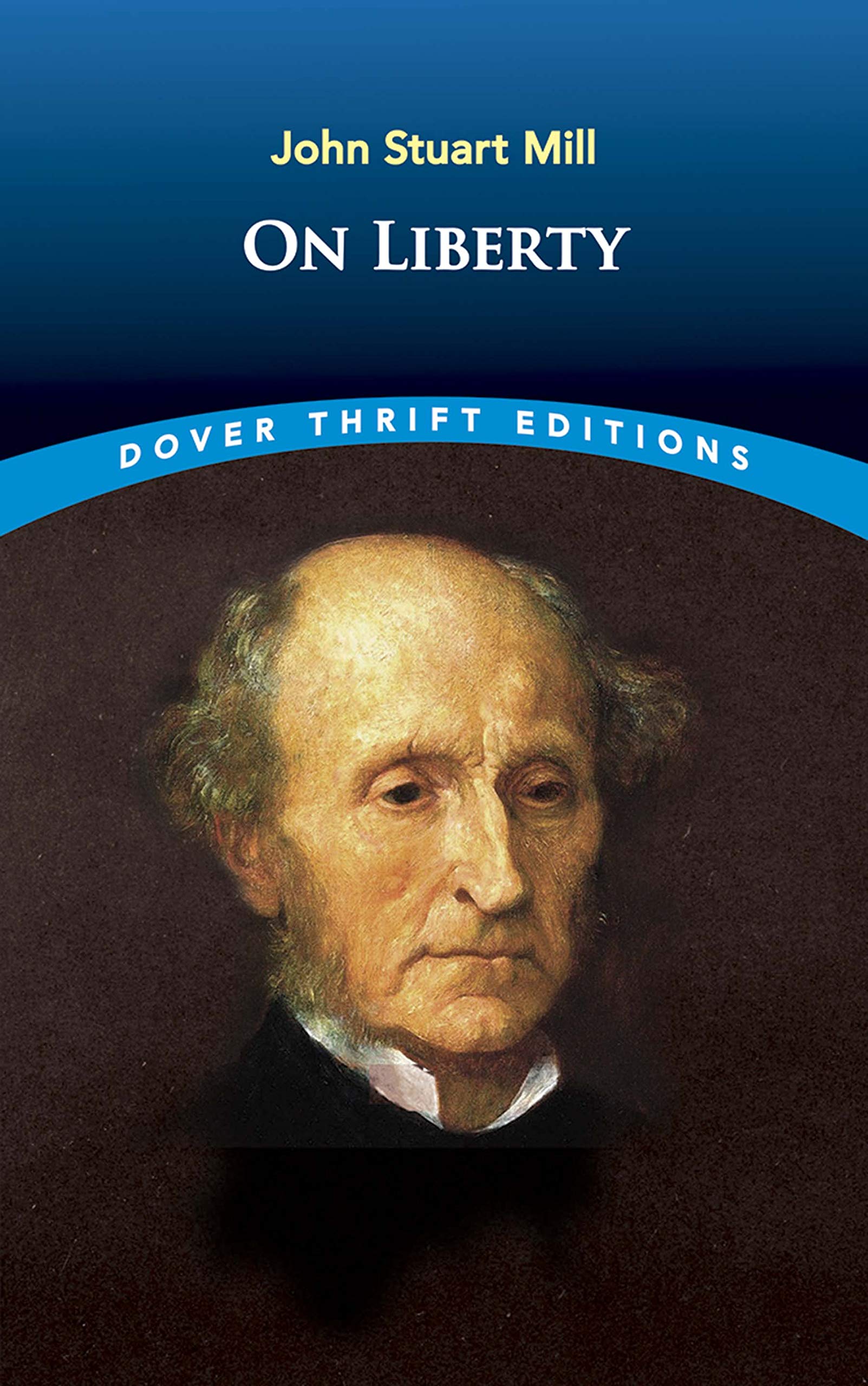
On Liberty: Chapter III
In this influential essay, Mill examines the nature of liberty as it applies to the individual and society as a whole. Read the full text here.
Here are links to our lists for the text: Chapter I, Chapter II, Chapter III, Chapter IV, Chapter V
40 words
28 learners
Learn words with Flashcards and other activities
Definition First

Other learning activities
Full list of words from this list:
-
proviso
a stipulated condition...let us next examine whether the same reasons do not require that men should be free to act upon their opinions—to carry these out in their lives, without hindrance, either physical or moral, from their fellow-men, so long as it is at their own risk and peril. This last proviso is of course indispensable. No one pretends that actions should be as free as opinions.
-
placard
a sign posted in a public placeAn opinion that corn-dealers are starvers of the poor, or that private property is robbery, ought to be unmolested when simply circulated through the press, but may justly incur punishment when delivered orally to an excited mob assembled before the house of a corn-dealer, or when handed about among the same mob in the form of a placard.
-
intrinsic
belonging to a thing by its very natureBut the evil is, that individual spontaneity is hardly recognised by the common modes of thinking, as having any intrinsic worth, or deserving any regard on its own account.
-
treatise
a formal text that treats a particular topic systematicallyFew persons, out of Germany, even comprehend the meaning of the doctrine which Wilhelm von Humboldt, so eminent both as a savant and as a politician, made the text of a treatise...
-
transient
lasting a very short time...the end of man, or that which is prescribed by the eternal or immutable dictates of reason, and not suggested by vague and transient desires, is the highest and most harmonious development of his powers to a complete and consistent whole...
-
manifold
many and varied; having many features or forms...for this there are two requisites, "freedom, and a variety of situations;" and that from the union of these arise "individual vigour and manifold diversity," which combine themselves in "originality."
-
presumptive
having a reasonable basis for belief or acceptanceThe traditions and customs of other people are, to a certain extent, evidence of what their experience has taught them; presumptive evidence, and as such, have a claim to his deference: but, in the first place, their experience may be too narrow; or they may not have interpreted it rightly.
-
discern
recognize or perceive a difference or distinctionThe human faculties of perception, judgment, discriminative feeling, mental activity, and even moral preference, are exercised only in making a choice. He who does anything because it is the custom, makes no choice. He gains no practice either in discerning or in desiring what is best.
-
inert
slow and apatheticIf the grounds of an opinion are not conclusive to the person's own reason, his reason cannot be strengthened, but is likely to be weakened by his adopting it: and if the inducements to an act are not such as are consentaneous to his own feelings and character (where affection, or the rights of others, are not concerned), it is so much done towards rendering his feelings and character inert and torpid, instead of active and energetic.
-
torpid
slow and apatheticIf the grounds of an opinion are not conclusive to the person's own reason, his reason cannot be strengthened, but is likely to be weakened by his adopting it: and if the inducements to an act are not such as are consentaneous to his own feelings and character (where affection, or the rights of others, are not concerned), it is so much done towards rendering his feelings and character inert and torpid, instead of active and energetic.
-
indolent
disinclined to work or exertionEnergy may be turned to bad uses; but more good may always be made of an energetic nature, than of an indolent and impassive one.
-
susceptibility
the state of being easily affectedThe same strong susceptibilities which make the personal impulses vivid and powerful, are also the source from whence are generated the most passionate love of virtue, and the sternest self-control.
-
ordinance
an authoritative ruleThings are vastly changed, since the passions of those who were strong by station or by personal endowment were in a state of habitual rebellion against laws and ordinances, and required to be rigorously chained up to enable the persons within their reach to enjoy any particle of security.
-
pecuniary
relating to or involving moneyThey ask themselves, what is suitable to my position? what is usually done by persons of my station and pecuniary circumstances? or (worse still) what is usually done by persons of a station and circumstances superior to mine?
-
eccentricity
strange and unconventional behaviorThus the mind itself is bowed to the yoke: even in what people do for pleasure, conformity is the first thing thought of; they live in crowds; they exercise choice only among things commonly done: peculiarity of taste, eccentricity of conduct, are shunned equally with crimes...
-
dint
force or effort...by dint of not following their own nature, they have no nature to follow: their human capacities are withered and starved: they become incapable of any strong wishes or native pleasures, and are generally without either opinions or feelings of home growth, or properly their own.
-
mitigated
made less severe or intenseThat is the theory of Calvinism; and it is held, in a mitigated form, by many who do not consider themselves Calvinists; the mitigation consisting in giving a less ascetic interpretation to the alleged will of God; asserting it to be his will that mankind should gratify some of their inclinations...
-
ascetic
practicing great self-denialThat is the theory of Calvinism; and it is held, in a mitigated form, by many who do not consider themselves Calvinists; the mitigation consisting in giving a less ascetic interpretation to the alleged will of God; asserting it to be his will that mankind should gratify some of their inclinations...
-
hidebound
stubbornly inflexible and narrow-mindedIn some such insidious form there is at present a strong tendency to this narrow theory of life, and to the pinched and hidebound type of human character which it patronises.
-
abnegate
deny or renounceThere is a different type of human excellence from the Calvinistic; a conception of humanity as having its nature bestowed on it for other purposes than merely to be abnegated.
-
latitude
scope for freedom of action or thoughtTo give any fair-play to the nature of each, it is essential that different persons should be allowed to lead different lives. In proportion as this latitude has been exercised in any age, has that age been noteworthy to posterity.
-
injunction
a formal command or admonitionEven despotism does not produce its worst effects, so long as Individuality exists under it; and whatever crushes individuality is despotism, by whatever name it may be called, and whether it professes to be enforcing the will of God or the injunctions of men.
-
avail
use to one's advantageDoubtless, however, these considerations will not suffice to convince those who most need convincing; and it is necessary further to show, that these developed human beings are of some use to the undeveloped—to point out to those who do not desire liberty, and would not avail themselves of it, that they may be in some intelligible manner rewarded for allowing other people to make use of it without hindrance.
-
gainsay
take exception toThere is always need of persons not only to discover new truths, and point out when what were once truths are true no longer, but also to commence new practices, and set the example of more enlightened conduct, and better taste and sense in human life. This cannot well be gainsaid by anybody who does not believe that the world has already attained perfection in all its ways and practices.
-
stagnant
not growing or changing; without force or vitalityBut these few are the salt of the earth; without them, human life would become a stagnant pool. Not only is it they who introduce good things which did not before exist; it is they who keep the life in those which already existed.
-
succession
a group of people or things arranged or following in orderThere is only too great a tendency in the best beliefs and practices to degenerate into the mechanical; and unless there were a succession of persons whose ever-recurring originality prevents the grounds of those beliefs and practices from becoming merely traditional, such dead matter would not resist the smallest shock from anything really alive, and there would be no reason why civilisation should not die out...
-
erratic
liable to sudden unpredictable changeIf they are of a strong character, and break their fetters, they become a mark for the society which has not succeeded in reducing them to commonplace, to point at with solemn warning as "wild," "erratic," and the like; much as if one should complain of the Niagara river for not flowing smoothly between its banks like a Dutch canal.
-
dignitary
an important or influential personAnd what is a still greater novelty, the mass do not now take their opinions from dignitaries in Church or State, from ostensible leaders, or from books. Their thinking is done for them by men much like themselves, addressing them or speaking in their name, on the spur of the moment, through the newspapers.
-
eminence
high status importance owing to marked superiorityIt does seem, however, that when the opinions of masses of merely average men are everywhere become or becoming the dominant power, the counterpoise and corrective to that tendency would be, the more and more pronounced individuality of those who stand on the higher eminences of thought.
-
reproach
disgrace or shamePrecisely because the tyranny of opinion is such as to make eccentricity a reproach, it is desirable, in order to break through that tyranny, that people should be eccentric.
-
aesthetic
characterized by an appreciation of beauty or good tasteSuch are the differences among human beings in their sources of pleasure, their susceptibilities of pain, and the operation on them of different physical and moral agencies, that unless there is a corresponding diversity in their modes of life, they neither obtain their fair share of happiness, nor grow up to the mental, moral, and aesthetic stature of which their nature is capable.
-
monastic
relating to life in an isolated religious communityNowhere (except in some monastic institutions) is diversity of taste entirely unrecognised; a person may, without blame, either like or dislike rowing, or smoking, or music, or athletic exercises, or chess, or cards, or study, because both those who like each of these things, and those who dislike them, are too numerous to be put down.
-
disparaging
expressive of low opinionTo indulge somewhat, I repeat: for whoever allow themselves much of that indulgence, incur the risk of something worse than disparaging speeches—they are in peril of a commission de lunatico, and of having their property taken from them and given to their relations.
-
prudent
marked by sound judgmentIn these days such a movement has set in; much has actually been effected in the way of increased regularity of conduct, and discouragement of excesses; and there is a philanthropic spirit abroad, for the exercise of which there is no more inviting field than the moral and prudential improvement of our fellow-creatures.
-
proscribe
command againstIt proscribes singularity, but it does not preclude change, provided all change together. We have discarded the fixed costumes of our forefathers; every one must still dress like other people, but the fashion may change once or twice a year.
-
preclude
keep from happening or arisingIt proscribes singularity, but it does not preclude change, provided all change together. We have discarded the fixed costumes of our forefathers; every one must still dress like other people, but the fashion may change once or twice a year.
-
accord
allow to haveWe have a warning example in China—a nation of much talent, and, in some respects, even wisdom, owing to the rare good fortune of having been provided at an early period with a particularly good set of customs, the work, in some measure, of men to whom even the most enlightened European must accord, under certain limitations, the title of sages and philosophers.
-
antecedent
a preceding occurrence or cause or eventThe modern régime of public opinion is, in an unorganised form, what the Chinese educational and political systems are in an organised; and unless individuality shall be able successfully to assert itself against this yoke, Europe, notwithstanding its noble antecedents and its professed Christianity, will tend to become another China.
-
entrenched
established firmly and securelyAs the various social eminences which enabled persons entrenched on them to disregard the opinion of the multitude, gradually become levelled; as the very idea of resisting the will of the public, when it is positively known that they have a will, disappears more and more from the minds of practical politicians; there ceases to be any social support for non-conformity...
-
deserts
an outcome (good or bad) that is well meritedIn former days, when it was proposed to burn atheists, charitable people used to suggest putting them in a madhouse instead: it would be nothing surprising nowadays were we to see this done, and the doers applauding themselves, because, instead of persecuting for religion, they had adopted so humane and Christian a mode of treating these unfortunates, not without a silent satisfaction at their having thereby obtained their deserts.
Created on Wed Jul 14 13:46:53 EDT 2021
(updated Wed Jul 21 14:39:38 EDT 2021)
Sign up now (it’s free!)
Whether you’re a teacher or a learner,
Vocabulary.com can put you or your class
on the path to systematic vocabulary improvement.