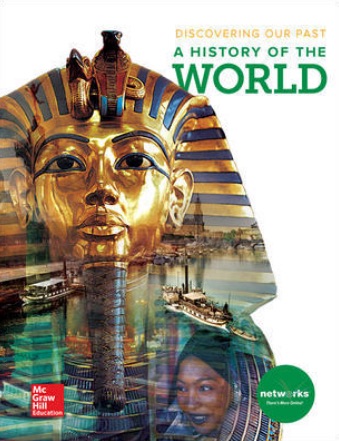
A History of the World: Chapter 18: Civilizations of Korea, Japan, and Southeast Asia
25 words
98 learners
Learn words with Flashcards and other activities
Definition First

Other learning activities
Full list of words from this list:
-
shamanism
an animistic religion of northern Asia having the belief that the mediation between the visible and the spirit worlds is effected by shamansEarly Koreans believed in shamanism. They thought that certain people could communicate with spirits. These people, known as shamans, acted as a connection between humans and spirits.
-
shaman
one acting as a medium between the visible and spirit worldsMany shamans were women. They carried out rituals—songs, dances, and chants—to convince the spirits to help people. Shamans were thought to have the ability to cure illnesses.
-
achievement
the action of accomplishing somethingThe printing of Buddhist sacred texts with wooden blocks was another Silla achievement.
-
tribute
payment by one nation for protection by anotherThe Yi dynasty was forced to surrender. They had to pay tribute to China's Manchu rulers.
-
archipelago
a group of many islands in a large body of waterJapan is an archipelago, or a chain of islands, that runs north to south in the Pacific Ocean.
-
isolated
remote and separate physically or sociallyStill, the seas around Japan kept the Japanese isolated, or separated, from the rest of Asia.
-
animism
the doctrine that all natural objects have soulsThe early Japanese believed that humans, animals, plants, rocks, and rivers all have their own spirits. This idea is known as animism.
-
ensure
make certain ofShinto later became linked to Japan's rulers. Their duties included taking part in Shinto rituals to ensure the well-being of Japan.
-
behalf
as the agent of or on someone's partAbout A.D. 600, a Yamato prince named Shotoku ruled Japan on behalf of his aunt.
-
constitution
law determining the fundamental principles of a governmentHe wanted to give Japan a strong, well-organized government, so Shotoku created a constitution, or a plan of government. Shotoku's constitution stated that the emperor was an all-powerful ruler.
-
samurai
Japanese warrior who was a member of the feudal aristocracyThe nobles gave land to warriors who agreed to fight for them. These warriors became known as samurai. In battle, samurai fought on horseback with swords, daggers, and bows and arrows.
-
shogun
a hereditary military dictator of JapanIn 1192, he gave Yoritomo the title of shogun, or commander of the military forces.
-
vassal
a person who owes allegiance and service to a feudal lordMany samurai became vassals of a daimyo. These samurai gave an oath of loyalty to their daimyo and pledged to serve him in battle. In return, each daimyo gave land to his samurai.
-
feudalism
the social system in which vassals were protected by lordsThis bond of loyalty between a lord and a vassal is known as feudalism. A similar form of feudalism existed in Europe between the fall of the Western Roman Empire and the early modern period.
-
labor
productive work, especially physical work done for wagesFor the most part, Japan's wealth came from the hard labor of its farmers.
-
guild
a formal association of people with similar interestsMore and more artisans and merchants began to live in Kyoto. They set up groups called guilds, or za in Japanese, to protect their jobs and increase their earnings.
-
sect
a subdivision of a larger religious groupBy the time Buddhism reached Japan, it had formed into many different sects, or small groups.
-
martial art
any of several East Asian arts of weaponless self-defenseFollowers of Zen disciplined their bodies through martial arts, or sports that involved combat and self-defense.
-
meditation
contemplation of spiritual mattersZen Buddhists also practiced meditation. A person who meditated sat cross-legged and motionless. The person tried to clear the mind of all worldly thoughts and desires. Meditation was considered a way for people to relax and find inner peace.
-
volcano
a mountain formed by igneous materialSouth and east of the region's mainland are thousands of mountainous islands. Part of a geographical area known for being unstable, these islands hold many active volcanoes. These volcanoes provide rich soil for farming.
-
tsunami
a cataclysm resulting from a destructive sea waveA tsunami is a huge ocean wave caused by an underwater earthquake. Tsunamis usually strike coastal lowlands, killing many people and destroying buildings.
-
network
an interconnected system of things or peopleThey set up a trading network that exchanged goods and ideas among the peoples of Southeast Asia, India, and the Middle East.
-
maritime
relating to ships or navigationStates on the coast became maritime, or seafaring, powers that controlled shipping.
-
style
a mode of expression typical of a person, group, or periodSupported by Khmer kings, architects created a new style of building based on Indian and local designs.
-
institution
a custom that has been an important feature of some groupLike the Thai, the Burmese adopted Buddhism, as well as Indian political institutions and culture.
Created on Thu Jun 17 10:21:21 EDT 2021
(updated Sun Jun 20 14:08:20 EDT 2021)
Sign up now (it’s free!)
Whether you’re a teacher or a learner,
Vocabulary.com can put you or your class
on the path to systematic vocabulary improvement.