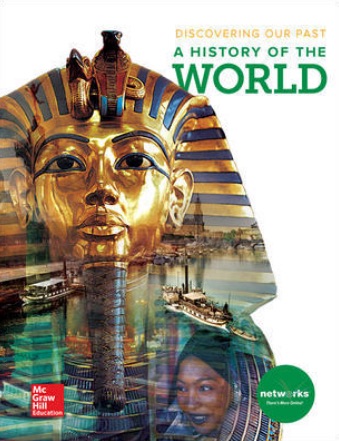
A History of the World: Chapter 2: Studying Geography, Economics, and Citizenship
38 words
228 learners
Learn words with Flashcards and other activities
Definition First

Other learning activities
Full list of words from this list:
-
hemisphere
half of the terrestrial globeIt divides the Earth into "half spheres," or hemispheres. Everything north of the Equator is in the Northern Hemisphere. Everything south of the Equator is in the Southern Hemisphere.
-
latitude
an imaginary line around the Earth parallel to the equatorLines of latitude circle the Earth parallel to the Equator. They measure distance north or south of the Equator in degrees. The Equator is at 0° (zero degrees) latitude, while the North Pole is at latitude 90° N (90 degrees north).
-
longitude
the angular distance from the prime meridian at GreenwichLines of longitude circle the Earth from Pole to Pole. These lines measure distances east or west of the Prime Meridian, which is at 0° longitude.
-
distort
twist and press out of shapeWhen the curves of a globe become straight lines on a map, the size, shape, distance, or area can change. Imagine taking an orange peel and trying to flatten it on a table. You would either have to cut it or distort, or stretch, parts of it.
-
projection
the representation of a figure or solid on a planeUsing mathematics, they have created different types of map projections, or ways of showing the Earth on a flat sheet of paper. Each kind of projection shows the Earth's surface in a slightly different way.
-
theme
a unifying idea that is a recurrent element in literary workThe Five Themes of Geography are (1) location, (2) place, (3) human-environment interaction, (4) movement, and (5) regions.
-
awareness
the state of having knowledge of somethingLocation is a useful starting point. By asking "Where is it?" you begin to develop an awareness of the world around you.
-
symbol
an arbitrary sign with a conventional significanceThe key explains the lines and colors used on a map. It also explains any symbols, or signs and pictures, used on a map.
-
scale
the ratio between the size of a thing and its representationThe map scale is a measuring line that tells you the distances represented on the map.
-
cardinal
serving as an essential componentA map has a symbol called a compass rose that tells you the position of the cardinal directions—north, south, east, and west. Cardinal directions help you explain the relative location of any place on Earth.
-
choropleth map
a map that uses graded differences in shading or color or the placing of symbols inside defined areas on the map in order to indicate the average values of some property or quantity in those areasA choropleth map uses colors to show population density.
-
migration
the movement of persons from one locality to anotherThe movement of people from one place to settle in another place is called migration.
-
culture
all the knowledge and values shared by a societyCulture is the set of beliefs, behaviors, and traits shared by the members of a group.
-
resource
aid or support that may be drawn upon when neededIn order to make goods and offer services, people need resources. There are four major kinds of resources: land, labor, capital, and entrepreneurship.
-
labor
productive work, especially physical work done for wagesLabor is the ability of people to do work.
-
capital
assets available for use in the production of further assetsCapital is money and goods used to help people make or do things.
-
entrepreneur
someone who organizes a business ventureEntrepreneurship is the act of running a business and taking on the risks of that business.
-
technology
the practical application of science to commerce or industryTechnology is using knowledge in a practical way to accomplish a task.
-
supply
offering goods and services for saleSupply is the amount of a good or service that a producer wants to sell. The law of supply says that the higher the price you can charge for a good or service, the more of it you will want to sell.
-
demand
the ability and desire to purchase goods and servicesDemand is the amount of something that a consumer wants to buy. The law of demand says that the lower the price of a good or service, the more of it people will want to buy.
-
scarcity
a small and inadequate amountThere are other factors that affect supply and demand. One is scarcity, or lack of a resource.
-
opportunity cost
the benefits lost by choosing one option over anotherThe opportunity cost of something is what you give up to make it or buy it.
-
economy
the system of production and distribution and consumptionA traditional economy is based on custom. In such an economy, children often do the same work as their parents.
-
individual
a human beingIn a market economy, each person, or individual, makes choices about what to make, sell, and buy.
-
recession
a situation in which the state of the economy declinesWhen the economy grows very slowly or shrinks, it is called a recession.
-
inflation
a general and progressive increase in pricesRising prices are a sign of inflation.
-
expert
a person with special knowledge who performs skillfullyHowever, experts who study economics disagree about what causes inflation.
-
export
a commodity sold to a foreign countryExports are goods shipped out of a country and sold somewhere else.
-
import
commodities bought from a foreign countryImports are the goods and services that a country buys from other countries.
-
barter
exchange goods without involving moneyWhen people barter, goods and services are traded for other goods and services.
-
globalization
growth to a worldwide scaleToday, most of the world's countries take part in some form of international trade. The process is called globalization.
-
representative
related to government in which citizens elect officialsThe United States has a representative government. This means that citizens vote for officials who serve the will of the people. The government must act in the people’s interests and protect their rights.
-
legislative
relating to a lawmaking assemblyThe legislative branch is known as the U.S. Congress. It passes laws for the whole country.
-
executive
having the function of carrying out plans or ordersThe executive branch includes the office of the U.S. president. The president and other members of the executive branch ensure that the nation’s laws are carried out.
-
judicial
decreed by or proceeding from a court of lawThe judicial branch includes the U.S. Supreme Court and various lesser courts. The judges in the judicial branch use the Constitution to interpret laws.
-
seek
try to get or reachAll Americans have the right to seek life, liberty, and happiness.
-
jury
a body of citizens sworn to give a verdict in a court of lawPeople who are accused of a crime have the right to receive a fair trial by a jury of their peers.
-
issue
some situation or event that is thought aboutCitizens should stay informed about important issues, or topics. An awareness of critical issues—such as concern for the global environment—will help them make wise choices when they vote in federal, state, and local elections.
Created on Thu Jun 17 09:48:46 EDT 2021
(updated Tue Jun 22 08:54:51 EDT 2021)
Sign up now (it’s free!)
Whether you’re a teacher or a learner,
Vocabulary.com can put you or your class
on the path to systematic vocabulary improvement.