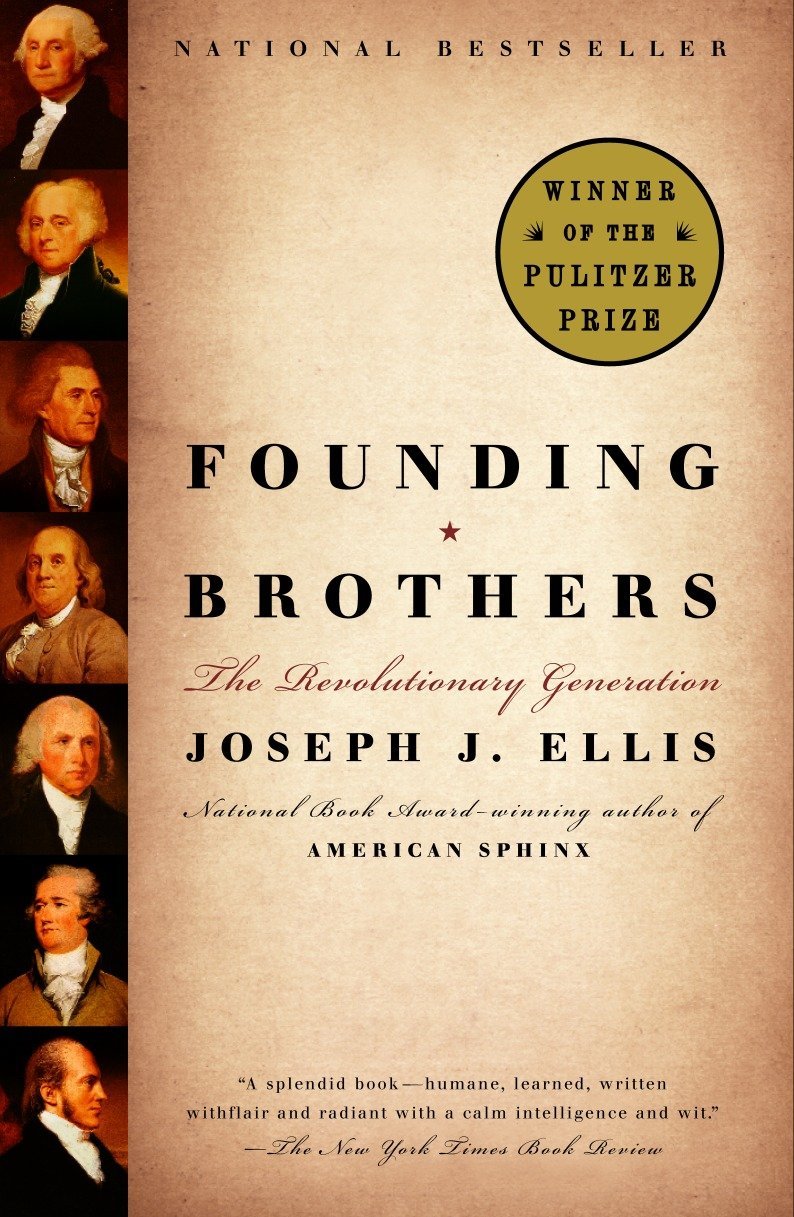
Founding Brothers: Chapter Five
This nonfiction account explores the lives and ideas of six "Founding Fathers" of the United States: George Washington, Alexander Hamilton, Thomas Jefferson, Benjamin Franklin, John Adams, and James Madison.
Here are links to our lists for the book: Preface, Chapter One, Chapter Two, Chapter Three, Chapter Four, Chapter Five, Chapter Six
40 words
43 learners
Learn words with Flashcards and other activities
Definition First

Other learning activities
Full list of words from this list:
-
bicameral
composed of two legislative bodiesHe used his spare time in London to toss off three volumes of political philosophy, entitled Defence of the Constitution of the United States, which emphasized the advantages of a strong executive, a bicameral legislature, and the principle of checks and balances.
-
cul de sac
a street with only one way in or outSubsequent occupants of the vice presidential office have lengthened the list of semihumorous complaints about inhabiting a prestigious political prison (for example, “not worth a bucketful of spit”), but Adams originated the jokes because he was the first prominent American statesman to experience the paradox of being a proverbial heartbeat away from maximum power while languishing in the political version of a cul-de-sac.
-
extraneous
not essentialIt was difficult to think of the ever-combative, highly combustible champion of the American Revolution as extraneous and invisible, but that is what the vice presidency had made him.
-
trappings
ornaments; embellishments to or characteristic signs ofBut when he lectured the Senate on the need for elaborate trappings of authority and proposed that President Washington be addressed as “His Majesty” or “His Highness,” his remarks became the butt of several barbed jokes, including the suggestion that he had been seized by “nobilimania” during his long sojourn in England and might prefer to be addressed as “His Rotundity” or the “Duke of Braintree.”
-
pugilist
someone who fights with fists for sportEver the political pugilist who felt obliged to answer every bell, Adams refused to back away from his belief that the new American government needed a strong executive presence.
-
discourse
an extended communication dealing with some particular topicIn a series of thirty-one essays printed in the Gazette of the United States and subsequently published as Discourses on Davila, he argued that all stable governments required what he called a “monarchical principle,” meaning a singular figure empowered to embody the will of the nation and to protect the ordinary citizenry from the inevitable accumulation of power by the more wealthy and wellborn.
-
jocular
characterized by jokes and good humor“I know not what your idea is of the best form of government. You and I never had a serious conversation together that I can recollect concerning the nature of government. The very transient hints that have passed between us have been jocular and superficial, without ever coming to any explanation.”
-
obstinate
refusing to change one's mind or ways; difficult to convinceBut his want of candor, his obstinate prejudices against all forms of government power, his real partiality in spite of all his pretensions...have so nearly reconciled me to it that I will not weep....
-
sequester
keep away from othersHis letters to Madison also featured the Monticellan Jefferson, the statesman-turned-farmer sequestered in “my remote canton.”
-
polemicist
a writer who argues in opposition to othersOn the other side, Federalist editors and polemicists, encountering this mounting campaign on Jefferson’s behalf, began to generate anti-Jefferson propaganda: He had suffered humiliation as governor of Virginia when he fled before British troops; he was an inveterate Francophile; he was an intellectual dreamer, “more fit to be a professor in a College, President of a Philosophical Society...but certainly not the first magistrate of a great nation.”
-
sanguine
confidently optimistic and cheerfulAbigail heard him out about the doomed course of the French Revolution but was somewhat more sanguine: “I ruminate upon France as I lie awake many hours before light,” she wrote. “My present thought is that their virtuous army will give them a government in time in spite of all their conventions but of what nature it will be, it is hard to say.”
-
carp
raise trivial objectionsWhen Adams offered a harsh appraisal of Washington’s lack of formal education and knowledge of the classics, Abigail chided him: Washington was the only man apart from her husband capable of detachment and ought not be carped at behind his back.
-
farce
a comedy characterized by broad satireLike Jefferson—indeed, like any self-respecting statesman of the era, save perhaps Burr—Adams had no intention of campaigning for the office. (Burr did, and acted on it.) “I am determined to be a silent spectator of the silly and wicked game,” Adams explained to Abigail, “and to enjoy it as a comedy, a farce, or as a gymnastic exhibition at Sadler’s Wells.”
-
obloquy
abusive, malicious, and condemnatory languageYes, the presidency was a thankless job, “a most unpleasant seat, full of thorns, briars, thistles, murmuring, fault-finding, calumny, obloquy.”
-
facade
a showy misrepresentation to conceal something unpleasantThis was not a mere facade, but it was only the top layer of Jefferson's thinking. A level below the surface, he, much like Adams, was preoccupied with the long shadow of George Washington.
-
perfidy
an act of deliberate betrayalIn the present situation of the United States, divided as they are between two parties, which mutually accuse each other of perfidy and treason...this exalted station [the presidency] is surrounded with dangerous rocks, and the most eminent abilities will not be sufficient to steer clear of them all.
-
stilted
artificially formal or stiffAdams would have been overjoyed to receive such a message—given the stilted language of their most recent and rather contrived correspondence, it seemed to meet him more than halfway—but the letter was never sent.
-
rectitude
righteousness as a consequence of being honorable and honest“The deviation from that line of politics on which we had been united has not made me less sensible of the rectitude of his heart: and I wished him to know this.”
-
truism
an obvious statement of factThe Adams presidency, in fact, might be the classic example of the historical truism that inherited circumstances define the parameters within which presidential leadership takes shape, that history shapes presidents, rather than vice versa.
-
privateer
a ship commissioned to prey on other shipsOn the one hand, the country was already waging an undeclared war against French privateers in the Atlantic and Caribbean.
-
loath
unwilling to do something contrary to your customMuch like Jefferson, Adams regarded the impasse as a breakdown of mutual trust: “You can witness for me,” he wrote to John Quincy concerning Jefferson's opposition, “how loath I have been to give him up. It is with much reluctance that I am obliged to look upon him as a man whose mind is warped by prejudice...."
-
doctrinaire
stubbornly insistent on theory rather than practicalityHis vice president was in fact the leader of the opposition party; his cabinet was loyal to the memory of Washington, which several members regarded as embodied now in the person of Alexander Hamilton, who was officially retired from the government altogether; political parties were congealing into doctrinaire ideological camps...
-
indomitable
impossible to subdueIt was a recipe for political chaos that even the indomitable Washington would have been hard-pressed to control.
-
gadfly
a persistently annoying personGerry was a kind of New England version of Benjamin Rush, a lovable gadfly with close personal ties to the Adams family but with ideological convictions that floated in unpredictable patterns over the entire political landscape.
-
machination
a crafty and involved plot to achieve your endsNevertheless, she followed the highly partisan exchanges in the Republican newspapers and provided her husband with regular reports on the machinations and accusations of the opposition.
-
disenfranchise
deprive of voting rightsThese infamous statutes, unquestionably the biggest blunder of his presidency, were designed to deport or disenfranchise foreign-born residents, mostly Frenchmen, who were disposed to support the Republican party, and to make it a crime to publish “any false, scandalous, and malicious writing or writings against the Government of the United States.”
-
specious
deceptively pleasingGallatin, she observed, “that specious, subtle, spare Cassius, that imported foreigner,” was guilty of treasonable behavior by delivering speeches or introducing amendments “that obstruct their cause and prevent their reaching their goals.”
-
enclave
an enclosed territory that is culturally distinctAbigail herself reported that all the bedrock Federalist enclaves of New England were taken by surprise: “the whole community were like a flock of frightened pigions; nobody had their story ready.”
-
invective
abusive language used to express blame or censureIn the immediate context of the party wars then raging, however, Adams’s unilateral action was politically suicidal: “He has sustained the whole force of an unpopular measure,” Abigail observed, “which he knew would...shower down upon his head a torrent of invective. As he expected, he has been abused and calumniated by his enemies, that was to be looked for—but in the house of his friends, they have joined loudest in the clamor.”
-
vacillate
be undecided about somethingThree overlapping reasons appear to have converged in Adams’s mind and provided decisive direction to a foreign policy that, until then, had been vacillating between the incompatible agendas of the Federalists and the Republicans.
-
aide-de-camp
an officer who acts as an assistant to a more senior officerHamilton intended to make the New Army his personal instrument of power. It was a foregone conclusion that Washington would be called out of retirement to head the force, but equally predictable that the aging general would delegate actual command to his former aide-de-camp.
-
iconoclastic
characterized by attack on established beliefsIt was all part of the Adams pattern, an iconoclastic and contrarian temperament that relished alienation.
-
predilection
a predisposition in favor of something(John Quincy and then great-grandson Henry Adams exhibited the same pattern over the next century, suggesting that the predilections resided in the bloodstream.)
-
overture
a tentative suggestion to elicit the reactions of othersOnce they decided to reject Adams’s overture and set themselves up as the leaders of the Republican opposition, they closed ranks around their own heartfelt convictions and interpreted the several crises confronting him as opportunities to undermine the Federalist party, which they sincerely regarded as an organized conspiracy against the true meaning of the American Revolution.
-
hoary
having gray or white hair as with ageIn The Prospect Before Us, Callender delivered the goods, describing Adams as “a hoary headed incendiary” who was equally determined on war with France and on declaring himself president for life, with John Quincy lurking in the background as his successor.
-
diatribe
thunderous verbal attackWhen confronted with the charge that, despite his position as vice president, he had paid Callender to write diatribes against the president, Jefferson claimed to know nothing about it.
-
flagrant
conspicuously and outrageously bad or reprehensibleThere are only a few universal laws of political life, but one of them guided the Republicans during the last year of the Adams presidency—namely, never interfere when your enemies are busily engaged in flagrant acts of self-destruction.
-
ribald
humorously vulgarIn New Jersey, for example, when a drunken Republican editor was charged with making a ribald reference to the president’s posterior, the jury returned a not guilty verdict on the grounds that truth was a legitimate defense.
-
fray
a noisy fightNo leader could credibly claim to be above the fray.
-
anachronism
an artifact that belongs to another timeIf the very idea of virtue was no longer an ideal in American politics, then there was no place for him in public life. If the Adams brand of statesmanship was now an anachronism—and it was—then the Adams presidency would serve as a fitting monument to its passing.
Created on Tue Nov 17 14:53:26 EST 2020
(updated Tue Dec 01 10:35:28 EST 2020)
Sign up now (it’s free!)
Whether you’re a teacher or a learner,
Vocabulary.com can put you or your class
on the path to systematic vocabulary improvement.