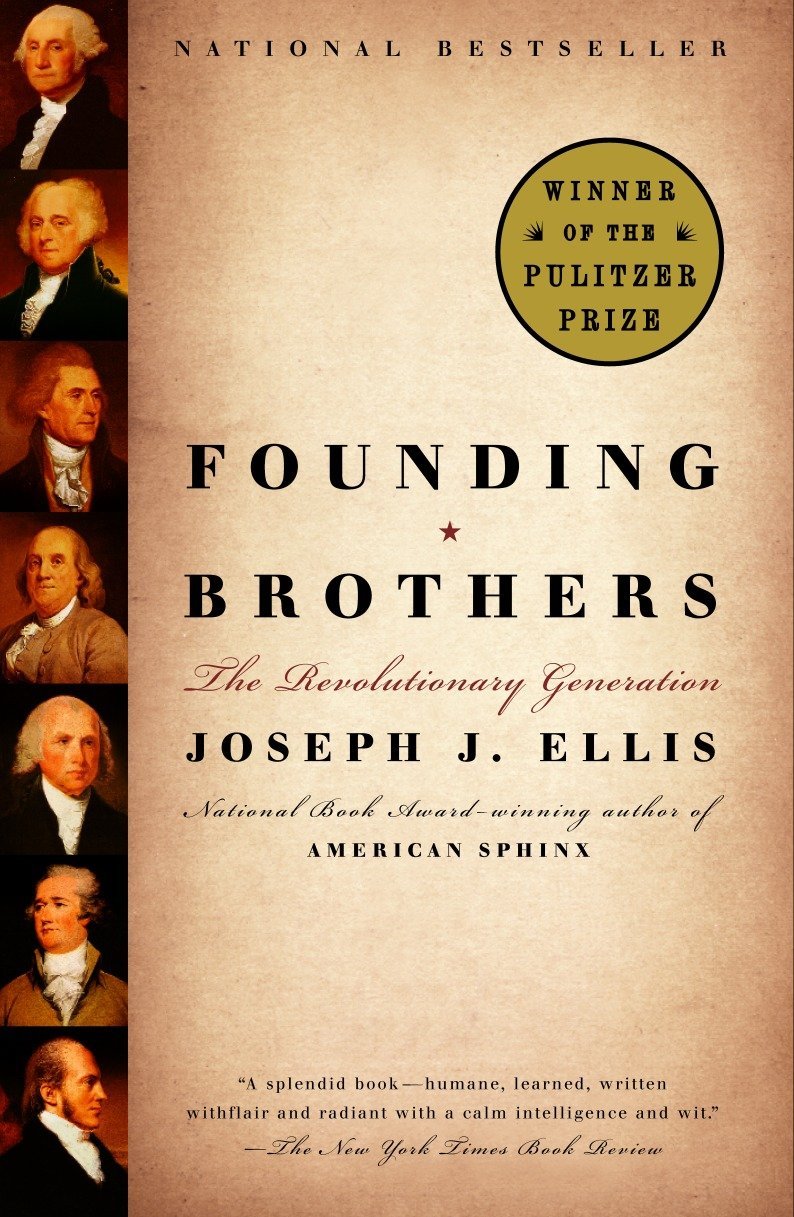
Founding Brothers: Chapter Four
This nonfiction account explores the lives and ideas of six "Founding Fathers" of the United States: George Washington, Alexander Hamilton, Thomas Jefferson, Benjamin Franklin, John Adams, and James Madison.
Here are links to our lists for the book: Preface, Chapter One, Chapter Two, Chapter Three, Chapter Four, Chapter Five, Chapter Six
40 words
41 learners
Learn words with Flashcards and other activities
Definition First

Other learning activities
Full list of words from this list:
-
delineate
determine the essential quality ofBy the time he assumed the presidency in 1789—no other candidate was even thinkable—the mythology surrounding Washington’s reputation had grown like ivy over a statue, effectively covering the man with an aura of omnipotence, rendering the distinction between his human qualities and his heroic achievements impossible to delineate.
-
bequeath
leave or give, especially by will after one's deathThe only serious contender for primacy was Benjamin Franklin, but just before his death in 1790, Franklin himself acknowledged Washington’s supremacy. In a characteristically Franklinesque gesture, he bequeathed to Washington his crab-tree walking stick, presumably to assist the general in his stroll toward immortality.
-
linchpin
a central cohesive source of support and stabilityHis commanding presence had been the central feature in every major event of the revolutionary era: the linchpin of the Continental Army throughout eight long years of desperate fighting from 1775 to 1783; the presiding officer at the Constitutional Convention in 1787; the first and only chief executive of the fledgling federal government since 1789.
-
platitude
a trite or obvious remarkOver a longer stretch of time, the Farewell Address achieved transcendental status, ranking alongside the Declaration of Independence and the Gettysburg Address as a seminal statement of America's abiding principles. Its Olympian tone made it a perennial touchstone at those political occasions requiring platitudinous wisdom.
-
statecraft
wisdom in the management of public affairsMeanwhile, several generations of historians, led by students of American diplomacy, have made the interpretation of the Farewell Address into a cottage industry of its own, building up a veritable mountain of commentary around its implications for an isolationist foreign policy and a bipartisan brand of American statecraft.
-
valedictory
of or relating to an occasion or expression of farewellIn February of 1796, Washington had first approached Alexander Hamilton about drafting some kind of valedictory statement.
-
tribulation
an annoying or frustrating or catastrophic eventLamentations about the tribulations of public life, followed by celebrations of the bucolic splendor of retirement to rural solitude, had become a familiar, even formulaic, posture within the leadership class of the revolutionary generation, especially within the Virginia dynasty.
-
deportment
the way a person behaves toward other people“He has so much martial dignity in his deportment," observed Benjamin Rush, “that there is not a king in Europe but would look like a valet de chambre by his side.”
-
taciturnity
the trait of being uncommunicativeAdams said that Washington had “the gift of taciturnity," meaning he had an instinct for the eloquent silence.
-
apostate
a disloyal person who betrays or deserts his causeIn the wake of his Farewell Address, for example, an open letter appeared in Benjamin Franklin Bache's Aurora, in which the old firebrand Tom Paine celebrated Washington’s departure, actually prayed for his imminent death, then predicted that “the world will be puzzled to decide whether you are an apostate or an impostor, whether you have abandoned good principles, or whether you ever had any.”
-
sot
a chronic drinkerThe rebuttals to Paine’s open letter, for example, appeared immediately, describing Paine as “that noted sot and infidel," whose efforts to despoil Washington’s reputation “resembled the futile efforts of a reptile infusing its venom into the Atlantic or ejecting its filthy saliva towards the Sun.”
-
compunction
a feeling of deep regret, usually for some misdeedHe had no compunction about driving around Philadelphia in an ornate carriage drawn by six cream-colored horses; or, when on horseback, riding a white stallion with a leopard cloth and gold-trimmed saddle; or accepting laurel crowns at public celebrations that resembled coronations.
-
inveterate
habitualAt the very core of the revolutionary legacy, however, was a virulent hatred of monarchy and an inveterate suspicion of any consolidated version of political authority.
-
tenet
a basic principle or belief that is accepted as trueA major tenet of the American Revolution—Jefferson had given it lyrical expression in the Declaration of Independence—was that all kings, and not just George III, were inherently evil.
-
treatise
a formal text that treats a particular topic systematicallyWashington was not claiming to offer novel prescriptions based on his original reading of philosophical treatises or books; quite the opposite, he was reminding his countrymen of the venerable principles he had acquired from personal experience, principles so obvious and elemental that they were at risk of being overlooked by his contemporaries; and so thoroughly grounded in the American Revolution that they are virtually invisible to a more distant posterity.
-
restive
impatient especially under restriction or delayBack then, faced with a restive and unpaid remnant of the victorious army quartered in Newburgh, New York, he had suddenly appeared at a meeting of officers who were contemplating insurrection; the murky plot involved marching on the Congress and then seizing a tract of land for themselves in the West, all presumably with Washington as their leader.
-
auspicious
indicating favorable circumstances and good luck“At this auspicious period,” he wrote, “the United States came into existence as a Nation, and if their Citizens should not be completely free and happy, the fault will be intirely their own.”
-
corollary
something that follows or accompanies naturallyIn Washington’s case, the most obvious corollary to his view of American national interest was the avoidance of a major war during the gestative phase of national development.
-
embroil
force into some kind of situation or course of actionEvery true friend to this Country must see and feel that the policy of it is not to embroil ourselves with any nation whatsoever; but to avoid their disputes and politics; and if they will harass one another, to avail ourselves of the neutral conduct we have adopted.
-
precocious
appearing or developing earlyIn a sense, it was a precocious preview of the Monroe Doctrine (1823), for it linked American security and economic development to the British fleet, which provided a protective shield of incalculable value throughout the nineteenth century.
-
entrails
internal organs collectivelyLike Voltaire, Jefferson longed for the day when the last king would be strangled with the entrails of the last priest.
-
foreboding
a feeling of evil to comeShortly after his return to the United States in 1790, Jefferson began to harbor the foreboding sense that the American Revolution, as he understood it, had been captured by alien forces.
-
excise
a fee measured by the amount of business doneThe catalyst for the change was the Whiskey Rebellion, a popular insurgency in four counties of western Pennsylvania protesting an excise tax on whiskey.
-
discrete
constituting a separate entity or partWhereas Washington regarded the national interest as a discrete product of political and economic circumstances shaping the policies of each nation-state at a specific moment in history, Jefferson envisioned a much larger global pattern of ideological conflict in which all nations were aligned for or against the principles that America had announced to the world in 1776.
-
dichotomy
a classification into two opposed parts or subclassesThe same moralistic dichotomy that Jefferson saw inside the United States between discernible heroes and villains, he also projected into the international arena.
-
careen
move sideways or in an unsteady wayHe acknowledged that the random violence and careening course of the French Revolution were lamentable developments, but he insisted they were merely a passing chapter in the larger story of triumphant global revolution.
-
deluge
fill or cover completely, usually with water"I am convinced they [the French] will triumph completely,” he wrote in 1794, "& the consequent disgrace of the invading tyrants is destined, in the order of events, to kindle the wrath of the people of Europe against those who have dared to embroil them in such wickedness, and to bring at length, kings, nobles & priests to the scaffolds which they have been so long deluging with blood.”
-
tenor
the general meaning or substance of an utteranceAlthough Randolph was almost certainly innocent of this charge, the whole tenor and tone of Fauchet's account revealed Randolph confiding his personal opposition to the entire domestic and foreign policy of the Washington administration, lamenting the ascendance of a “financiering class” that aimed at the restitution of monarchy...
-
approbation
official acceptance or agreement“It has been my object to render this act importantly and lastingly useful,” he confided to Washington, "and avoid all just cause of present exception, to embrace such reflections and sentiments as will wear well, progress in approbation with time & redound to future reputation.”
-
redound
have an effect for good or ill“It has been my object to render this act importantly and lastingly useful,” he confided to Washington, "and avoid all just cause of present exception, to embrace such reflections and sentiments as will wear well, progress in approbation with time & redound to future reputation.”
-
inculcate
teach and impress by frequent repetitions or admonitionsOn July 30, he sent the fruits of his labors to Washington, who found the Hamilton draft “exceedingly just, & just such as ought to be inculcated.”
-
cogent
powerfully persuasiveWhat was Hamilton’s contribution? Chiefly to assure that the elaboration of Washington's ideas occurred within a rhetorical framework that maintained a stately and dignified tone throughout, and to sustain a palpable cogency and sense of proportion in developing Washington’s argument, which itself embodied the self-assurance so central to his major theme about the nation itself.
-
ruminate
reflect deeply on a subject...It may skew indeed my sense of its importance, and that it is a sufficient inducement with me to bring the matter before the public in some shape or another, at the closing Scenes of my political exit...to set the People ruminating on the importance of the measure.
-
imbibe
receive into the mind and retain“In the general Juvenal period of life, when friendships are formed, & habits established that will stick by one,” he explained, “the Youth, or young men from different parts of the United States would be assembled together, & would by degrees discover that there was not just cause for those jealousies & prejudices which one part of the Union had imbibed against another part...."
-
exhort
urge or force in an indicated directionThroughout the Farewell Address Washington had been exhorting Americans to think of themselves as a collective unit with a common destiny.
-
subsume
contain or includeThis brought women and children into the picture, not as full-blooded citizens, to be sure, but as part of the American people whose political identity was subsumed within the family and conveyed by the male heads of household.
-
plaintively
in a manner expressing sorrowAs he prepared for his own retirement, in effect he was encouraging the Indian tribes to retire from their way of life as Indians: “What I have recommended to you,” he wrote somewhat plaintively, “I am myself going to do. After a few moons are passed I shall leave the great town and retire to my farm. There I shall attend to the means of increasing my cattle, sheep and other useful animals.”
-
calumny
an abusive attack on a person's character or good name“This man has a celebrity in a certain way,” Washington remarked concerning Bache, “for his calumnies are to be exceeded only by his impudence, and both stand unrivaled.”
-
rejoinder
a quick reply to a question or remarkOne of his last acts as president was to place on file in the State Department his rejoinder to Bache's accusations, which historians have long since discovered were based on forged English documents.
-
vicissitude
a variation in circumstances or fortune"Clouds may and doubtless often will in the vicissitudes of events, hover over our political concerns,” he announced, “but a steady adherence to these principles will not only dispel but render our prospects the brighter by such temporary obscurities.”
Created on Tue Nov 17 14:53:03 EST 2020
(updated Tue Dec 01 10:32:48 EST 2020)
Sign up now (it’s free!)
Whether you’re a teacher or a learner,
Vocabulary.com can put you or your class
on the path to systematic vocabulary improvement.