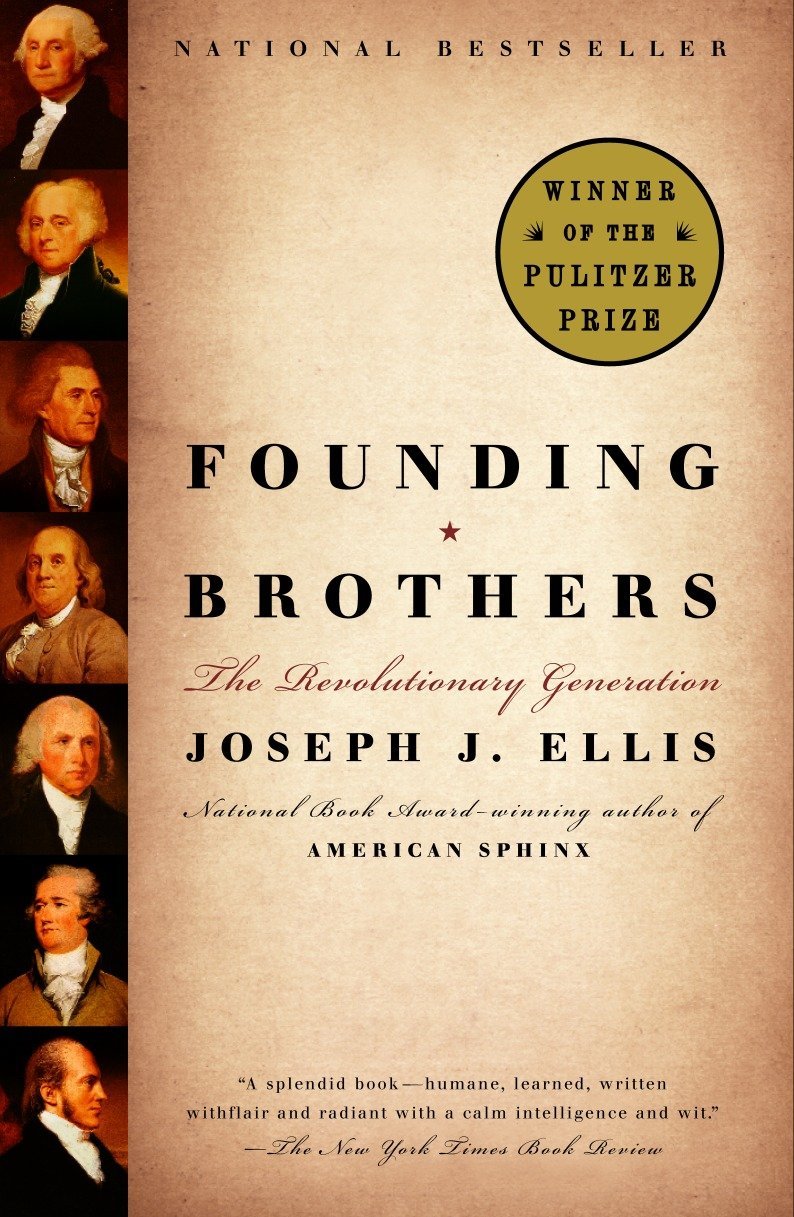
Founding Brothers: Chapter One
This nonfiction account explores the lives and ideas of six "Founding Fathers" of the United States: George Washington, Alexander Hamilton, Thomas Jefferson, Benjamin Franklin, John Adams, and James Madison.
Here are links to our lists for the book: Preface, Chapter One, Chapter Two, Chapter Three, Chapter Four, Chapter Five, Chapter Six
40 words
75 learners
Learn words with Flashcards and other activities
Definition First

Other learning activities
Full list of words from this list:
-
maxim
a saying that is widely accepted on its own meritsAlthough he slept that night on his couch and in his clothes, the vice president of the United States was a lifelong disciple of Lord Chesterfield’s maxim that a gentleman was free to do anything he pleased as long as he did it with style.
-
depraved
deviating from what is considered moral or right or properHis grandfather, the great theologian Jonathan Edwards, had once said that we were all depraved creatures, mere spiders hanging precariously over a never-ending fire.
-
sagacious
acutely insightful and wiseBut Burr’s entire life had been a sermon on the capacity of the sagacious spider to lift himself out of hellish difficulties and spin webs that trapped others.
-
protege
a person who receives support from an influential patronNo one can be sure what was in Burr’s mind as a single oarsman rowed him and William Van Ness, his devoted disciple and protégé, toward the New Jersey Palisades on the other side, but the judgment of posterity would be that Burr had finally trapped Hamilton in his diabolical web, and he was now moving in for the kill.
-
diffidence
lack of self-assuranceLike Burr, Hamilton was properly attired and also carried himself with a similar air of gentlemanly diffidence.
-
parapet
fortification consisting of a low wallWhether he was leading an infantry assault against an entrenched British strong point at Yorktown—first over the parapet in a desperate bayonet charge—or imposing his own visionary fiscal program for the new nation on a reluctant federal government, Hamilton tended to regard worldly problems as personal challenges, and therefore as fixed objects against which he could perform his own isometric exercises, which usually took the form of ostentatious acts of gallantry.
-
consign
commit foreverSo there you have it: Hamilton safely buried and assuming legendary proportions as a martyr; Burr slipping out of town, eventually headed toward bizarre adventures in the American West, but already consigned to political oblivion.
-
wherewithal
the necessary means (especially financial means)But Pendleton’s attention had been fixed on his own chief and he apparently had lacked the wherewithal to say anything in this drawn-out moment of the drama.
-
culmination
a concluding actionThe somewhat longer answer is that the exchange of words that preceded the exchange of shots was itself merely a culmination of long-standing personal animosity and political disagreement that emerged naturally, in retrospect almost inevitably, out of the supercharged political culture of the early republic.
-
harangue
a loud bombastic declamation expressed with strong emotionOn June 18, 1804, he called Hamilton’s attention to a letter published almost two months earlier in the Albany Register in which the author, Dr. Charles Cooper, recalled a harangue Hamilton had delivered against Burr the preceding February.
-
insinuation
an indirect (and usually malicious) implicationTherefore, all Hamilton had to do at this propitious moment was deny having said anything that could possibly fit that description, then express his personal regret that such slanderous insinuations had been attributed to him in the press.
-
impropriety
the condition of being unsuitable or offensiveHe could not, he explained, “without manifest impropriety, make the avowal or disavowal you seem to think necessary.”
-
vagary
an unexpected and inexplicable change in somethingAfter delivering a brief lecture on the vagaries of grammar and syntax, calculated to irritate Burr, Hamilton went on the offensive.
-
gratuitous
unnecessary and unwarrantedNot only did he miss the opportunity to disown the offensive characterization of Burr, he raised the rhetorical stakes with his dismissive tone and gratuitously defiant counterthreat.
-
incisive
demonstrating ability to recognize or draw fine distinctionsBurr’s response was incisively curt: “having Considered it attentively,” he wrote, “I regret to find in it nothing of that sincerity and delicacy which you profess to Value.”
-
ingenuous
characterized by an inability to mask your feelingsThen he raised the verbal game to yet a higher level of insult: “I relied with unsuspecting faith that from the frankness of a Soldier and the Candor of a gentleman I might expect an ingenuous declaration.”
-
duplicitous
marked by deliberate deceptivenessBut such expectations were obviously too much for such a duplicitous character as Hamilton, who lacked “the Spirit to Maintain or the Magnanimity to retract” his own words.
-
magnanimity
nobility and generosity of spiritBut such expectations were obviously too much for such a duplicitous character as Hamilton, who lacked “the Spirit to Maintain or the Magnanimity to retract” his own words.
-
indiscretion
a petty misdeedTwo years earlier, in fact, Burr had claimed to have confronted Hamilton with a personal complaint about incessant vilifications of his character, and Hamilton had acknowledged his indiscretion. Despite the apology and apparent promise to stop, Hamilton had then resumed his back-stabbing campaign.
-
concession
the act of yieldingStrictly speaking, Hamilton’s concession should have been the end of it.
-
traduce
speak unfavorably aboutBut Burr did not budge, repeating his accusation that “secret whispers traducing his fame and impeaching his honor” over more than a decade demanded an unqualified apology, and that Hamilton’s insistence on distinctions and qualifications “are proofs that he has done the injury specified.”
-
redress
act of correcting an error or a fault or an evilOn June 27, 1804, Burr’s patience ran out: “The length to which this correspondence has extended only tending to prove that the satisfactory redress...cannot be obtained,” Van Ness explained, “he deems it useless to offer any proposition except the simple Message which I shall now have the honor to deliver.”
-
wont
an established customBurr contrary to his wont, was silent, gloomy, sour; while Hamilton entered with glee into the gaiety of a convivial party, and even sung an old military song.
-
convivial
occupied with or fond of the pleasures of good companyBurr contrary to his wont, was silent, gloomy, sour; while Hamilton entered with glee into the gaiety of a convivial party, and even sung an old military song.
-
animadversion
harsh criticism or disapproval“There were intrinsick difficulties in the thing,” Hamilton explained in his statement, rooted in the reality “not to be denied, that my animadversions on the political principles, character and views of Col Burr” had been extremely severe, “to include very unfavourable criticisms on particular instances of the private conduct of the Gentleman.”
-
vilify
spread negative information aboutIn other words, Burr’s allegation that Hamilton had made a practice of vilifying him for many years was essentially correct.
-
censure
rebuke formallyWhat ultimately blocked any prospect of an apology or retraction was Hamilton’s abiding conviction that his libels of Burr were all true: “I have not censured him on light grounds,” Hamilton concluded, “or from unworthy inducements. I certainly have had strong reasons for what I may have said.”
-
tantamount
being essentially equal to somethingIn other words, if he did not answer Burr’s challenge, he would be repudiating his well-known convictions, and in so doing, he would lose the respect of those political colleagues on whom his reputation depended. This would be tantamount to retiring from public life.
-
facile
performing adroitly and without effortBurr’s facile shift in his allegiance, the first in what would be several similarly agile switches during his career, captured Hamilton’s attention and produced his first recorded anti-Burr remarks, questioning Burr’s lack of political principle.
-
incumbent
the official who holds an officeIn 1791 Burr defeated Philip Schuyler, Hamilton’s wealthy father-in-law, in the race for the United States Senate, when several rival factions within the clannish, even quasi-feudal, politics of New York united to unseat the incumbent, who was generally perceived as a Hamilton supporter.
-
gubernatorial
relating to the head of a state governmentBurr used his perch in the Senate to oppose Hamilton's fiscal program, then to decide a disputed (and probably rigged) gubernatorial election in New York against Hamilton’s candidate.
-
titular
of or bearing an appellation signifying status or functionThis made logical as well as political sense, since Jefferson was the titular leader of the Republican opposition and Adams was the leader of the moderate wing of the Federalists, a group that found Hamilton’s policies sometimes excessive and his flamboyant style always offensive.
-
salvo
an outburst resembling the discharge of firearmsThe full and better-recorded salvo came late in 1800 and early in 1801, during the debate in the House of Representatives over the presidential deadlock between Burr and Jefferson.
-
implacable
incapable of being appeased or pacifiedSince everyone knew that Jefferson was Hamilton’s implacable political enemy, the kind of elusive target who seemed to be put on earth by God to subvert Hamilton’s visionary plans for a powerful federal government, Hamilton’s strong endorsement of Jefferson as “by far not so dangerous a man,” who possessed “solid pretensions to character,” only served to underline his contempt for Burr.
-
licentious
lacking moral disciplineBy accusing Burr of being Catiline, Hamilton was making the ultimate accusation, for Catiline was the treacherous and degenerate character whose scheming nearly destroyed the Roman Republic and whose licentious ways inspired, by their very profligacy, Cicero’s eloquent oration on virtue, which was subsequently memorized by generations of American schoolboys.
-
profligacy
dissolute indulgence in sensual pleasureBy accusing Burr of being Catiline, Hamilton was making the ultimate accusation, for Catiline was the treacherous and degenerate character whose scheming nearly destroyed the Roman Republic and whose licentious ways inspired, by their very profligacy, Cicero’s eloquent oration on virtue, which was subsequently memorized by generations of American schoolboys.
-
aberration
a state or condition markedly different from the normAs if to demonstrate that his questionable behavior in the presidential crisis of 1801 was no aberration, Burr repeated the pattern in 1804 during the campaign for governor of New York.
-
apprise
inform somebody of somethingWhen apprised that the leading New England Federalists were waiting to hear that their old chief was committed to the secessionist plot, Hamilton made clear his opposition: “Tell them from ME, at MY request, for God’s sake, to cease these conversations and threatenings about a separation of the Union. It must hang together as long as it can be made to.”
-
moribund
being on the point of deathThe last letter that Hamilton ever wrote, composed the night before the duel, was devoted to squelching the still-lingering Federalist fantasies of a separate northeastern confederation, a dream that refused to die until the moribund effort at the Hartford Convention in 1815 exposed it as a fiasco.
-
putative
purportedThe problem with Hamilton’s distinction, however, was that the putative barrier between personal and political criticism, or private and public behavior, kept getting overwhelmed by real choices.
Created on Tue Nov 17 14:51:15 EST 2020
(updated Tue Dec 01 10:29:42 EST 2020)
Sign up now (it’s free!)
Whether you’re a teacher or a learner,
Vocabulary.com can put you or your class
on the path to systematic vocabulary improvement.