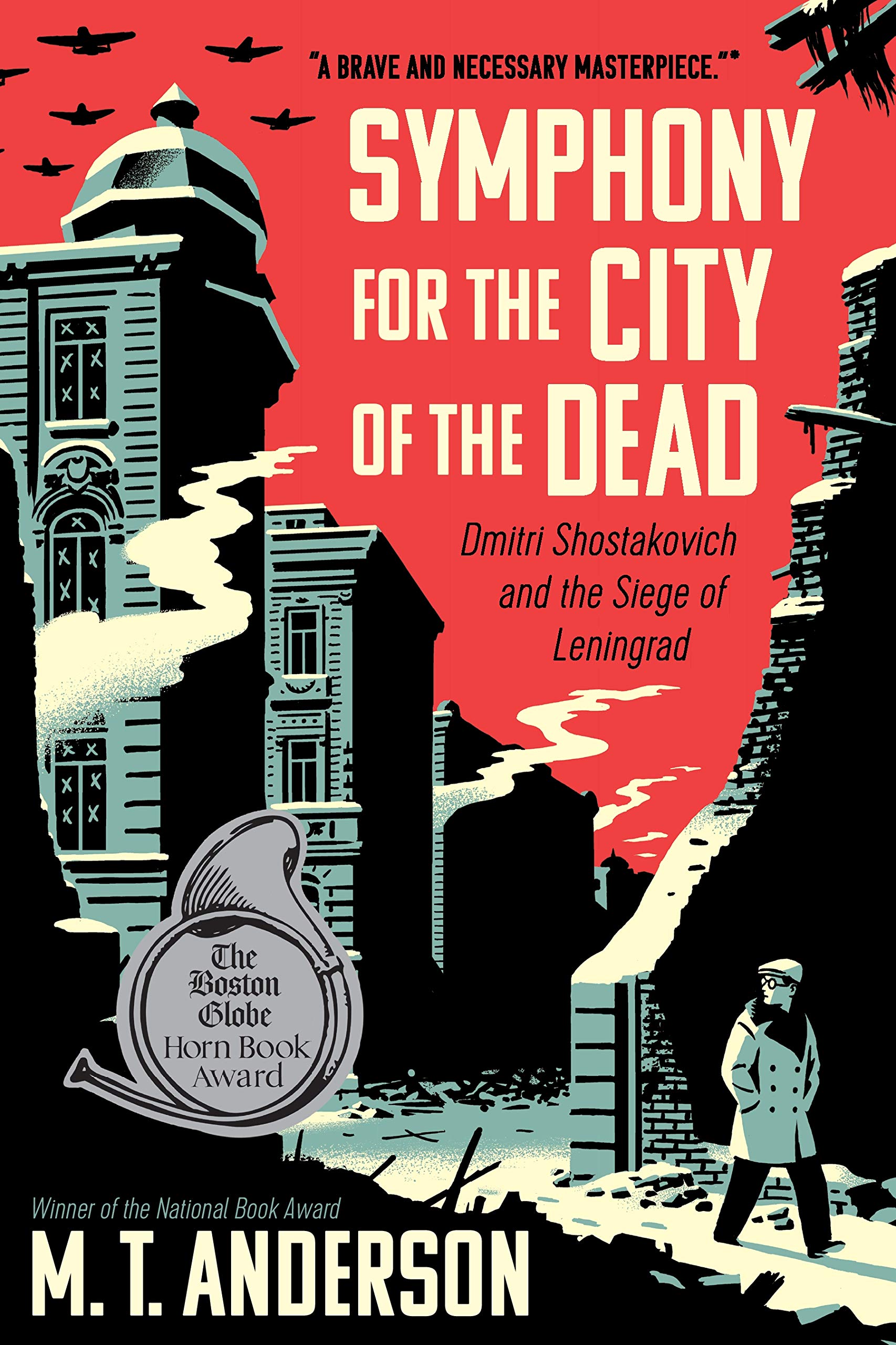
Symphony for the City of the Dead: Part Three
In 1941, composer Dmitri Shostakovich wrote a symphony in response to the relentless Siege of Leningrad. M.T. Anderson explores both the siege and Shostakovich's work in this award-winning nonfiction account.
Here are links to our lists for the book: Prologue–Part One, Part Two, Part Three
40 words
60 learners
Learn words with Flashcards and other activities
Definition First

Other learning activities
Full list of words from this list:
-
cadence
a recurrent rhythmical seriesHistory does not allow for perfect cadences.
-
flotilla
a fleet of small craftA flotilla of warships, freighters, and barges carried hundreds of tons of supplies to the city across Lake Ladoga.
-
unremitting
uninterrupted in time and indefinitely long continuingIt is a powerfully distressed piece, unremitting in its depiction of war.
-
compliance
a disposition or tendency to yield to the will of othersHe was a mixture of defiance and compliance. “He was only a man,” conductor Kurt Sanderling said. “He was a coward when it concerned his own affairs, but he was very courageous when it concerned others.”
-
nostalgic
unhappy about being away and longing for familiar thingsFor the NKVD, Shostakovich wrote a suite of nostalgic, light music called “Native Leningrad,” remembering his hometown.
-
destitute
poor enough to need help from othersShostakovich did use his new connections with authority to help composers who were destitute, in exile, or on the front.
-
chafe
tear or wear off the skin or make sore by abradingYoung Weinberg took his little sister and ran. Unfortunately, his sister complained that day that her shoes chafed.
-
vestige
an indication that something has been presentOn January 14, 1944, the last vestige of German Army Group North was finally forced away from Leningrad.
-
roseate
of something having a dusty purplish pink color“To the last crack in its walls, the city was revealed to us—shell-pitted, bullet-riddled, scarred Leningrad, with its plywood windowpanes. And we saw that despite all the cruel slashes and blows, Leningrad retained its proud beauty. In the bluish, roseate, green and white of the lights, the city appeared to us so austere and touching we could not feast our eyes enough on it.”
-
austere
severely simple“To the last crack in its walls, the city was revealed to us—shell-pitted, bullet-riddled, scarred Leningrad, with its plywood windowpanes. And we saw that despite all the cruel slashes and blows, Leningrad retained its proud beauty. In the bluish, roseate, green and white of the lights, the city appeared to us so austere and touching we could not feast our eyes enough on it.”
-
masonry
structure built of stone or brickThe survivors lived, as another woman wrote, “without electric light or gas, without water....We are living like ghosts in a field of ruins...a city where nothing works apart from the telephones that sometimes ring, glumly and pointlessly, beneath piles of fallen masonry.”
-
desecrate
violate the sacred character of a place or languageThe Nazis left nothing but a blasted shell. They had stolen the statuary, blasted through the floors, delighted in desecrating Russia’s proud history.
-
fanaticism
excessive intolerance of opposing viewsHis fanaticism worked well for him early in the war, surprising and shocking the world as he conquered nation after nation.
-
delusional
suffering from or characterized by erroneous beliefsThe same delusional self-confidence, however, encouraged him to overextend his Wehrmacht forces, picking a fight on his Eastern Front, in Russia, while he still was fighting the British in the west. His military leaders warned him of the stupidity and risk of this move, but increasingly, he did not listen.
-
disdain
reject with contemptHe ignored the intelligence of spies. He disdained the warnings of the capitalist Allies.
-
fodder
soldiers regarded as expendable under artillery fireYet, after he recovered from the shock of almost complete defeat, his ability to treat his own citizens like fodder, to ignore their sufferings when it was convenient, often led to victories, however costly.
-
contend
maintain or assertIt is unclear, though historian Robert Service is not alone when he contends, “The ultra-authoritarian features of the Soviet regime caused harm to its war effort.”
-
authoritarian
characteristic of an absolute ruler or absolute ruleIt is unclear, though historian Robert Service is not alone when he contends, “The ultra-authoritarian features of the Soviet regime caused harm to its war effort.”
-
eulogize
praise formally and eloquentlyShostakovich had been eulogized in the West. He had appeared on the cover of Time magazine.
-
decadent
relating to indulgence in something pleasurableThey pointed out that Shostakovich’s music was catnip to the bourgeois, decadent West.
-
pathological
caused by or evidencing a mentally disturbed conditionHe attacked Shostakovich personally as a formalist whose symphonies were “a peculiar writing in code,” which “often reflected images and emotions alien to Soviet realistic art,” such as “tenseness, neuroticism, escape into a region of abnormal, repulsive, and pathological phenomena.”
-
paltry
not worth consideringHe later told a friend, “I read like the most paltry wretch, a parasite, a puppet, a cut-out paper doll on a string!”
-
wretch
someone you feel sorry forHe later told a friend, “I read like the most paltry wretch, a parasite, a puppet, a cut-out paper doll on a string!”
-
consign
commit foreverShostakovich wrote several works on Jewish themes, which he consigned “to the desk drawer.”
-
crass
so unrefined as to be offensive or insensitiveHe also, in his silent fury, wrote a piece called Anti-Formalist Vaudeville, a crass parody of the historic Zhdanov decree.
-
stifle
smother or suppressHe was dragged out of a meeting of the Presidium and executed; he died, perhaps fittingly...with a towel shoved in his mouth to stifle any screams for mercy.
-
reckoning
a time or act of being held accountable; a settling of accountsPoet Anna Akhmatova looked forward to the reckoning that was to come: “Now those who have been arrested will return, and two Russias will look each other in the eye—the Russia that sent people to the camps, and the Russia that was sent to the camps.”
-
rehabilitation
re-establishment of a person's reputationShostakovich worked hard for the rehabilitation and release of his friends, family, and colleagues.
-
censure
rebuke formallyStill, occasionally, his works were censured or suppressed.
-
dissident
a person who objects to some established policyWas he brave or was he a coward? Or, as the sensationalist tagline of a Shostakovich biography asks: “Loyal Stalinist or Scornful Dissident?”
-
defamatory
harmful and often untrue; tending to discredit or malignOn the other hand, as he got older and sicker (he had spent his life smoking cheap Soviet cigarettes), he did not put up much of a fight when he was asked to sign defamatory articles written for him by Party hacks.
-
undiminished
not lessenedThe power of his compositional voice was undiminished up until the time of his death. His work was played and respected around the globe—and not simply on the planet’s surface.
-
peal
a deep prolonged soundIts last movement is haunted by the urgent peal of bells he had written into his “Suite for Two Pianos” when he was fifteen, more than fifty years earlier.
-
spectral
resembling or characteristic of a phantomThen he had been mourning the death of his father; now, softly, spectrally, he tolls the bells for himself.
-
earnest
devout or heartfeltHis music was at once clear and clever; obvious and obscure; public and private; sorrowful, but full of a fierce joy in living; marked with codes and messages, but famous for its direct and earnest communication.
-
exalted
of high moral or intellectual valueContemporary composer Sofia Gubaidulina has written, “I believe that Shostakovich’s music reaches such a wide audience because he was able to transform the pain that he so keenly experienced into something exalted and full of light, which transcends all worldly suffering....We listened to Shostakovich’s new works in a kind of exaltation.”
-
decorous
characterized by propriety and dignity and good tasteAbove the dead stands a statue of Mother Russia raising her garlanded arms in mourning. Trees whisper in the breeze. Loudspeakers play soft music. It is not Shostakovich’s Seventh Symphony, but rather music of decorous Baroque sorrow: Purcell, Albinoni, Bach.
-
baroque
relating to an elaborately ornamented style of art and musicAbove the dead stands a statue of Mother Russia raising her garlanded arms in mourning. Trees whisper in the breeze. Loudspeakers play soft music. It is not Shostakovich’s Seventh Symphony, but rather music of decorous Baroque sorrow: Purcell, Albinoni, Bach.
-
inter
place in a grave or tombEach mound, filled with hundreds of the war dead, is marked with the year they were interred.
-
tumult
violent agitationHistory is not simply the great tumults and tragedies but the accumulation of tiny moments and gestures.
Created on Mon Oct 19 10:41:16 EDT 2020
(updated Wed Oct 28 10:10:50 EDT 2020)
Sign up now (it’s free!)
Whether you’re a teacher or a learner,
Vocabulary.com can put you or your class
on the path to systematic vocabulary improvement.