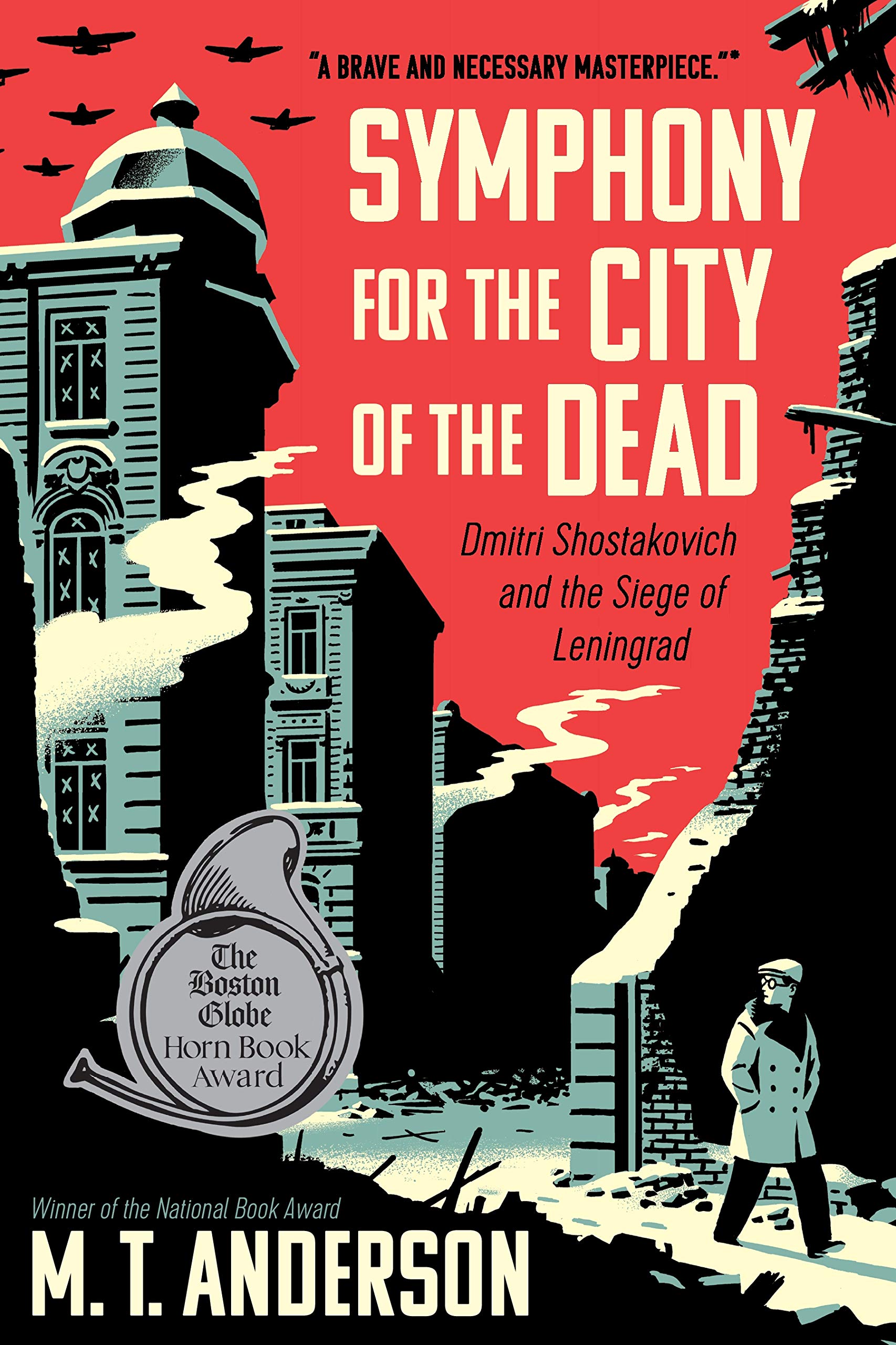
Symphony for the City of the Dead: Part Two
In 1941, composer Dmitri Shostakovich wrote a symphony in response to the relentless Siege of Leningrad. M.T. Anderson explores both the siege and Shostakovich's work in this award-winning nonfiction account.
Here are links to our lists for the book: Prologue–Part One, Part Two, Part Three
40 words
73 learners
Learn words with Flashcards and other activities
Definition First

Other learning activities
Full list of words from this list:
-
capitulate
surrender under agreed conditionsExactly a year to the day after the French capitulated, Hitler would stage his massive invasion of the USSR.
-
deign
do something that one considers to be below one's dignityStalin scoffed, “There’s this bastard who’s set up factories and brothels in Japan and even deigned to report the date of the German attack as 22 June. Are you suggesting I should believe him too?”
-
fitful
intermittently stopping and startingStalin may have slept fitfully; he may have lain awake, staring at the ceiling.
-
turncoat
a disloyal person who betrays or deserts a causeStalin insisted that the bombing raids might well be some turncoat German attempting to start a war with Russia without Hitler knowing.
-
tutelage
teaching pupils individuallyHe had written most of an opera (Rothschild’s Violin) under Shostakovich’s tutelage.
-
conscript
enroll into service compulsorilySince the deed was performed by conscripted citizens of Kaunas, the Nazis could report it neatly as a “spontaneous self-cleansing action.”
-
pacification
actions taken by a government to defeat insurgencyHitler issued an order that his soldiers did not need to worry about the usual rules of civilized warfare when fighting the Russian “subhumans”: “The troops must be aware that in this battle, mercy or considerations of international law with regard to [the Slavs] are false. They are a danger to our own safety and to the rapid pacification of the conquered territories.”
-
putative
purportedThey did not make particularly effective ditchdiggers, Shostakovich remembered in his putative memoirs...
-
egress
the act or means of going outThe military set up checkpoints throughout the streets and on the city’s perimeter to control all entrance and egress.
-
lozenge
a diamond-shaped parallelogram with four equal sidesThen, like grazing beasts, barrage balloons (great lozenges and blimps) drifted up and took their places in the summer sky.
-
tribunal
an assembly to conduct judicial businessPeople had to be careful as they whispered their updates; there was a new law announcing that “defeatists” who spread “false rumors provoking unrest among the population” could be arrested and tried by a military tribunal.
-
lathe
a machine tool for shaping a piece of rotating wood or metalThe trucks carry fly wheels, cog wheels, lathes, small machine parts, all kept separate, carefully greased and wrapped in parchment.
-
manifest
clearly revealed to the mind or the senses or judgmentWe were both extremely agitated; it was a rare event for Shostakovich to play a new work with such manifest emotion.
-
rife
frequent, common, or widespreadOne of the bitter experiences of the starving citizens during the Siege of Leningrad was glimpsing the children of a few well-connected Communist Party members eating ham sandwiches or leaving juicy rinds of fat on their plates. Corruption, unfortunately, was rife.
-
samovar
a metal urn with a spigot at the baseIn the background, like a stage set, a tasseled lamp hangs above a window and a samovar sits on an elegantly set table.
-
peremptory
offensively self-assured or exercising unwarranted powerAt the same time, a peremptory brutality trickled down through the ranks.
-
cubist
of art that renders objects as abstract, geometric planesLeningrad now literally resembled one of the fractured Cubist landscapes of the 1920s avant-garde—or, as Ginzburg remarked, one of Vsevolod Meyerhold’s stage sets.
-
inexorably
in a manner impervious to change or persuasionHe played them the march that inexorably repeated like the scuttling of “iron rats,” eventually growing to towering, ghastly dimensions.
-
convalesce
get over an illness or shockGiven what we know about his activities, he simply did not have time to be hospitalized with a serious head wound and to convalesce.
-
stint
an unbroken period of time during which you do somethingTake, for example, Shostakovich’s stints on the roof of the Leningrad Conservatory, watching for incendiary bombs.
-
clinical
detached or unemotionalThe Nazis, cold and clinical as their theorists might have been, believed entirely in the importance of emotion, mood, and propaganda.
-
inimitable
matchlessHitler put it in his own inimitable way; “Any violence which does not spring from a firm spiritual base will be wavering and uncertain. It lacks the stability which can only rest in a fanatical outlook.”
-
harry
make a pillaging or destructive raid on, as in wartimesThey began an insistent, ceaseless guerrilla war, running through the woods and hiding in holes in the ground to harry the Wehrmacht.
-
respite
a relief from harm or discomfortThey said, “We're giving you a respite until the 21st. If you do not surrender, we will grind you to a pulp.”
-
banal
repeated too often; overfamiliar through overuseIn particular, the people who heard it that day were struck by the first movement, in which “Shostakovich takes a monotonous Prussian march, sets it in the style of the most banal music-hall tune, then relentlessly and ingeniously turns it into a grotesque parody that implicitly, and with enormous force, stigmatizes the nonentity of German Nazism.”
-
bereft
lacking or deprived of something“He looked completely bereft. He was holding a sewing machine in one hand and a children’s potty in the other, while his wife Nina Vasilyevna stood beside the children and a mountain of stuff. I helped them load their things on to the train. Later, when I made my way home from the station, I was struck by the number of howling dogs roaming the snowy streets, having been abandoned by their owners.”
-
colonnade
structure consisting of a row of evenly spaced columnsThe Moscow Metro system was famous for its splendor, the marble colonnades and gleaming arches that welcomed commuters.
-
precarious
fraught with dangerKnowing what he did about the plight of Leningrad and the precarious situation of the country as a whole, Shostakovich couldn’t work on his piece.
-
atrophy
undergo weakening or degeneration as through lack of useTheir speech slurred as their vocal cords atrophied.
-
welter
a confused multitude of thingsThese ghastly decisions were made in a welter of starvation, which sharpened the senses but confused thought.
-
purloin
make off with belongings of othersOne family (a father, a mother, and a thirteen-year-old boy) were arrested for stealing bodies from a hospital morgue, presumably for resale as food. A nurse was arrested for purloining amputated limbs from the surgery room floor.
-
monograph
a detailed and documented treatise on a particular subjectIn Bomb Shelter No. 3, hundreds of scholars hunkered down by candle stubs, barely alive, slowly scratching out monographs on the art of the Netherlands or Sumerian philology.
-
philology
the humanistic study of language and literatureIn Bomb Shelter No. 3, hundreds of scholars hunkered down by candle stubs, barely alive, slowly scratching out monographs on the art of the Netherlands or Sumerian philology.
-
conducive
tending to bring about; being partly responsible forA district nurse concluded: “I found in my work that it was not only nutrition that was conducive to survival, but morale.”
-
trappings
ornaments; embellishments to or characteristic signs ofSome chose to respond to the crisis by giving in to their hungriest, most brutal selves: others fought to work together, to recall the trappings of a civilization that lay in heaps around them.
-
profuse
produced or growing in extreme abundanceTo make things worse, an intense cultural difference soured negotiations over the aid packages: the Americans expected profuse thanks and shows of gratitude from the Russians: the Russians were much more hardheaded and practical, knowing that they were taking the brunt of the Germans’ military might.
-
twee
excessively or affectedly dainty, sentimental, or refinedVery softly, with the rattle of drums, Shostakovich’s irritating little march starts—plucky, even twee.
-
lilting
characterized by a buoyant rhythmAfter the oddly lilting second movement, the stark, lonely fanfares of the third, the watchfulness and brave struggle of the fourth—the piece ends in final triumph.
-
emaciated
very thin, especially from disease or hunger or coldThey were sick and emaciated. Shostakovich wrote to his friend Glikman that Maria and young Dmitri were all right but that Sofia was “nothing but skin and bone.”
-
consummate
having or revealing supreme mastery or skillA telegram from Shostakovich to conductor Arturo Toscanini, via the Russian Embassy and agent Eugene Weintraub: "Dear friend, I'm happy to know you'll conduct my Seventh Symphony. I'm confident that with your consummate, inherent talent and superlative skill you'll convey to [the] public of democratic America [the] concepts which I've endeavored [to] embody in this work."
Created on Mon Oct 19 10:40:56 EDT 2020
(updated Wed Oct 28 09:49:27 EDT 2020)
Sign up now (it’s free!)
Whether you’re a teacher or a learner,
Vocabulary.com can put you or your class
on the path to systematic vocabulary improvement.