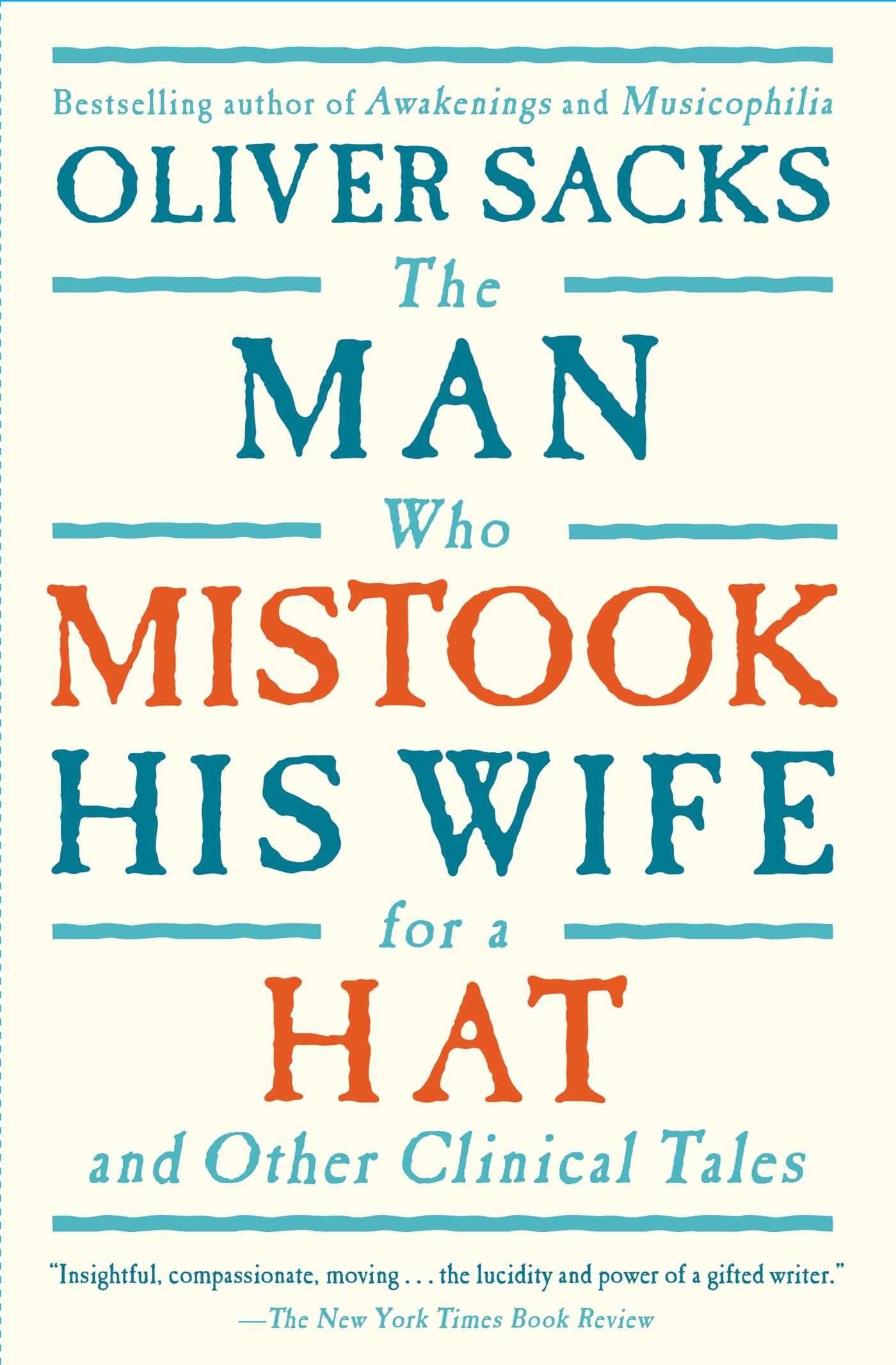
The Man Who Mistook His Wife for a Hat: "Reminiscence"
In this classic collection of "clinical tales," neurologist Oliver Sacks explores a range of neurological conditions and phenomena.
Here are links to our lists for the collection: Part One Introduction; The Man Who Mistook His Wife for a Hat; The Lost Mariner; The Disembodied Lady; The Man Who Fell out of Bed; Hands; Phantoms; On the Level; Eyes Right!; The President's Speech; Part Two Introduction; Witty Ticcy Ray; Cupid's Disease; A Matter of Identity; Yes, Father-Sister; The Possessed; Part Three Introduction; Reminiscence; Incontinent Nostalgia; A Passage to India; The Dog Beneath the Skin; Murder; The Visions of Hildegard; Part Four Introduction; Rebecca; A Walking Grove; The Twins; The Autist Artist
40 words
4 learners
Learn words with Flashcards and other activities
Definition First

Other learning activities
Full list of words from this list:
-
nostalgic
unhappy about being away and longing for familiar thingsOne night, in January 1979, she dreamt vividly, nostalgically, of her childhood in Ireland, and especially of the songs they danced to and sang.
-
amiss
not functioning properlyShe was bright, alert, not delirious or mad, but with a remote, absorbed look, as of someone half in a world of their own. I could find nothing neurologically amiss.
-
manifest
clearly revealed to the mind or the senses or judgmentAnd, manifestly, she had been normal the day before.
-
seizure
a sudden attack characterized by spasms or convulsionsThis confirmed that she was indeed having temporal-lobe seizures, which, as Hughlings Jackson guessed and Wilder Penfield proved, are the invariable basis of ‘reminiscence' and experiential hallucinations.
-
provocative
serving or tending to excite or stimulateShe tried, therefore, to avoid thinking of them, but the avoidance of thinking was as provocative as the thinking.
-
hubbub
loud confused noise from many sourcesShe would hear countless songs—sometimes several simultaneously; sometimes she would hear an orchestra or choir; and, occasionally, voices, or a mere hubbub of noises.
-
crude
devoid of any qualifications or disguise or adornment'Musical epilepsy' sounds like a contradiction in terms: for music, normally, is full of feeling and meaning, and corresponds to something deep in ourselves, 'the world behind the music', in Thomas Mann's phrase—whereas epilepsy suggests quite the reverse: a crude, random physiological event, wholly unselective, without feeling or meaning.
-
evoke
call forth, as an emotion, feeling, or responsePenfield was not only able to locate their origin in the temporal lobes, but was able to evoke the ‘elaborate mental state', or the extremely precise and detailed ‘experiential hallucinations' of such seizures by gentle electrical stimulation of the seizure-prone points of the cerebral cortex, as this was exposed, at surgery, in fully conscious patients.
-
prosaic
not challenging; dull and lacking excitementSuch stimulations would instantly call forth intensely vivid hallucinations of tunes, people, scenes, which would be experienced, lived, as compellingly real, in spite of the prosaic atmosphere of the operating room, and could be described to those present in fascinating detail, confirming what Jackson described sixty years earlier, when he spoke of the characteristic ‘doubling of consciousness'...
-
resonance
the ability to create understanding or an emotional responseWe know, all too well, from the study of ‘free associations’ that the most seemingly trivial or random thoughts may turn out to have an unexpected depth and resonance, but that this only becomes evident given an analysis in depth.
-
elicit
call forth, as an emotion, feeling, or responseI have gone back to Mrs O’M. briefly, to elicit her associations, her feelings, to her ‘songs’.
-
apt
naturally disposed towardAlthough, consciously, she cannot attribute to the three songs special feeling or meaning, she now recalls, and this is confirmed by others, that she was apt to hum them, unconsciously, long before they became hallucinatory seizures.
-
convulsion
a sudden uncontrollable attackI put Mrs O’M. on anticonvulsants, and she forthwith ceased her musical convulsions.
-
apoplexy
a loss of consciousness from the lack of oxygen in the brainThere was, for the first 72 hours, an almost continuous seizure, or seizure ‘status’, associated with an apoplexy of the temporal lobe.
-
induce
cause to ariseA representative, 31 (Case 2770), had major epilepsy induced by finding himself alone among strangers.
-
subside
wear off or die downHe gets gooseskin, goes hot and cold, and either the attack subsides or proceeds to a convulsion.
-
anamnesis
the ability to recall the pastFor Mrs O'C., nearly ninety, approaching the end of a long lonely life, this recapturing of ‘sacred and precious' childhood memories, this strange and almost miraculous anamnesis, breaking open the closed door, the amnesia of childhood, was provided, paradoxically, by a cerebral mishap.
-
felicity
state of well-being characterized by contentmentYou all, healthy people, can't imagine the happiness which we epileptics feel during the second before our fit...I don't know if this felicity lasts for seconds, hours or months, but believe me, I would not exchange it for all the joys that life may bring.
-
acme
the highest level or degree attainableShe too knew, in her seizures, an extraordinary felicity. But it seemed to her the acme of sanity and health—the very key, indeed the door, to sanity and health. Thus she felt her illness as health, as healing.
-
wistful
showing pensive sadnessAs she got better, and recovered from her stroke, Mrs O'C. had a period of wistfulness and fear. ‘The door is closing,' she said. 'I'm losing it all again.'
-
repressed
characterized by the suppression of impulses or emotionsWhat is peculiarly important, and moving, in the case of Mrs O’C., is that epileptic ‘reminiscence’ here seized on something unconscious—very early, childhood experiences, either faded, or repressed from consciousness—and restored them, convulsively, to full memory and consciousness.
-
idle
silly or trivial‘It was the healthiest, happiest experience of my life. There’s no longer a great chunk of childhood missing. I can’t remember the details now, but I know it’s all there. There’s a sort of completeness I never had before.’
These were not idle words, but brave and true. -
moor
secure in or as if in a berth or dockShe suffered from a Jacksonian ‘reminiscence', but this served to moor and heal her, as a Freudian ‘anamnesis'.
-
akin
similar in quality or characterWhat, we may ask, could be played in such a way as to reconstitute an experience? Is it something akin to a film or record, played on the brain's film projector or phonograph?
-
anterior
earlier in timeIs it something akin to a film or record, played on the brain's film projector or phonograph? Or something analogous, but logically anterior—such as a script or score?
-
repertoire
a collection of works that an artist or company can performWhat is the final form, the natural form, of our life's repertoire? That repertoire which provides not only memory and ‘reminiscence', but our imagination at every level, from the simplest sensory and motor images, to the most complex imaginative worlds, landscapes, scenes? A repertoire, a memory, an imagination, of a life which is essentially personal, dramatic and ‘iconic’.
-
analogous
similar or equivalent in some respectsAnalogous questions about the nature of knowing (or gnosis) are raised by our patients with agnosias—the dramatic visual agnosia of Dr P. (‘The Man Who Mistook His Wife for a Hat'), and the auditory and musical agnosias of Mrs O'M. and Emily D.
-
praxis
translating an idea into actionAnd similar questions about the nature of action (or praxis) are raised by the motor bewilderment, or apraxia, of certain retardates, and by patients with frontal-lobe apraxias—apraxias which may be so severe that such patients may be unable to walk, may lose their ‘kinetic melodies', their melodies of walking...
-
iconic
relating to a symbolic figureComputational representations—even of the exquisite sophistication envisaged by Marr and Bernstein (the two greatest pioneers and thinkers in this realm)—could never, of themselves, constitute ‘iconic' representations, those representations which are the very thread and stuff of life.
-
categorically
in an absolute, definite, or firm mannerThus a gulf appears, indeed a chasm, between what we learn from our patients and what physiologists tell us. Is there any way of bridging this chasm? Or, if that is (as it may be) categorically impossible, are there any concepts beyond those of cybernetics by which we may better understand the essentially personal, Proustian nature of reminiscence of the mind, of life?
-
inherent
existing as an essential constituent or characteristicSuch patterns of meaning would indeed transcend purely formal or computational programmes or patterns, and allow the essentially personal quality which is inherent in reminiscence, inherent in all mnesis, gnosis, and praxis.
-
conjecture
believe especially on uncertain or tentative groundsThe score of ‘Easter Parade’, I conjecture, is indelibly inscribed in Mrs O’M.’s brain—the score, her score, of all she heard and felt at the original moment and imprinting of the experience.
-
indelible
not able to be forgotten, removed, or erasedThe score of ‘Easter Parade’, I conjecture, is indelibly inscribed in Mrs O’M.’s brain—the score, her score, of all she heard and felt at the original moment and imprinting of the experience.
-
dramaturgy
the art of writing and producing playsSimilarly, in the ‘dramaturgic' portions of Mrs O’C.’s brain, apparently forgotten, but none the less totally recoverable, must have lain, indelibly inscribed, the script of her dramatic, childhood scene.
-
iterate
run or be performed againAnd let us note, from Penfield’s cases, that the removal of the minute, convulsing point of cortex, the irritant focus causing reminiscence, can remove in toto the iterating scene, and replace an absolutely specific reminiscence or ‘hyper-mnesia’ by an equally specific oblivion or amnesia.
-
oblivion
total forgetfulnessAnd let us note, from Penfield’s cases, that the removal of the minute, convulsing point of cortex, the irritant focus causing reminiscence, can remove in toto the iterating scene, and replace an absolutely specific reminiscence or ‘hyper-mnesia’ by an equally specific oblivion or amnesia.
-
lobotomy
surgery on nerves to and from the frontal lobe of the brainThere is something extremely important, and frightening here: the possibility of a real psycho-surgery, a neurosurgery of identity (infinitely finer and more specific than our gross amputations and lobotomies, which may damp or deform the whole character, but cannot touch individual experiences).
-
inhibit
limit, block, or decrease the action or function ofSince the original publication of this book I have been consulted for innumerable cases of musical ‘reminiscence’—it is evidently not uncommon, especially in the elderly, though fear may inhibit the seeking of advice.
-
benign
not dangerous to health; not recurrent or progressivePatients with severe nerve-deafness may have musical ‘phantoms’. But in most cases no pathology can be found, and the condition, though a nuisance, is essentially benign.
-
prone
having a tendency(Why the musical parts of the brain, above all, should be so prone to such ‘releases’ in old age remains far from clear.)
Created on Wed Sep 02 12:33:18 EDT 2020
(updated Wed Oct 28 10:57:44 EDT 2020)
Sign up now (it’s free!)
Whether you’re a teacher or a learner,
Vocabulary.com can put you or your class
on the path to systematic vocabulary improvement.