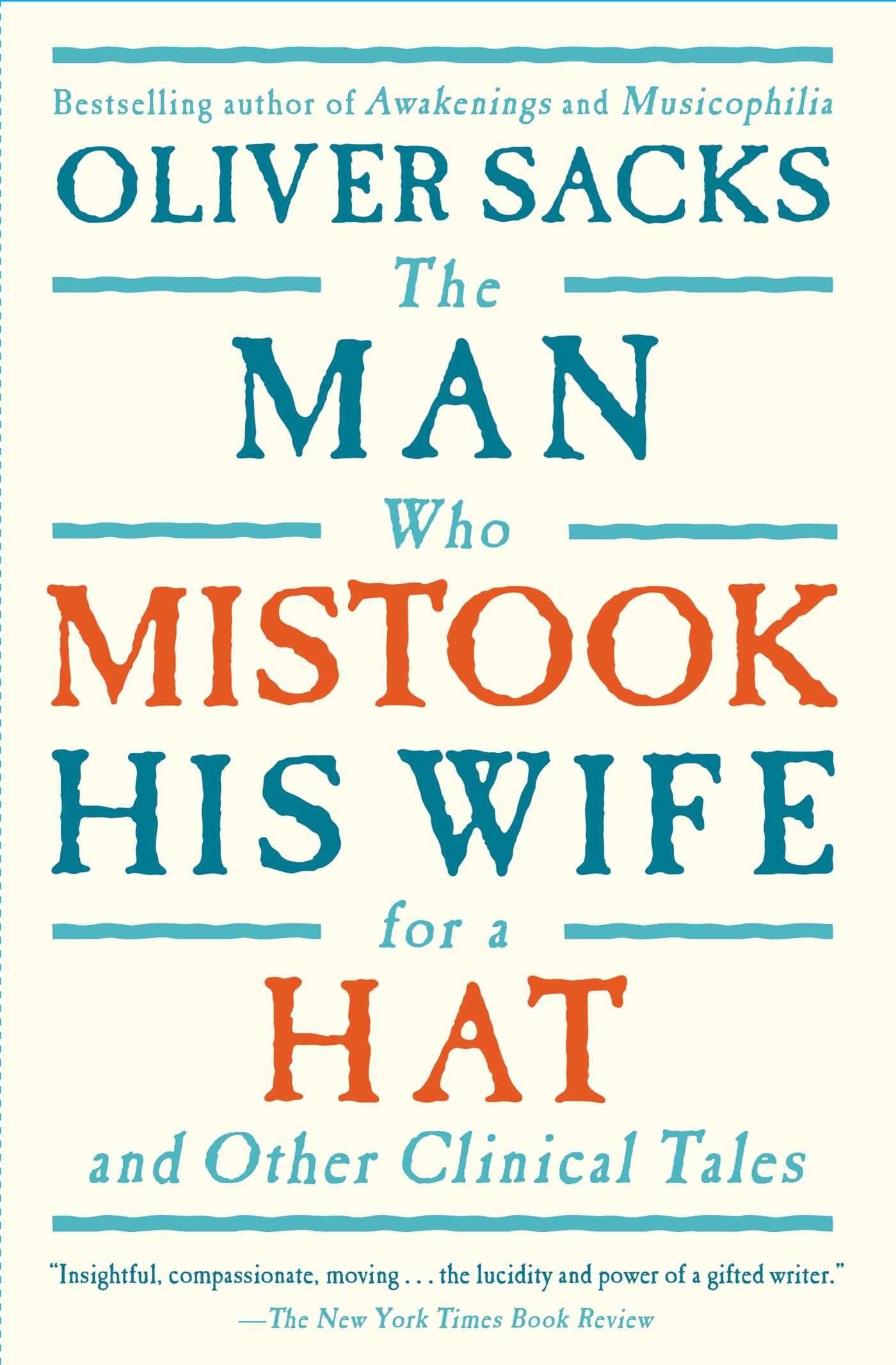
The Man Who Mistook His Wife for a Hat: “The Lost Mariner”
In this classic collection of "clinical tales," neurologist Oliver Sacks explores a range of neurological conditions and phenomena.
Here are links to our lists for the collection: Part One Introduction; The Man Who Mistook His Wife for a Hat; The Lost Mariner; The Disembodied Lady; The Man Who Fell out of Bed; Hands; Phantoms; On the Level; Eyes Right!; The President's Speech; Part Two Introduction; Witty Ticcy Ray; Cupid's Disease; A Matter of Identity; Yes, Father-Sister; The Possessed; Part Three Introduction; Reminiscence; Incontinent Nostalgia; A Passage to India; The Dog Beneath the Skin; Murder; The Visions of Hildegard; Part Four Introduction; Rebecca; A Walking Grove; The Twins; The Autist Artist
35 words
13 learners
Learn words with Flashcards and other activities
Definition First

Other learning activities
Full list of words from this list:
-
clinical
relating to or based on direct observation of patientsThis moving and frightening segment in Buñuel’s recently translated memoirs raises fundamental questions—clinical, practical, existential, philosophical: what sort of a life (if any), what sort of a world, what sort of a self, can be preserved in a man who has lost the greater part of his memory and, with this, his past, and his moorings in time?
-
genial
diffusing warmth and friendlinessHe was a genial soul, very ready to talk and to answer any questions I asked him.
-
ashen
pale from illness or emotionHe suddenly turned ashen and gripped the sides of the chair.
-
lapse
a break or intermission in the occurrence of somethingA man went to his doctor complaining of memory lapses.
-
apt
at risk of or subject to experiencing somethingHoming in on his memory, I found an extreme and extraordinary loss of recent memory—so that whatever was said or shown to him was apt to be forgotten in a few seconds’ time.
-
cogitation
attentive consideration and thoughtThis faint amusement and indifference were very characteristic, as were the involved cogitations to which he was driven by being so disoriented and lost in time.
-
efface
remove completely from recognition or memoryIt was not, apparently, that he failed to register in memory, but that the memory traces were fugitive in the extreme, and were apt to be effaced within a minute, often less, especially if there were distracting or competing stimuli, while his intellectual and perceptual powers were preserved, and highly superior.
-
penchant
a strong liking or preferenceJimmie’s scientific knowledge was that of a bright high school graduate with a penchant for mathematics and science.
-
consummate
having or revealing supreme mastery or skillUnless he was a consummate actor, a fraud simulating an astonishment he did not feel, this was an utterly convincing demonstration that he was still in the past.
-
lacuna
a blank gap or missing part‘He is, as it were,’ I wrote in my notes, ‘isolated in a single moment of being, with a moat or lacuna of forgetting all round him...He is man without a past (or future), stuck in a constantly changing, meaningless moment.’
-
prosaic
not fanciful or imaginativeAnd then, more prosaically, 'The remainder of the neurological examination is entirely normal...'
-
privation
the act of stripping someone of food, money, or rightsMy note was a strange mixture of facts and observations, carefully noted and itemised, with irrepressible meditations on what such problems might ‘mean’, in regard to who and what and where this poor man was—whether, indeed, one could speak of an ‘existence’, given so absolute a privation of memory or continuity.
-
pathos
a quality that arouses emotions, especially pity or sorrowAnd in Luria’s account science became poetry, and the pathos of radical lostness was evoked.
-
integral
constituting the undiminished entirety'In consequence, they lose their integral experience of time and begin to live in a world of isolated impressions.’
-
atrophy
a decrease in size of an organ caused by disease or disuseWe did various tests on him (EEG, brain scans), and found no evidence of massive brain damage, although atrophy of the tiny mammillary bodies would not show up on such tests.
-
pallid
lacking in vitality or interest or effectivenessIn his fascinating oral history The Good War (1985) Studs Terkel transcribes countless stories of men and women, especially fighting men, who felt World War II was intensely real—by far the most real and significant time of their lives—everything since as pallid in comparison. Such men tend to dwell on the war and to relive its battles, comradeship, moral certainties and intensity.
-
vicissitude
a variation in circumstances or fortuneIt was obvious from reading this—especially reading between the lines—that the brothers had scarcely seen each other since 1943, and gone separate ways, partly through the vicissitudes of location and profession, and partly through deep (though not estranging) differences of temperament.
-
estrange
arouse hostility or indifference inIt was obvious from reading this—especially reading between the lines—that the brothers had scarcely seen each other since 1943, and gone separate ways, partly through the vicissitudes of location and profession, and partly through deep (though not estranging) differences of temperament.
-
jargon
technical terminology characteristic of a particular subjectDuring the next month, the excitement and delirium died down, but he was left with deep and bizarre memory lapses, or ‘deficits,' to use the medical jargon.
-
retrograde
of amnesia; affecting time immediately preceding traumaWhen I received this information, I was more perplexed still: why did Jimmie not remember his later years in the navy, why did he not recall and organise his memories until 1970? I had not heard then that such patients might have a retrograde amnesia.
-
elicit
call forth, as an emotion, feeling, or responseShe also attempted to hypnotize Jimmie, in the hope of eliciting memories repressed by hysteria—this tends to work well in cases of hysterical amnesia.
-
facade
a showy misrepresentation to conceal something unpleasant‘I have no feeling or evidence,’ the psychiatrist wrote, of any hysterical or “put-on” deficit. He lacks both the means and the motive to make a façade.
-
incorrigible
impervious to correction by punishmentHis memory deficits are organic and permanent and incorrigible, though it is puzzling they should go back so long.
-
manifest
reveal its presence or make an appearanceSince, she felt, he was ‘unconcerned...manifested no special anxiety...constituted no management problem,' there was nothing she could offer, or any therapeutic ‘entrance’ or ‘lever’ she could see.
-
equanimity
steadiness of mind under stressLuria mentioned his patient Kur as manifesting a rare self-awareness, in which hopelessness was mixed with an odd equanimity.
-
abiding
unceasingBut were there depths in this unmemoried man, depths of an abiding feeling and thinking, or had he been reduced to a sort of Humean drivel, a mere succession of unrelated impressions and events?
-
drivel
a worthless messageBut were there depths in this unmemoried man, depths of an abiding feeling and thinking, or had he been reduced to a sort of Humean drivel, a mere succession of unrelated impressions and events?
-
inertia
the tendency of something to stay in rest or motionHe was strongly built and fit, he had a sort of animal strength and energy, but also a strange inertia, passivity, and (as everyone remarked) 'unconcern'; he gave all of us an overwhelming sense of 'something missing,' although this, if he realised it, was itself accepted with an odd 'unconcern.'
-
fallible
likely to fail or make errorsThere was no forgetting, no Korsakov’s then, nor did it seem possible or imaginable that there should be; for he was no longer at the mercy of a faulty and fallible mechanism—that of meaningless sequences and memory traces—but was absorbed in an act, an act of his whole being, which carried feeling and meaning in an organic continuity and unity, a continuity and unity so seamless it could not permit any break.
-
pensive
deeply or seriously thoughtfulBut if he was held in emotional and spiritual attention—in the contemplation of nature or art, in listening to music, in taking part in the Mass in chapel—the attention, its 'mood', its quietude, would persist for a while, and there would be in him a pensiveness and peace we rarely, if ever, saw during the rest of his life at the Home.
-
empirical
derived from experiment and observation rather than theoryI had wondered, when I first met him, if he was not condemned to a sort of 'Humean’ froth, a meaningless fluttering on the surface of life, and whether there was any way of transcending the incoherence of his Humean disease. Empirical science told me there was not—but empirical science, empiricism, takes no account of the soul, no account of what constitutes and determines personal being.
-
transient
lasting a very short timeA particularly fascinating case of an acute (and mercifully transient) Korsakov’s syndrome has been well described only very recently in the so-called Transient Global Amnesia (TGA) which may occur with migraines, head injuries or impaired blood supply to the brain.
-
expostulate
reason with for the purpose of dissuasion(‘You changed the curtains today!' he once expostulated to his wife. ‘How come? So suddenly? They were green this morning.' But they had not been green since 1978.)
-
poignancy
a quality that arouses emotions, especially pity or sorrowBut the real poignancy, the horror, would occur when his wife brought him back—brought him, in a fantastic and unaccountable manner (so he felt), to a strange home he had never seen, full of strangers, and then left him. ‘What are you doing?' he would scream, terrified and confused. ‘What in the hell is this place? What the hell's going on?'
-
anachronism
locating something at a time when it couldn't have existedI hear Stephen R. screaming with terror and confusion when he returns—screaming for a past which no longer exists. But what can we do? Can we create a time-capsule, a fiction? Never have I known a patient so confronted, so tormented, by anachronism, unless it was the ‘Rose R.' of Awakenings.
Created on Tue Sep 01 12:06:08 EDT 2020
(updated Wed Oct 28 11:33:12 EDT 2020)
Sign up now (it’s free!)
Whether you’re a teacher or a learner,
Vocabulary.com can put you or your class
on the path to systematic vocabulary improvement.