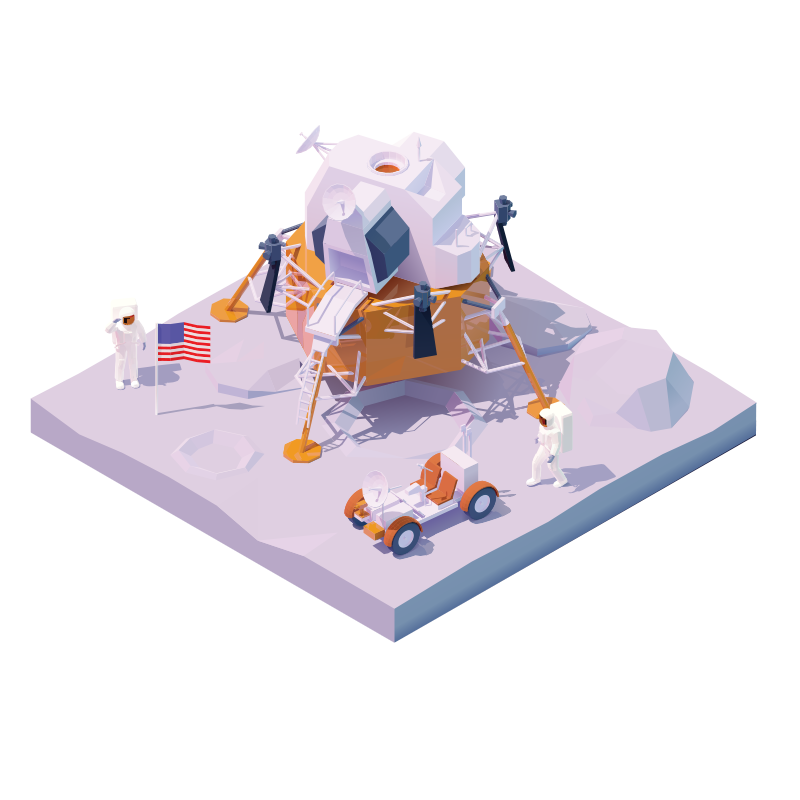
Space Is the Place: A Galaxy of Far Out Words: Over The Moon: Planetary Vocabulary
Planets and their moons have complex relationships as they spin through space around the sun. These words describe their motions and relationships, and will help you understand the gravity of the situation.
21 words
18114 learners
Learn words with Flashcards and other activities
Definition First

Other learning activities
Full list of words from this list:
-
apogee
the farthest point in an orbit around the EarthWhen the moon is far, it is at apogee.From the Greek apogaion, literally meaning "away from the Earth," apogee refers to the point in the moon's elliptical orbit that's farthest from the Earth.
-
asteroid
a small celestial body composed of rock and metalLast November Hayabuse2 finally left its orbit around the asteroid and began its one-year journey home.Aster is "star" in Greek, so an asteroid is a star-like object: a bright dot visible to the naked eye, but moving differently than the stars.
-
atmosphere
the envelope of gases surrounding any celestial bodyThe presence of methane increases the amount of heat trapped in the atmosphere.
-
axis
the center around which something rotatesThis led to the recognition of regular changes in key astronomical parameters: the eccentricity of Earth’s orbit around the Sun, and the obliquity and precession of Earth’s rotational axis.Axis is Latin, and it's also the source of axle the rod around which a wheel rotates.
-
crater
a bowl-shaped geological formation at the top of a volcanoThe robotic explorer would be NASA’s fifth rover on Mars, and it is very similar to Curiosity, which is now exploring the Gale crater.In Ancient Greece, a crater was a bowl in which water and wine were mixed for drinking.
-
eccentricity
a circularity that deviates from a circular pathThis led to the recognition of regular changes in key astronomical parameters: the eccentricity of Earth’s orbit around the Sun, and the obliquity and precession of Earth’s rotational axis.An eccentric orbit is not circular. An eccentric person is odd, quirky, a little off-center.
-
geocentric
having the earth in the middleAfter all, the geocentric Ptolemaic theory of epicycles was mathematically appealing and its framework was broad enough to describe the motion of all planets on the sky.
-
gibbous
(used of the moon) more than half fullIt was the moon—a 93.6% waxing gibbous at time of writing.Gibbus means "bump" or "hump" in Latin, so a gibbous moon is one that's moving towards its full phase.
-
heliocentric
having the sun as or in the middleBased on Polish mathematician Nicolaus Copernicus’s model, this heliocentric description challenged the teaching that the Sun revolved around Earth.
-
lunar
of or relating to or associated with the moon“The prospect of deploying an advanced reactor to the lunar surface is as exciting as it is challenging.”
-
meteor
a small, solid space object that has entered Earth's atmosphereOften the gathering coincides with the Perseids, a spectacular meteor shower.
-
orbit
the path of a celestial body in its revolution about anotherIn May 1962, Scott Carpenter became the second U.S. astronaut, after Glenn, to orbit Earth.Orbis means "spherical" in Latin; it's where we get orb from as well.
-
perigee
the nearest point in an orbit around the EarthThe phenomenon happens when the celestial satellite reaches its closest point to Earth - known as a perigee - and is on the opposite side of Earth to the sun.The opposite of apogee, above.
-
planetarium
an apparatus or model for representing the solar systemsIf you’ve ever been to a planetarium, perhaps you remember seeing a vibrant representation of a night sky from the perspective of where you were sitting in that moment.
-
pole
either of the two endpoints of the Earth's axis of rotationHe noted that E arth’s poles influence weather conditions far away, where hundreds of millions of people live.
-
retrograde
moving or directed or tending in a backward directionJonathan Kaplan, a clinical psychologist in New York, recently noticed that more and more of his clients are referring to Mercury being in retrograde.Sometimes planets appear to move "backwards," that is in the opposite direction from their normal paths through the sky. It's just a function of the way the Earth's orbit and theirs line up sometimes. Retrograde can also be used to describe people, opinions, or legislation that are backwards or which seem intent on moving society in reverse.
-
rotation
the act of turning as if on an axisLitvinyuk is impressed by the measurements of the rotation of the clock hand.
-
satellite
any celestial body orbiting around a planet or starThe pictures are the first released from the Solar Orbiter satellite mission, led by the European Space Agency.
-
terrestrial
of or relating to or characteristic of the planet EarthIt was that the neutrinos were not making it to our terrestrial detectors—or rather they were changing en route.
-
wax
increase in phaseSunspot activity waxes and wanes, oscillating over an 11 year period.Wax is a Germanic word, and describes the moon growing larger each night as it becomes full.
-
wane
a gradual decline (in size or strength or power or number)In the following years, antitrust enforcement waxed or waned depending on the administration in office; but after 1980, it virtually disappeared.The opposite of wax: when the moon becomes thinner, moving towards new, or anything else that diminishes in intensity or force.
Created on Sun Aug 09 20:13:30 EDT 2020
Sign up now (it’s free!)
Whether you’re a teacher or a learner,
Vocabulary.com can put you or your class
on the path to systematic vocabulary improvement.