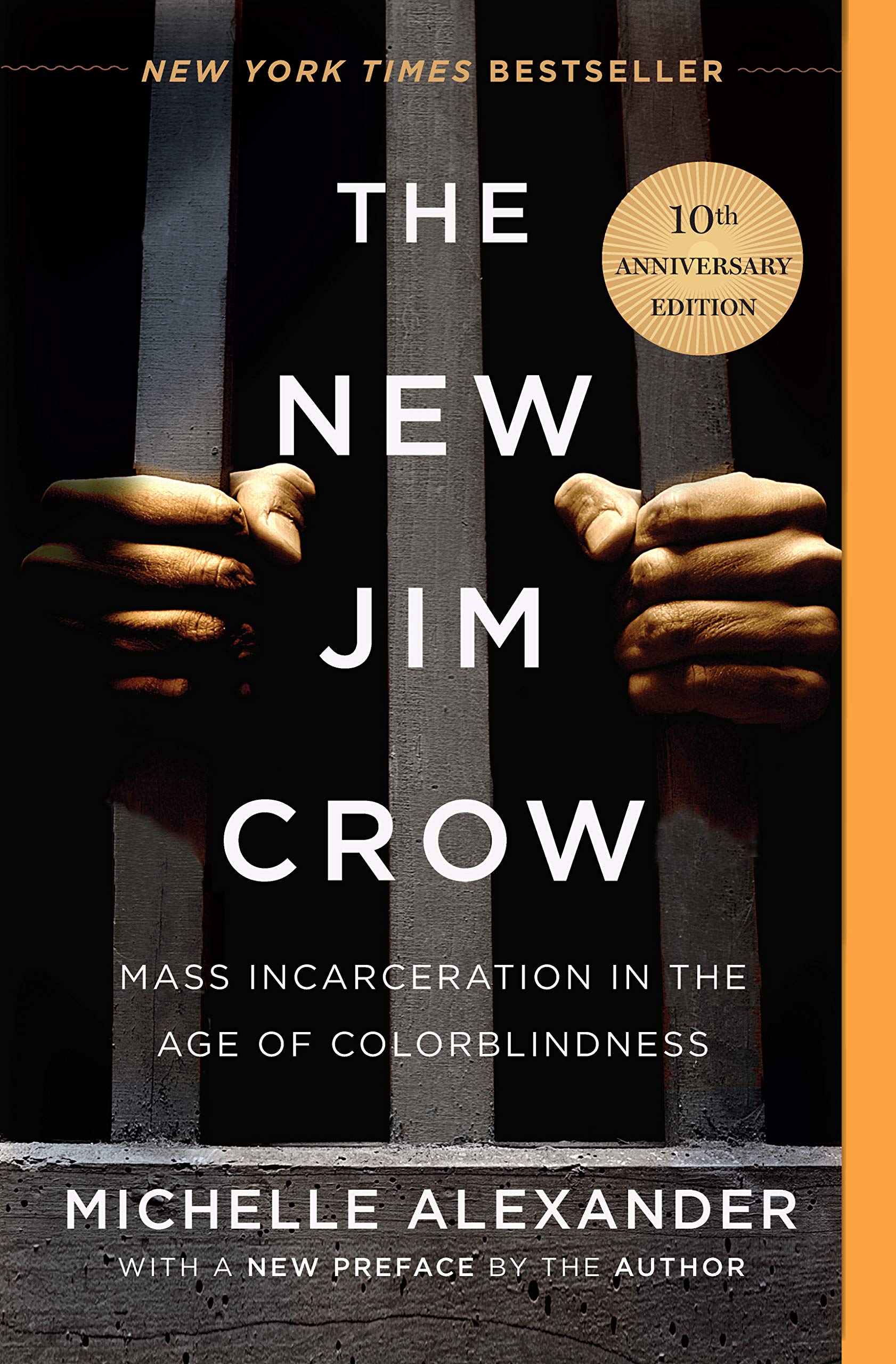
The New Jim Crow: Chapter 5
In this award-winning book, civil rights lawyer Michelle Alexander argues that the American criminal justice system unfairly targets and penalizes African Americans, resulting in long-term harm to black communities.
Here are links to our lists for the book: Introduction–Chapter 1, Chapter 2, Chapter 3, Chapter 4, Chapter 5, Chapter 6
35 words
29 learners
Learn words with Flashcards and other activities
Definition First

Other learning activities
Full list of words from this list:
-
atonement
the act of making amends for sin or wrongdoingAnd the message had been delivered with great passion by Louis Farrakhan, who more than a decade earlier summoned one million black men to Washington, DC, for a day of “atonement” and recommitment to their families and communities.
-
chide
scold or reprimand severely or angrilyDyson chided Obama for evoking a black stereotype for political gain, pointing out that “Obama’s words may have been spoken to black folk, but they were aimed at those whites still on the fence about whom to send to the White House.”
-
evoke
call to mindDyson chided Obama for evoking a black stereotype for political gain, pointing out that “Obama’s words may have been spoken to black folk, but they were aimed at those whites still on the fence about whom to send to the White House.”
-
cynical
believing the worst of human nature and motivesA more cynical approach was taken by Tyra Banks, the popular talk show host, who devoted a show in May 2008 to the recurring question, “Where Have All the Good Black Men Gone?”
-
awol
absent without leaveThe fact that Barack Obama can give a speech on Father’s Day dedicated to the subject of fathers who are “AWOL” without ever acknowledging that the majority of young black men in many large urban areas are currently under the control of the criminal justice system is disturbing, to say the least.
-
feign
give a false appearance ofIf we know, why do we feign ignorance? Could it be that most people really don’t know?
-
demagoguery
political rhetoric appealing to popular prejudice or emotionDenial is facilitated by persistent racial segregation in housing and schools, by political demagoguery, by racialized media imagery, and by the ease of changing one’s perception of reality simply by changing television channels.
-
apologist
a person who argues to defend some policy or institution“The system is not run by a bunch of racists,” the apologist would explain. “It’s run by people who are trying to fight crime.”
-
repercussion
a remote or indirect consequence of some actionThe disturbing images from the Jim Crow era also make it easy to forget that many African Americans were complicit in the Jim Crow system, profiting from it directly or indirectly or keeping their objections quiet out of fear of the repercussions.
-
jargon
technical terminology characteristic of a particular subjectAcademics have developed complicated theories and obscure jargon in an effort to describe what is now referred to as structural racism, yet the concept is fairly straightforward.
-
inviolate
treated as if holy and kept free from violation or criticismThey are rewarded in cash—through drug forfeiture laws and federal grant programs—for rounding up as many people as possible, and they operate unconstrained by constitutional rules of procedure that once were considered inviolate.
-
excommunication
the state of being excluded from a religious communityRacial bias in our criminal justice system is simply an old problem that has gotten worse, and the social excommunication of “criminals” has a long history; it is not a recent invention.
-
ancillary
furnishing added supportPrior drug wars were ancillary to the prevailing caste system. This time the drug war is the system of control.
-
reminiscent
serving to bring to mindMass incarceration has nullified many of the gains of the Civil Rights Movement, putting millions of black men back in a position reminiscent of Jim Crow.
-
clout
special advantage or influenceThis policy is disturbingly reminiscent of the three-fifths clause in the original Constitution, which enhanced the political clout of slaveholding states by including 60 percent of slaves in the population base for calculating Congressional seats and electoral votes, even though they could not vote.
-
progeny
the immediate descendants of a personCurrently, McCleskey v. Kemp and its progeny serve much the same function as Dred Scott and Plessy. In McCleskey, the Supreme Court demonstrated that it is once again in protection mode—firmly committed to the prevailing system of control.
-
confound
be confusing or perplexing toIn the era of mass incarceration, what it means to be a criminal in our collective consciousness has become conflated with what it means to be black, so the term white criminal is confounding, while the term black criminal is nearly redundant.
-
redundant
repeating the same sense in different wordsIn the era of mass incarceration, what it means to be a criminal in our collective consciousness has become conflated with what it means to be black, so the term white criminal is confounding, while the term black criminal is nearly redundant.
-
milieu
the environmental conditionAs Wideman explains, when “to be a man of color of a certain economic class and milieu is equivalent in the public eye to being a criminal,” being processed by the criminal justice system is tantamount to being made black, and “doing time” behind bars is at the same time “marking race.”
-
tantamount
being essentially equal to somethingAs Wideman explains, when “to be a man of color of a certain economic class and milieu is equivalent in the public eye to being a criminal,” being processed by the criminal justice system is tantamount to being made black, and “doing time” behind bars is at the same time “marking race.”
-
opportunism
taking advantage of favorable circumstances selfishlySaying that mass incarceration is the New Jim Crow can leave a misimpression. The parallels between the two systems of control are striking, to say the least—in both, we find racial opportunism by politicians, legalized discrimination, political disenfranchisement, exclusion of blacks from juries, stigmatization, the closing of courthouse doors, racial segregation, and the symbolic production of race—yet there are important differences.
-
conscientious
characterized by extreme care and great effortThe sincerity of many people’s bigoted racial beliefs is what led Martin Luther King Jr. to declare, “Nothing in all the world is more dangerous than sincere ignorance and conscientious stupidity.”
-
dissonant
not in accordThe criminalization of white men would disturb us to the core. So the critical questions are: “What disturbs us? What is dissonant? What seems anomalous? What is contrary to expectation?”
-
anomalous
deviating from the general or common order or typeSo the critical questions are: “What disturbs us? What is dissonant? What seems anomalous? What is contrary to expectation?” Or more to the point: Whom do we care about?
-
ensuing
following immediately and as a result of what went beforeMedia coverage of the movement peaked in 1988, when a drunk driver traveling the wrong way on Interstate 71 in Kentucky caused a head-on collision with a school bus. Twenty-seven people died and dozens more were injured in the ensuing fire.
-
lexicon
a language user's knowledge of wordsThroughout the 1980s, drunk driving was a regular topic in the media, and the term designated driver became part of the American lexicon.
-
wreak
cause to happen or to occur as a consequenceAs Glenn Loury explained more than a decade ago, when violent crime rates were making headlines, “The young black men wreaking havoc in the ghetto are still ‘our youngsters’ in the eyes of many of the decent poor and working-class black people who sometimes are their victims.”
-
flout
treat with contemptuous disregardJim Crow, as oppressive as it was, offered a measure of security for blacks who were willing to play by its rules. Those who flouted the rules or resisted them risked the terror of the Klan.
-
elicit
call forth, as an emotion, feeling, or responseSupporters of the politics of respectability believe that African Americans, if they hope to be accepted by whites, must conduct themselves in a fashion that elicits respect and sympathy rather than fear and anger from other races.
-
bourgeois
conforming to the conventions of the middle classThis strategy worked to some extent for a segment of the African American community, particularly those who had access to education and relative privilege. But a much larger segment—those who were uneducated and desperately poor—found themselves unable, as one historian put it, “to conform to the gender roles, public behavior, and economic activity deemed legitimate by bourgeois America but which the forces of Jim Crow sought to prevent black people from achieving.”
-
embroil
force into some kind of situation or course of actionIt was a pattern that would repeat itself in cities throughout the United States, as black communities found themselves embroiled in deep conflict over goals and strategies pursued by the black elite.
-
apathetic
marked by a lack of interestIn the view of these black elites, a “poverty complex” plagued the black poor, one that made them politically apathetic and content with broken-down, overcrowded, and dirty living conditions.
-
largesse
a gift or money given, usually ostentatiouslyAs historian Karen Ferguson observes, “when [black reformers] had the opportunity to determine the recipients of New Deal largesse, they did not choose the ‘mudsills’ of the black working class but rather the more prosperous elements who were more able to be respectable according to the reformers’ vision.”
-
denizen
a person who inhabits a particular placeAs political theorist Tommie Shelby has observed, “Individuals are forced to make choices in an environment they did not choose. They would surely prefer to have a broader array of good opportunities. The question we should be asking—not instead of but in addition to questions about penal policy—is whether the denizens of the ghetto are entitled to a better set of options, and if so, whose responsibility it is to provide them.”
-
vilify
spread negative information aboutThey were vilified in the media and condemned for their condition as part of a well-orchestrated political campaign to build a new white, Republican majority in the South.
Created on Fri Jun 19 17:47:32 EDT 2020
(updated Tue Jun 30 14:33:07 EDT 2020)
Sign up now (it’s free!)
Whether you’re a teacher or a learner,
Vocabulary.com can put you or your class
on the path to systematic vocabulary improvement.