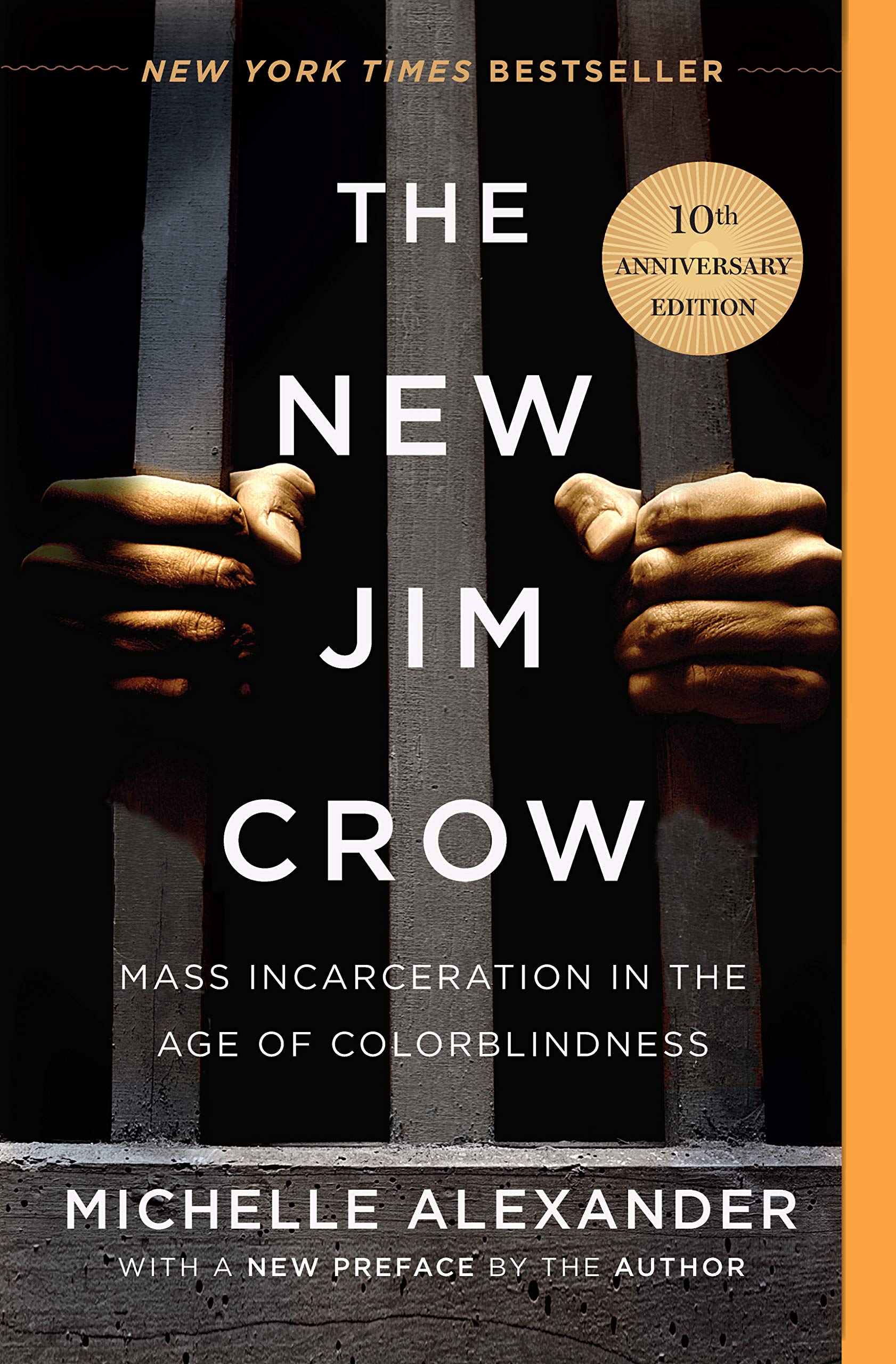
The New Jim Crow: Chapter 4
In this award-winning book, civil rights lawyer Michelle Alexander argues that the American criminal justice system unfairly targets and penalizes African Americans, resulting in long-term harm to black communities.
Here are links to our lists for the book: Introduction–Chapter 1, Chapter 2, Chapter 3, Chapter 4, Chapter 5, Chapter 6
40 words
21 learners
Learn words with Flashcards and other activities
Definition First

Other learning activities
Full list of words from this list:
-
decry
express strong disapproval ofWhen Frederick Douglass and the other delegates to the National Colored Convention converged in Rochester, New York, in the summer of 1853 to discuss the condition, status, and future of “coloreds” (as they were called then), they decried the stigma of race—the condemnation and scorn heaped upon them for no reason other than the color of their skin.
-
collateral
accompanying; following as a consequenceDespite the brutal, debilitating impact of these “collateral consequences” on the lives of those convicted of crimes, courts have generally declined to find that such sanctions are actually “punishment” for constitutional purposes.
-
forbear
a person from whom you are descendedLike their forbears, they do their best to survive, even thrive—against all odds.
-
covenant
a signed written agreement between two or more partiesDuring Jim Crow, it was legal to deny housing on the basis of race, through restrictive covenants and other exclusionary practices. Today, discrimination against people with criminal records and their families is routine among public and private landlords alike. Rather than racially restrictive covenants, we have restrictive lease agreements, barring the new “undesirables.”
-
scant
less than the correct or legal or full amountThe crackdown inspired by the War on Drugs has resulted in unprecedented punitiveness, as housing officials began exercising their discretion to deny poor people access to public housing for virtually any crime. “Just about any offense will do, even if it bears scant relation to the likelihood the applicant will be a good tenant.”
-
stipulate
make an express demand or provision in an agreementThe “One Strike and You’re Out” policy requires every public housing lease to stipulate that if the tenant, or any member of the tenant’s household, or any guest of the tenant, engages in any drug-related or other criminal activity on or off the premises, the tenancy will be terminated.
-
respectively
in the order givenResearch conducted by the Corporation for Supportive Housing in New York State shows that the use of state prisons and city jails dropped by 74 percent and 40 percent respectively when people with past criminal records were provided with supportive housing.
-
decrepit
worn and broken down by hard useMany are tracked for prison at early ages, labeled as criminals in their teen years, and then shuttled from their decrepit, underfunded inner-city schools to brand-new, high-tech prisons.
-
bleak
offering little or no hopeThe communities and schools from which they come fail to prepare them for the workforce, and once they have been labeled criminals, their job prospects are forever bleak.
-
competence
the quality of being adequately or well qualifiedFour decades ago, employers were free to discriminate explicitly on the basis of race; today employers feel free to discriminate against those who bear the prison label—i.e., those labeled criminals by the state. The result is a system of stratification based on the “official certification of individual character and competence”—a form of branding by the government.
-
ordinance
a statute enacted by a city governmentHowever, unlike a similar ordinance adopted in Boston, San Francisco’s policy applies only to public employment, not to private vendors that do business with the city or county of San Francisco.
-
ethnography
scientific description of individual human societiesThis concern is supported by ethnographic work suggesting that employers have fears of violence by black men relative to other groups of applicants and act on those fears when making hiring decisions.
-
levy
impose and collectExamples of preconviction service fees imposed throughout the United States today include jail book-in fees levied at the time of arrest, jail per diems assessed to cover the cost of pretrial detention, public defender application fees charged when someone applies for court-appointed counsel, and the bail investigation fee imposed when the court determines the likelihood of the accused appearing at trial.
-
exorbitant
greatly exceeding bounds of reason or moderationSome of the collection fees are exorbitant. Alabama charges a 30 percent collection fee, and Florida allows private debt collectors to tack on a 40 percent surcharge to the underlying debt.
-
restitution
a sum of money paid in compensation for loss or injuryOn top of that, probation officers in most states can require that an individual dedicate 35 percent of his or her income toward the payment of fines, fees, surcharges, and restitution charged by numerous agencies.
-
probation
a trial period when an offender has time to redeem himselfAlthough “debtor’s prison” is illegal in all states, many states use the threat of probation or parole revocation as a debt-collection tool.
-
revocation
the state of being cancelled or annulledAlthough “debtor’s prison” is illegal in all states, many states use the threat of probation or parole revocation as a debt-collection tool.
-
pittance
an inadequate paymentTypically, people are released from prison with only the clothes on their backs and a pittance in gate money. Sometimes the money is barely enough to cover the cost of a bus ticket back home.
-
cumbersome
difficult to handle or use, especially because of size or weightThe process is so cumbersome, confusing, and onerous that many people who are theoretically eligible to vote never manage to get their voting rights back.
-
onerous
burdensome or difficult to endureThe process is so cumbersome, confusing, and onerous that many people who are theoretically eligible to vote never manage to get their voting rights back.
-
befall
become of; happen toWhile this might strike some as paranoia, many Southern blacks have vivid memories of the harsh consequences that befell their parents and grandparents who attempted to vote in defiance of poll taxes, literacy tests, and other devices adopted to suppress the black vote.
-
referendum
a legislative act referred for approval to a popular voteOne parent barred from voting due to his felony conviction put it this way: “I have no right to vote on the school referendums that...will affect my children. I have no right to vote on how my taxes is going to be spent or used, which I have to pay whether I’m a felon or not, you know?..."
-
archetypal
of an original pattern on which other things are modeledAs long as you “look like” or “seem like” a criminal, you are treated with the same suspicion and contempt, not just by police, security guards, or hall monitors at your school, but also by the woman who crosses the street to avoid you and by the store employees who follow you through the aisles, eager to catch you in the act of being the “criminalblackman”—the archetypal figure who justifies the New Jim Crow.
-
pundit
an expert who publicly gives opinions via mass mediaRemarkably, it is not uncommon today to hear media pundits, politicians, social critics, and celebrities—most notably Bill Cosby—complain that the biggest problem black men have today is that they “have no shame.”
-
mitigate
lessen or to try to lessen the seriousness or extent ofWhereas light-skinned blacks during the Jim Crow era sometimes cut off relations with friends and family in an effort to “pass” as white and enjoy the upward mobility and privilege associated with whiteness, today many family members lie and try to hide the status of their relatives in an effort to mitigate the stigma of criminality.
-
obfuscation
the activity of obscuring people's understandingPeople with criminal records lie (by refusing to check the box on employment applications), and family members lie through omission or obfuscation because they are painfully aware of the historically intransigent stereotypes of criminal, dysfunctional families that pervade not only public discussions of inner cities but of the black community in general.
-
intransigent
impervious to pleas, persuasion, requests, or reasonPeople with criminal records lie (by refusing to check the box on employment applications), and family members lie through omission or obfuscation because they are painfully aware of the historically intransigent stereotypes of criminal, dysfunctional families that pervade not only public discussions of inner cities but of the black community in general. This awareness can lead beyond shame to a place of self-hate.
-
engender
call forthThe silence this stigma engenders among family members, neighbors, friends, relatives, co-workers, and strangers is perhaps the most painful—yet least acknowledged—aspect of the new system of control.
-
estrangement
the feeling of being alienated from other peopleDescriptions of the silence that hovers over mass incarceration are rare because people—whether they are social scientists, judges, politicians, or reporters—are usually more interested in speech, acts, and events than in the negative field of silence and estrangement that lurks beneath the surface.
-
normative
relating to or dealing with typical standards or patternsFor some, the notion that black communities are severely stigmatized and shamed by criminality is counterintuitive: if incarceration in many urban areas is the statistical norm, why isn’t it socially normative as well?
-
devolve
grow worseIs there not some truth to the notion that black culture has devolved in recent years...
-
fawn
try to gain favor through flattery or deferential behaviorThe media fawn over Bill Cosby and other figures when they give stern lectures to black audiences about black men failing to be good fathers and failing to lead respectable lives. They act as though this is a message black audiences have not heard many times before from their ministers, from their family members, and from politicians who talk about the need for more “personal responsibility.”
-
corollary
something that follows or accompanies naturallyWhile “black is beautiful” is a powerful antidote to the logic of Jim Crow, and “gay pride” is a liberating motto for those challenging homophobia, one corollary for young men trapped in the ghetto in the era of mass incarceration is something akin to “gangsta love.”
-
decadence
the state of being degenerate in mental or moral qualitiesNone of the foregoing should be interpreted as an excuse for the violence, decadence, or misogyny that pervades what has come to be known as gangsta culture.
-
mores
the conventions embodying the fundamental values of a groupOften these images emanate from BET or black-themed reality shows and thus are considered “authentic” expressions of black attitudes, culture, and mores.
-
complicity
guilt as a confederate in a crime or offenseThe profits to be made from racial stigma are considerable, and the fact that blacks—as well as whites—treat racial oppression as a commodity for consumption is not surprising. It is a familiar form of black complicity with racialized systems of control.
-
pander
yield to; give satisfaction toMany people are unaware that, although minstrel shows were plainly designed to pander to white racism and to make whites feel comfortable with—indeed, entertained by—racial oppression, African Americans formed a large part of the black minstrels’ audience.
-
misogyny
hatred of womenMany of these artists articulate a sharp critique of American politics and culture, and some reject the misogyny and violence preached by gangsta rappers.
-
chastise
scold or criticize severelyLegally barred from employment, housing, and welfare benefits—and saddled with thousands of dollars of debt—these people were shamed and condemned for failing to hold together their families. They were chastised for succumbing to depression and anger, and blamed for landing back in prison.
-
platitude
a trite or obvious remarkAs the saying goes, “You gotta hate the crime, but love the criminal.” This is not a mere platitude; it is a prescription for liberation.
Created on Fri Jun 19 17:46:50 EDT 2020
(updated Tue Jun 30 14:32:58 EDT 2020)
Sign up now (it’s free!)
Whether you’re a teacher or a learner,
Vocabulary.com can put you or your class
on the path to systematic vocabulary improvement.