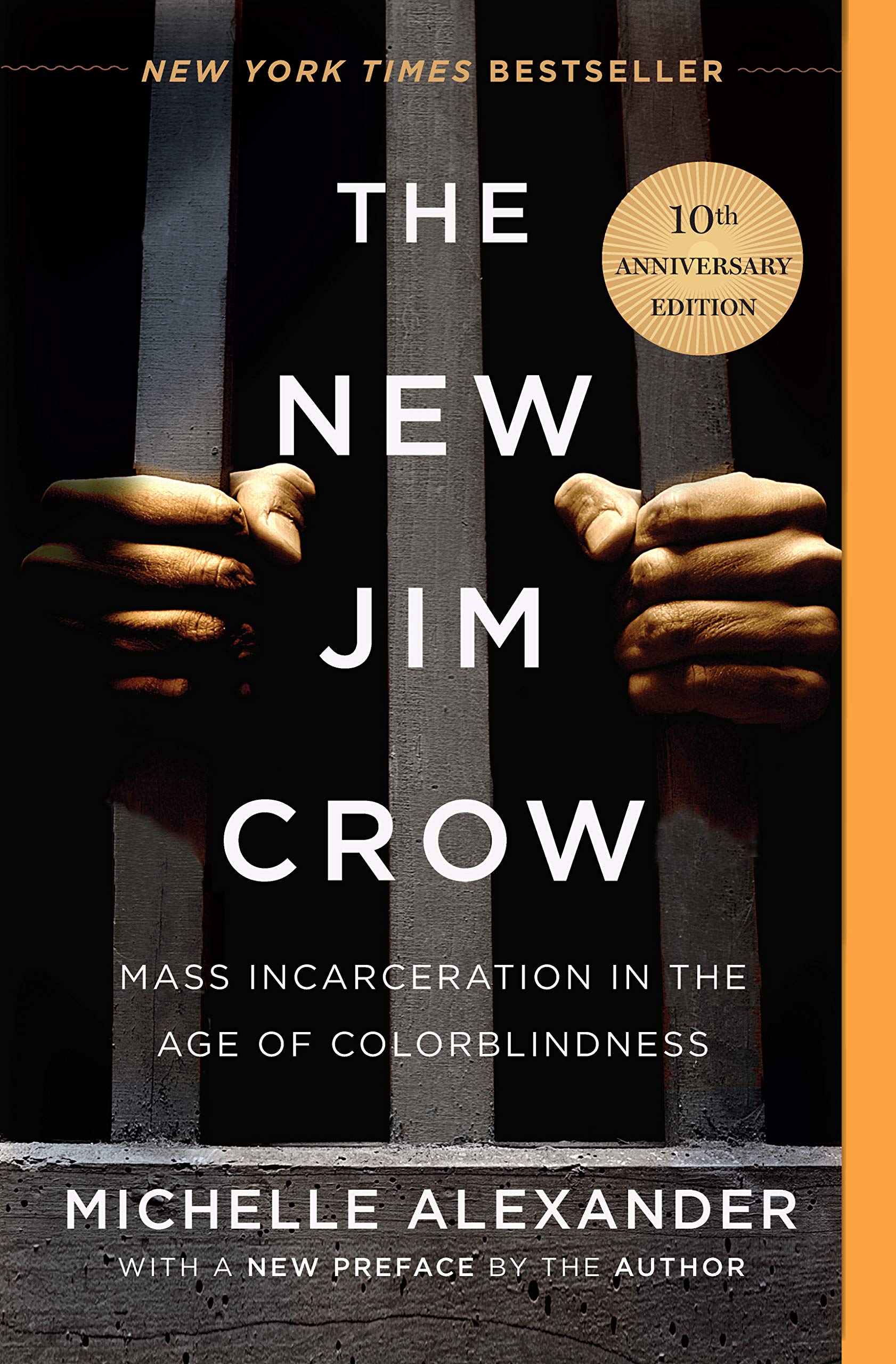
The New Jim Crow: Chapter 3
In this award-winning book, civil rights lawyer Michelle Alexander argues that the American criminal justice system unfairly targets and penalizes African Americans, resulting in long-term harm to black communities.
Here are links to our lists for the book: Introduction–Chapter 1, Chapter 2, Chapter 3, Chapter 4, Chapter 5, Chapter 6
40 words
22 learners
Learn words with Flashcards and other activities
Definition First

Other learning activities
Full list of words from this list:
-
glaring
extremely obvious or conspicuousThe truth, however, is that rates and patterns of drug crime do not explain the glaring racial disparities in our criminal justice system. People of all races use and sell illegal drugs at remarkably similar rates.
-
belie
be in contradiction withAny notion that drug use among blacks is more severe or dangerous is belied by the data; white youth have about three times the number of drug-related emergency room visits as their African American counterparts.
-
prevalence
a superiority in numbers or amountUpon reflection, however, the prevalence of white drug crime—including drug dealing—should not be surprising. After all, where do whites get their illegal drugs?
-
affront
a deliberately offensive actForms of race discrimination that were open and notorious for centuries were transformed in the 1960s and 1970s into something un-American—an affront to our newly conceived ethic of colorblindness.
-
counterintuitive
contrary to what common sense would suggestEqually important to understand is this: the fact that half of a state’s prison population is comprised of people who are labeled violent offenders does not mean that half of the people sentenced to prison in that state have been convicted of violent crimes. This may seem counterintuitive at first, but if you pause to consider how the system actually operates this fact becomes obvious.
-
fanfare
a gaudy outward displayAs we shall see, despite the colorblind rhetoric and fanfare of recent years, the design of the drug war effectively guarantees that those who are swept into the nation’s new undercaste are largely black and brown.
-
disparate
fundamentally different or distinct in quality or kindMoreover, because blacks and whites are almost never similarly situated (given extreme racial segregation in housing and disparate life experiences), trying to “control for race” in an effort to evaluate whether the mass incarceration of people of color is really about race or something else—anything else—is difficult.
-
unbridled
not restrained or controlledUnbridled discretion inevitably creates huge racial disparities.
-
ubiquity
the state of being everywhere at onceThe ubiquity of illegal drug activity, combined with its consensual nature, requires a far more proactive approach by law enforcement than what is required to address ordinary street crime. It is impossible for law enforcement to identify and arrest everyone who commits a drug crime.
-
supplant
take the place or move into the position ofBy 1985, however, as the War on Drugs moved into high gear, this frame was supplanted by a new “siege paradigm,” in which transgressors were poor, nonwhite users and dealers of crack cocaine.
-
paradigm
the generally accepted perspective of a disciplineBy 1985, however, as the War on Drugs moved into high gear, this frame was supplanted by a new “siege paradigm,” in which transgressors were poor, nonwhite users and dealers of crack cocaine.
-
immaculate
without error or flawThe quotation, commonly attributed to Nietzsche, that “there is no immaculate perception,” perfectly captures how cognitive schemas—thought structures—influence what we notice and how the things we notice get interpreted. Studies have shown that racial schemas operate not only as part of conscious, rational deliberations, but also automatically—without conscious awareness or intent.
-
schema
an organized representation of concepts or actionsThe quotation, commonly attributed to Nietzsche, that “there is no immaculate perception,” perfectly captures how cognitive schemas—thought structures—influence what we notice and how the things we notice get interpreted. Studies have shown that racial schemas operate not only as part of conscious, rational deliberations, but also automatically—without conscious awareness or intent.
-
conflate
mix together different elementsOnce blackness and crime, especially drug crime, became conflated in the public consciousness, the “criminalblackman,” as termed by legal scholar Kathryn Russell, would inevitably become the primary target of law enforcement.
-
discrete
constituting a separate entity or partThe risk that African Americans would be unfairly targeted should have been of special concern to the U.S. Supreme Court—the one branch of government charged with the responsibility of protecting “discrete and insular minorities” from the excesses of majoritarian democracy and guaranteeing constitutional rights for groups deemed unpopular or subject to prejudice.
-
exhaustive
performed comprehensively and completelyIn support of his claim, he offered an exhaustive study of more than two thousand murder cases in Georgia. The study was known as the Baldus study—named after Professor David Baldus, who was its lead author. The study found that defendants charged with killing white victims received the death penalty eleven times more often than defendants charged with killing black victims.
-
caveat
a warning against certain actsAccording to the Court, whether or not police discriminate on the basis of race when making traffic stops is irrelevant to a consideration of whether their conduct is “reasonable" under the Fourth Amendment. The Court did offer one caveat, however.
-
preclude
make impossible, especially beforehandCourts also had rejected claims that crack sentencing laws were racially discriminatory, largely on the grounds that the Supreme Court’s decision in McCleskey v. Kemp precluded such a result.
-
remand
refer a matter or legal case back to another authorityThe court remanded the case back to the district court for resentencing.
-
inexplicable
incapable of being explained or accounted forThe petition argued that the Court’s decision was a dire mistake; if the decision were allowed to stand and prosecutors were compelled to explain gross racial disparities such as the ones at issue, it would be a “substantial step toward invalidating” the death penalty and would “paralyze the criminal justice system”—apparently because severe and inexplicable racial disparities pervaded the system as a whole.
-
affidavit
written declaration made under oathIn support of their claim that Armstrong should, at the very least, be entitled to discovery, Armstrong’s lawyers offered two sworn affidavits.
-
extenuating
partially excusing or justifyingI had an [assistant U.S. attorney who] wanted to drop the gun charge against the defendant [in a case in which] there were no extenuating circumstances.
-
circumvent
beat through cleverness and witAlmost immediately after Batson was decided, however, it became readily apparent that prosecutors had no difficulty circumventing the formal requirement of colorblindness in jury selection by means of a form of subterfuge the Court would come to accept, if not endorse.
-
subterfuge
something intended to misrepresent the nature of an activityAlmost immediately after Batson was decided, however, it became readily apparent that prosecutors had no difficulty circumventing the formal requirement of colorblindness in jury selection by means of a form of subterfuge the Court would come to accept, if not endorse.
-
bluster
vain and empty boastingFor all its bluster, the Court offered no meaningful protection against jury discrimination in the years that followed.
-
per se
with respect to its inherent natureThe Supreme Court reversed. Clearly, what offended the U.S. Supreme Court was not the exclusion of blacks from jury service per se, but rather doing so openly and explicitly.
-
peremptory
not allowing contradiction or refusalIn theory, peremptory strikes may increase the fairness of the proceeding by eliminating jurors who may be biased but whose biases cannot be demonstrated convincingly to a judge. In practice, however, peremptory challenges are notoriously discriminatory.
-
flagrant
conspicuously and outrageously bad or reprehensibleGiven how flagrantly prosecutors were violating Batson's ban on race discrimination in jury selection, it was reasonable to hope that, if presented with a particularly repugnant case, the Supreme Court might be willing to draw the line at practices that make a mockery of the antidiscrimination principle.
-
forego
be earlier in time; go back furtherThe Court of Appeals for the Eighth Circuit ruled that the foregoing explanation for the prosecutor’s strikes of black jurors was insufficient and should have been rejected by the trial court because long hair and facial hair are not plausibly related to a person’s ability to perform as a juror.
-
adamant
impervious to pleas, persuasion, requests, or reasonRacially biased police discretion is key to understanding how the overwhelming majority of people who get swept into the criminal justice system in the War on Drugs turn out to be black or brown, even though the police adamantly deny that they engage in racial profiling.
-
rappel
lower oneself with a rope coiled around the body from a mountainsideSWAT teams could have rappelled from helicopters in gated suburban communities and raided the homes of high school lacrosse players known for hosting coke and ecstasy parties after their games.
-
coffer
the funds of a government, institution, or individualAnd so long as the number of drug arrests increases or at least remains high, federal dollars continue to flow in and fill the department’s coffers.
-
reflexive
without volition or conscious controlEach time we drove into a public housing project and stopped the car, every young black man in the area would almost reflexively place his hands up against the car and spread his legs to be searched. And the officers would search them.
-
empirical
derived from experiment and observation rather than theoryIn 2002, a team of researchers at the University of Washington decided to take the defenses of the drug war seriously by subjecting the arguments to empirical testing in a major study of drug-law enforcement in a racially mixed city—Seattle.
-
insurmountable
not capable of being overcomeAs legal scholar David Cole has observed, “The Court has imposed nearly insurmountable barriers to persons challenging race discrimination at all stages of the criminal justice system.” The barriers are so high that few lawsuits are even filed, notwithstanding shocking and indefensible racial disparities.
-
injunction
a judicial remedy to prohibit a party from doing somethingThe Supreme Court dismissed the case, however, ruling that Lyons lacked “standing” to seek an injunction against the deadly practice. In order to have standing, the Court reasoned, Lyons would have to show that he was highly likely to be subject to a chokehold again.
-
disingenuous
not straightforward or candidBut any suggestion that litigants need not worry about policy reform because they can always sue for damages would be disingenuous—particularly as applied to race discrimination cases. Why? Neither the state nor the state police can be sued for damages.
-
concession
a point that is yieldedThe truth, however, is this: at other stages of the criminal justice process, the Court has indicated that overt racial bias necessarily triggers strict scrutiny—a concession that has not been costly, as very few law enforcement officials today are foolish enough to admit bias openly.
-
doublespeak
language that conceals or misrepresents the truthPolice departments and highway patrol agencies frequently declare, “We do not engage in racial profiling,” even though their officers routinely use race as a factor when making decisions regarding whom to stop and search. The justification for the implicit doublespeak—“we do not racial-profile; we just stop people based on race”—can be explained in part by the Supreme Court’s jurisprudence.
-
epithet
a defamatory or abusive word or phraseSo long as officers refrain from uttering racial epithets and so long as they show the good sense not to say “the only reason I stopped him was ’cause he’s black,” courts generally turn a blind eye to patterns of discrimination by the police.
Created on Fri Jun 19 17:46:23 EDT 2020
(updated Tue Jun 30 14:32:50 EDT 2020)
Sign up now (it’s free!)
Whether you’re a teacher or a learner,
Vocabulary.com can put you or your class
on the path to systematic vocabulary improvement.