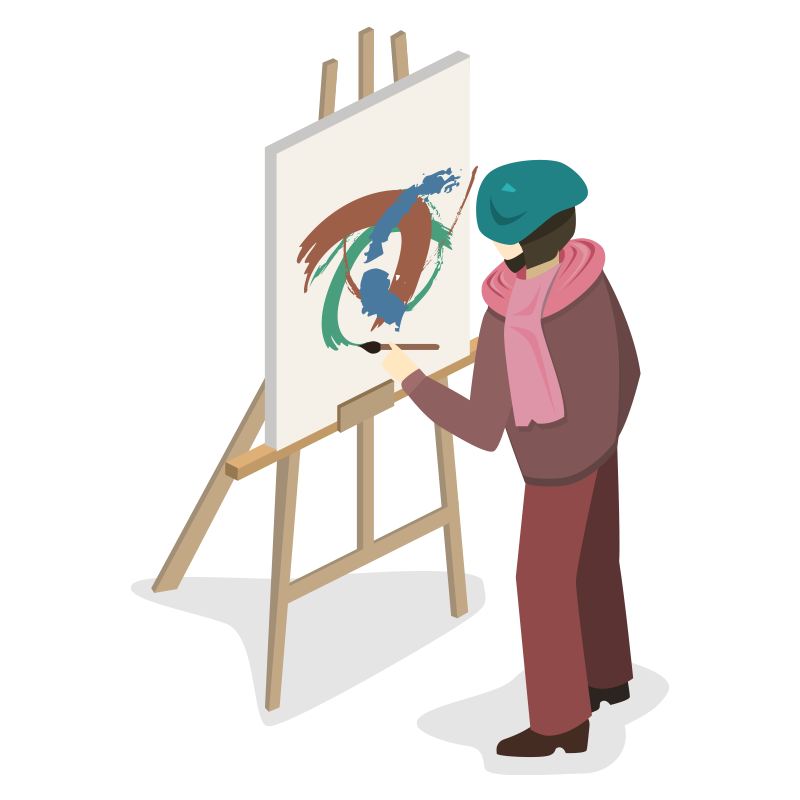
Art Attack: The Vocabulary of Creativity: Stroke of Genius: Words About Painting
The art of painting is at least 40,000 years old — there's something fundamentally human about the urge to create pictures of the things we see or imagine. Use this list to brush up on your palette of painterly parlance.
31 words
6101 learners
Learn words with Flashcards and other activities
Definition First

Other learning activities
Full list of words from this list:
-
abstract
not representing or imitating external realityIn 1968 and ’69, she produced a group of symmetrical geometric abstract paintings in a rich, winy palette. New York Times (Apr 2, 2020)As a noun, abstract refers to an excerpt or a summary of a larger written work. As an adjective, abstract means something that is not connected to the real world, existing only in the mind. In the case of visual art, an abstract painting is not representational —meaning it's not a picture of something real, like a person or a vase of flowers — but rather uses shape, color, line and texture to make an image that doesn't depict something else.
-
aesthetics
the branch of philosophy dealing with beauty and tasteThe artist said she felt useful in this crisis: turning aesthetics into function. Fox News (Apr 5, 2020)
-
aqueous
similar to or containing or dissolved in waterAs light passing through an aqueous solution encounters a lipid surface, the change in refractive index causes it to bend and scatter. Nature (Dec 3, 2018)If you see aqua in aqueous, that's not a coincidence. Aqua is Latin (and Italian) for water. Watercolor, gouache, and acrylic are all examples of aqueous media: paints that use water as their solvent.
-
canvas
a heavy, closely woven fabricWood panels were once the standard for paintings, but by the 17th century they were largely overtaken by canvas, and the paint itself changed, too. New York Times (Apr 8, 2020)
-
chiaroscuro
the arrangement or interplay of light and dark in an artworkHe especially liked to shoot into rooms or buildings from the outside, because the sharp change in the lighting heightened the stereo effect, just as chiaroscuro adds depth to Renaissance paintings. New York Times (Dec 11, 2019)In Italian, chiaro means "light" and scuro means "dark." Our words clear and obscure both derive from the same roots. So chiaroscuro means "light-dark" and refers to a style of painting that depicts dramatically lit scenes with bold highlights and dark shadows. This style originated in the Italian Renaissance, and was perfected a little later in the Baroque period, most famously by Caravaggio.
-
composition
the spatial property resulting from the arrangement of partsPollock, on the other hand, found composition difficult. Washington Post (Apr 1, 2020)
-
contrast
perceptual effect of the juxtaposition of different colorsThe mix of organic and industrial, ancient and anodyne, is by artistic design — “I like that contrast and the tension that it creates,” Mr. Lind-Ramos said. New York Times (Apr 1, 2020)
-
cubism
an artistic movement featuring surfaces of geometric planesUp on the fifth floor, the galleries aren’t labeled by the old “isms” of art history — Fauvism, expressionism, cubism, surrealism — though the works are mostly grouped by stylistic or intellectual affinities. Washington Post (Oct 9, 2019)
-
daub
an unskillful paintingIncidents include the daubing of a Neolithic burial chamber with animal blood and bluestone fragments from rocks linking Pembrokeshire with Stonehenge being sold online. BBC (Mar 15, 2020)If you apply paint to a surface using a toothbrush, or the chewed-up end of a stick, that's daubing.
-
enamel
any smooth glossy coating that resembles ceramic glazeShe painted it with 1 Shot-brand sign lettering enamels mixed with clear enamel and pearlescent powdered pigments. Washington Post (Mar 25, 2020)
-
fresco
a mural done with watercolors on wet plasterIt includes designs for the Sistine Chapel and the massive fresco “The Last Judgment” at the Vatican. Los Angeles Times (Mar 28, 2020)Fresco means "fresh" in Italian, which is also used the way we use "wet" to describe paint that's just been applied. When painting a fresco, paint is mixed into wet plaster on a wall.
-
gouache
an opaque watercolor prepared with gumDrawing on motifs from Persian, Nigerian and Senegalese textiles, Olowu created a series of rough gouache sketches, layering them up, pattern on pattern. New York Times (Jan 27, 2020)
-
medium
a liquid with which pigment is mixed by a painterWhen the little vials— when you put the swab in it to send it to the lab, it needs a particular medium in it to preserve it. Slate (Apr 7, 2020)Medium has multiple meanings, but here it refers to the "oil" in "oil paint." When you mix powdered pigment with a liquid — linseed oil, acrylic emulsion, or beeswax, for example — each of those different substances is the medium. The words binder or vehicle are sometimes used instead. If you see a piece of art labeled with the term "mixed media," that means more than one kind of paint or material was used to create it.
-
miniature
painting or drawing included in a bookThe miniature was bought from the dealer Philip Mould thanks to money from the Beecroft Bequest and the Art Fund. The Guardian (Apr 7, 2020)
-
palette
a board on which an artist mixes paintsBeneath her, energetically sketched in a washy palette of ocher and green, lies the harbor of Palermo, and in the background is Monte Pellegrino, the hill where her relics were found. New York Times (Mar 26, 2020)A palette is a wooden board or other surface for mixing paints. Palette can also describe the color scheme in a painting, or in the decor of a room. Don't confuse it with palate, which is part of your mouth and also a term for your taste in food. A pallet is a wooden platform, used in shipping, that allows forklifts to move bulk items easily, and also a term for a simple bed on the ground.
-
panel
sheet that forms a distinct section of somethingWood panels were once the standard for paintings, but by the 17th century they were largely overtaken by canvas, and the paint itself changed, too. New York Times (Apr 8, 2020)
-
parchment
a superior paper resembling sheepskinLarge sheets of parchment folded to create 24 pages. New York Times (Mar 26, 2020)
-
pastel
any of various pale or light colorsThe artist Molly Crabapple drew an old-law tenement, surrounded with flowers, in yellow watercolor and pastels. Slate (Apr 6, 2020)Pastel refers to a kind of crayon, where pigment is combined either with plant gums or oil and compressed into sticks. Pastel also means a particularly pale color, with a fair amount of white mixed in, like you would see in a drawing made with pastels.
-
perspective
appearance as determined by distance from the viewerSo here are some facts to help put the projections in comparative perspective. Los Angeles Times (Apr 8, 2020)Perspective, the use of lines converging on a vanishing point to accurately depict three dimensions on a two-dimensional surface, was the defining innovation of the Renaissance. Invented by the architect Filippo Brunelleschi around 1415, it transformed the art of painting forever, making images —especially buildings and landscapes — appear much more lifelike and real.
-
pigment
dry coloring materialThe Japanese factory that made the rosy paint pigment was battered and shut down by ocean waves. Washington Times (Apr 6, 2020)Pigments are intensely colored powders made from a variety of materials: mostly mineral, some vegetable, and a few animal (mainly insect). Depending on the medium a pigment is mixed with, the result can be anything from oil paint to watercolor to pastel.
-
primer
the first or preliminary coat of paint applied to a surfaceThe black frame is my preference, while the gray frame looks especially gloomy, like a glossy coat of furniture primer. The Verge (Mar 31, 2020)
-
Renaissance
period of European history at the close of the Middle AgesA leading light of the Spanish Renaissance, he was the subject of a magnificent show I saw last year at the Grand Palais in Paris. Washington Post (Mar 25, 2020)Renaissance means "rebirth" in French. It refers to a period in European history, roughly the fifteenth century, during which time huge advances were made in art, architecture, literature, and the sciences. Florence, Italy is famous for having been the most fertile city during this time, with Leonardo DaVinci and Michelangelo its most famous residents.
-
saturation
freedom from dilution with white and hence vivid in hue“This included increasing contrast, brand color saturation, and consistency among details like how and when we use shadows when in Dark Mode.” The Verge (Aug 28, 2019)A saturated color is the opposite of pastel: rich, deep, and intense.
-
sketch
preliminary drawing for later elaborationSome of the leading theoretical physicists in the world walk the hallways here at KITP, pausing to sketch and dissect new ideas at the well-placed chalkboards. Scientific American (Apr 1, 2020)
-
solvent
a liquid substance capable of dissolving other substancesIf the solvent works against the ink on your floor, it should lift quickly. Washington Post (Aug 23, 2019)
-
still life
a painting of inanimate objects such as fruit or flowersA painter offered up her still life of a bottle of bleach, a roll of toilet paper, hand sanitizer. Los Angeles Times (Mar 26, 2020)The plural of still life is still lifes. Really!
-
surrealism
an artistic movement using fantastic and incongruous imagesThe list of past subject areas includes surrealism, the Harlem Renaissance, the art of persuasion, the Civil War and Italian mathematician Fibonacci. Washington Post (Jan 9, 2020)Surreal is French for "more than real." Surrealism was a movement that began in France after World War I that used bizarre imagery, often taken from dreams, to create strange, haunting, and sometimes funny works of art.
-
symbolism
the practice of investing things with arbitrary meaningDavis accomplished one of the most moving, effective fusions of paint handling, narrative and symbolism in recent American art. New York Times (Feb 20, 2020)When something in a painting — or a film, or a novel, or a poem — stands in for something else, that's symbolism. Frida Kahlo is famous for her symbolistic paintings.
-
varnish
a coating that provides a hard, lustrous finish to a surfaceIt smells like oiled brass and varnished wood. Washington Post (Apr 5, 2020)Once a painting is fully dry, an artist might choose to varnish it. This makes the surface more shiny, and can add a layer of protection against light scratches and other damage. In French, gallery openings are known as vernissages, or "varnishings," because in earlier times the artists would apply a coat of varnish to the new paintings on the first day of an exhibition.
-
vellum
fine parchment prepared from the skin of a young animalThe most expensive and sought-after type of parchment was vellum, made from calfskin. The Girl Who Drew Butterflies: How Maria Merian's Art Changed ScienceMany ancient manuscripts were written on vellum, which was much more durable than paper.
-
viscous
having a relatively high resistance to flowThat technique allowed Pollock to avoid coiling instability, in which a viscous liquid like paint curls up and coils like a rope when it falls on a surface. Washington Post (Nov 7, 2019)Linseed oil, which is the medium for pigment in oil paint, is a viscous fluid: very slow to pour out of a jar. Honey is another good example of a liquid with high viscosity.
Created on Tue Jan 14 11:37:58 EST 2020
(updated Sun Apr 12 19:31:59 EDT 2020)
Sign up now (it’s free!)
Whether you’re a teacher or a learner,
Vocabulary.com can put you or your class
on the path to systematic vocabulary improvement.