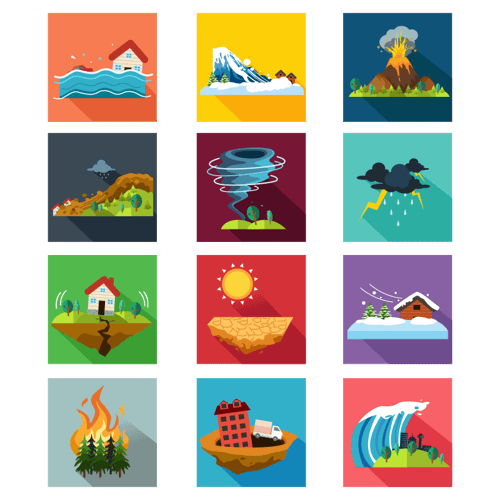
Disaster Area: Wind Power: The Words Beneath Your Wings
Are you a fan of wind? Then learning these words should be a breeze!
13 words
4483 learners
Learn words with Flashcards and other activities
Definition First

Other learning activities
Full list of words from this list:
-
cyclone
an atmospheric system in which air circulates rapidlyHe said the government was developing a national disaster risk reduction framework within the Department of Home Affairs that will deal with wildfires, cyclones, floods and drought. Washington Times (Jan 13, 2020)Any storm that revolves and looks like a huge spiral when seen from above is a cyclone. This includes hurricanes and typhoons, both on this list.
-
draught
a current of airLetterboxes are built into external porches, rather than the front doors, to reduce draughts. BBC (Oct 8, 2019)Draught can also be spelled draft. If you have an old house where cold air leaks in, you can describe it as drafty.
-
gale
a strong wind moving 34–40 knots"It will cause some disruption today to some travel, particularly for Scotland, northern and western areas with gales developing," he said. BBC (Jan 13, 2020)Strong winds above 30 miles per hour on or near the ocean are known as gale force winds. gales are most often measured using the Beaufort scale, which ranks winds on a scale from 0–12 and has beautifully poetic descriptions of weather conditions. The word's origin is unknown, though it may derive from the Old Norse galenn, meaning "mad" or "frantic."
-
gust
a strong current of airWednesday will likely be breezy in Seattle, with gusts up to 24 mph during the day and up to 36 mph at night. Seattle Times (Jan 15, 2020)
-
hurricane
a severe tropical cyclone usually with heavy rains and windsNow, even as hurricane recovery remains incomplete, a new natural disaster: a 6.4-magnitude earthquake followed by powerful aftershocks. Washington Post (Jan 12, 2020)A hurricane is a cyclone in the Atlantic, Carribbean, or Northeast Pacific with sustained winds over 74 miles per hour. Each season, which runs from late summer through the fall, hurricanes are given names in alphabetical order.
-
monsoon
rainy season in southern AsiaLast summer, a drought whipped up by warmer Pacific Ocean currents — the phenomenon known as El Niño — delayed and shortened the annual monsoon rains that nourish the river system. Los Angeles Times (Jan 20, 2020)From the Portuguese monção, which in turn derives from the Arabic mawsim, meaning "season," monsoon refers to both a strong seasonal wind in Asia and the steady, heavy rain that accompanies it.
-
squall
sudden violent winds, often accompanied by precipitationAnd Friday also was expected to include rain squalls that would lead to the rare less than perfect conditions in Maui. Golf Digest (Jan 3, 2020)Squall's origins are unclear. It may relate to squeal, since besides describing a storm that springs up quickly it can also refer to a baby's screaming cries.
-
tempest
a strong storm with violent windsThis wasn’t a blizzard; it was a tempest. A Walk in the WoodsTempest originated in the Latin word tempus, meaning "time," specifically in the sense that a season is a period of time and each season has different weather. Tempestas means "season," "weather," or "storm."
-
tornado
a violently destructive windstorm occurring over landExtreme heat kills hundreds of people in the US every year – more than any other hazardous weather event, including hurricanes, tornadoes, and flooding, according to the Centre for Disease Control. The Guardian (Jan 13, 2020)
-
typhoon
a tropical cyclone in the western Pacific or Indian oceansA passing typhoon turned Pinatubo’s ash and lava flows into a deadly exodus of mud. New York Times (Jan 15, 2020)Typhoon, unusually, has two origins. tufan is an Urdu word, from Persian and Arabic, for a violent storm. Tai fung is Cantonese dialect for ta feng, literally "big wind." Either way, it describes the same sort of storm that hurricane does, but in a different part of the world.
-
waft
be driven or carried along, as by the airBut, if we were able to travel back 67 million years, what scent would waft away from the hefty herbivore? Scientific American (Jan 12, 2020)If you catch a whiff of something good cooking downstairs, that smell wafted to your nose. Waft originally meant to transport something, usually across water, using wind power as in a sailing ship.
-
whirlwind
a column of air spinning around itself“It’s been a whirlwind of a year and one that I’m extremely grateful for,” said Ertz. Reuters (Dec 13, 2019)
-
zephyr
a slight windThe forecast for all four of the tournament’s rounds is fine and mild, with a moderate breeze on Thursday tapering off to a light zephyr on Sunday. Reuters (Jun 12, 2018)In Ancient Greek, zephyros referred to the west wind. Now zephyr means a gentle breeze.
Created on Thu Nov 07 12:48:03 EST 2019
(updated Tue Jan 21 11:10:41 EST 2020)
Sign up now (it’s free!)
Whether you’re a teacher or a learner,
Vocabulary.com can put you or your class
on the path to systematic vocabulary improvement.