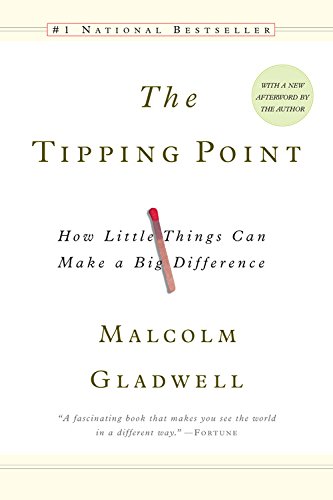
The Tipping Point: Chapter 7–Afterword
How does a small idea become a global craze? In this work of nonfiction, Malcolm Gladwell analyzes how trends are set in motion.
Here are links to our lists for the book: Introduction–Chapter 2, Chapters 3–4, Chapters 5–6, Chapter 7–Afterword
Here are links to our lists for other works by Malcolm Gladwell: Outliers, Blink
15 words
34 learners
Learn words with Flashcards and other activities
Definition First

Other learning activities
Full list of words from this list:
-
inveigh
speak against in an impassioned mannerAs any parent of a teenage child will tell you, the essential contrariness of adolescents suggests that the more adults inveigh against smoking and lecture teenagers about its dangers, the more teens, paradoxically, will want to try it.
-
relevant
having a bearing on or connection with the subject at issueThat’s why the epidemic of suicide in Micronesia is so interesting and potentially relevant to the smoking problem.
-
vulnerable
susceptible to criticism or persuasion or temptationIn the case of suicide, Phillips argues, the decision by someone famous to take his or her own life has the same effect: it gives other people, particularly those vulnerable to suggestion because of immaturity or mental illness, permission to engage in a deviant act as well.
-
nuance
a subtle difference in meaning or opinion or attitudeIf suicide in the West is a kind of crude language, in Micronesia it has become an incredibly expressive form of communication, rich with meaning and nuance, and expressed by the most persuasive of permission-givers.
-
scion
a descendent or heirThen, in November of 1966, came the death of R., the charismatic scion of one of the island’s wealthiest families.
-
extrovert
a person directed toward others as opposed to the selfThe quintessential hard-core smoker, according to Eysenck, is an extrovert, the kind of person who is sociable, likes parties, has many friends, needs to have people to talk to.
-
surfeit
the state of being more than full“One theory,” Krogh writes, “has it that their lack of deference and their surfeit of defiance combine to make them relatively indifferent to what people think of them.”
-
innate
present at birth but not necessarily hereditaryWe suspect, as I wrote previously, that one of the reasons some experimenters never smoke again and some turn into lifelong addicts is that human beings may have very different innate tolerances for nicotine.
-
debilitating
impairing strength and vitalityHere is stickiness with a vengeance: not only do some smokers find it hard to quit because they are addicted to nicotine, but also because without nicotine they run the risk of a debilitating psychiatric illness.
-
placebo
an innocuous or inert medicationIn the study, 23 percent of smokers given a course of anti-smoking counseling and a placebo quit after four weeks.
-
truculent
defiantly aggressiveTeens are always going to be fascinated by people like Maggie the au pair and Billy G. and Pam P., and they should be fascinated by people like that, if only to get past the adolescent fantasy that to be rebellious and truculent and irresponsible is a good way to spend your life.
-
impetus
a force that makes something happenWhat must underlie successful epidemics, in the end, is a bedrock belief that change is possible, that people can radically transform their behavior or beliefs in the face of the right kind of impetus.
-
volatile
liable to lead to sudden change or violenceThat’s why social change is so volatile and so often inexplicable, because it is the nature of all of us to be volatile and inexplicable.
-
inexplicable
incapable of being explained or accounted forThat’s why social change is so volatile and so often inexplicable, because it is the nature of all of us to be volatile and inexplicable.
-
credence
the mental attitude that something is believableThe fact that expressing a dissenting view in person is much harder socially, in other words, gives that opinion much more credence in the group’s deliberations.
Created on Tue Nov 26 14:31:47 EST 2013
(updated Mon Jul 14 15:59:29 EDT 2025)
Sign up now (it’s free!)
Whether you’re a teacher or a learner,
Vocabulary.com can put you or your class
on the path to systematic vocabulary improvement.