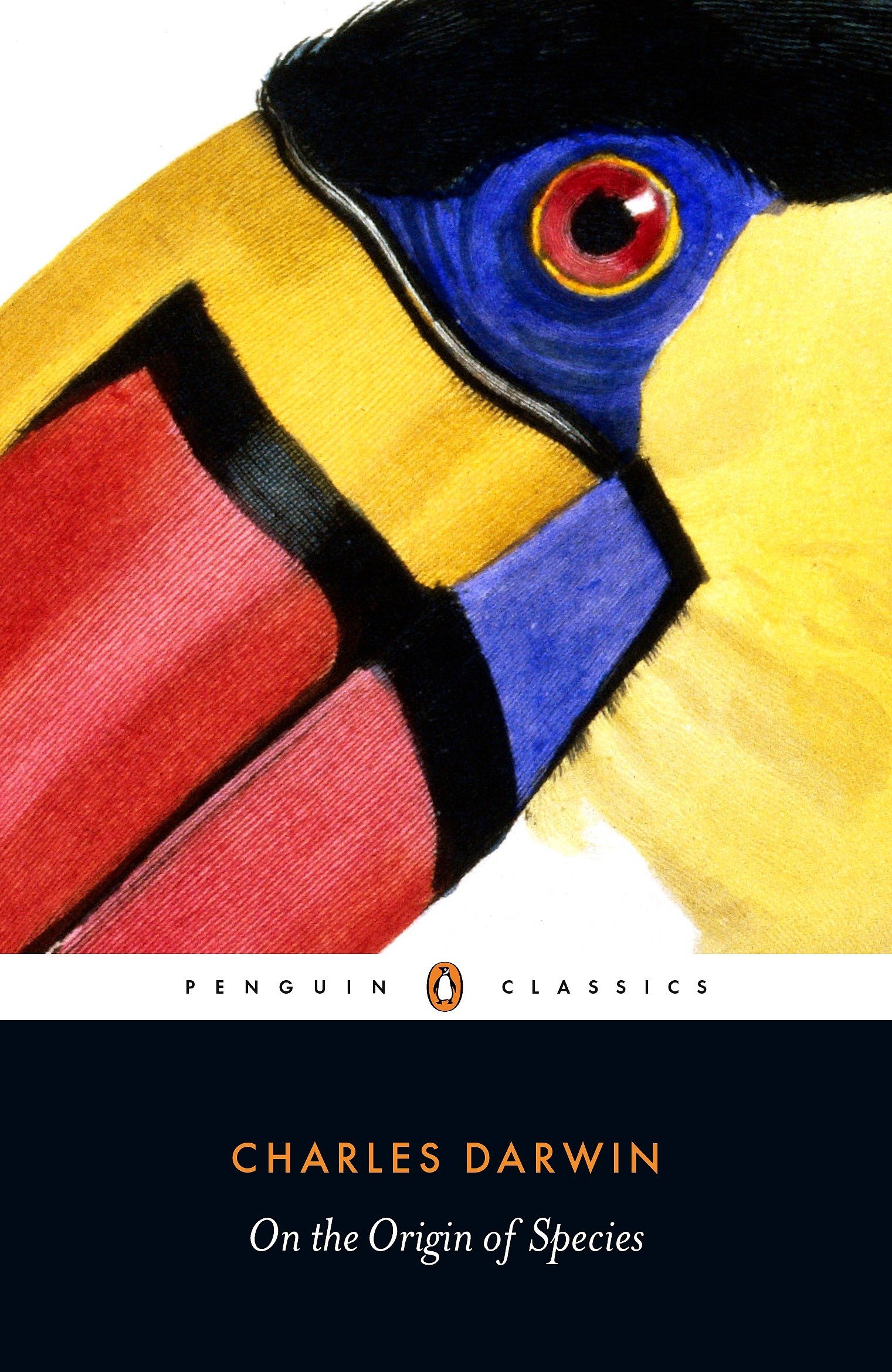
On the Origin of Species: Chapters 10–14
Darwin's groundbreaking and influential treatise on natural selection is a foundational text of evolutionary biology. Read the full text here.
Here are links to our lists for the book: Introduction–Chapter 1, Chapters 2–4, Chapters 5–6, Chapters 7–9, Chapters 10–14
40 words
223 learners
Learn words with Flashcards and other activities
Definition First

Other learning activities
Full list of words from this list:
-
incidentally
as a subordinate or chance occurrenceWe have as yet spoken only incidentally of the disappearance of species and of groups of species.
-
taper
diminish graduallyThere is reason to believe that the complete extinction of the species of a group is generally a slower process than their production: if the appearance and disappearance of a group of species be represented, as before, by a vertical line of varying thickness, the line is found to taper more gradually at its upper end, which marks the progress of extermination, than at its lower end, which marks the first appearance and increase in numbers of the species.
-
gratuitous
unnecessary and unwarrantedThe whole subject of the extinction of species has been involved in the most gratuitous mystery.
-
severally
one at a time or in the order givenBut we could not have told what the unfavourable conditions were which checked its increase, whether some one or several contingencies, and at what period of the horse's life, and in what degree, they severally acted.
-
diffuse
spread throughWe have distinct evidence on this head, in the plants which are dominant, that is, which are commonest in their own homes, and are most widely diffused, having produced the greatest number of new varieties.
-
pachyderm
a large mammal with thick skin, such as an elephant or hippoCuvier ranked the Ruminants and Pachyderms, as the two most distinct orders of mammals; but Owen has discovered so many fossil links, that he has had to alter the whole classification of these two orders; and has placed certain pachyderms in the same sub-order with ruminants: for example, he dissolves by fine gradations the apparently wide difference between the pig and the camel.
-
apprehend
understand or perceive the meaning of somethingBut I apprehend that in a perfectly natural classification many fossil species would have to stand between living species, and some extinct genera between living genera, even between genera belonging to distinct families.
-
disinter
dig up for reburial or for medical investigationIf, for instance, the genera a1, a5, a10, f8, m3, m6, m9 were disinterred, these three families would be so closely linked together that they probably would have to be united into one great family, in nearly the same manner as has occurred with ruminants and pachyderms.
-
vicissitude
a variation in circumstances or fortuneConsider the prodigious vicissitudes of climate during the pleistocene period, which includes the whole glacial period, and note how little the specific forms of the inhabitants of the sea have been affected.
-
interminable
tiresomely long; seemingly without endAll these causes taken conjointly, must have tended to make the geological record extremely imperfect, and will to a large extent explain why we do not find interminable varieties, connecting together all the extinct and existing forms of life by the finest graduated steps.
-
atoll
an island consisting of a coral reef surrounding a lagoonIn the coral-producing oceans such sunken islands are now marked, as I believe, by rings of coral or atolls standing over them.
-
dissemination
the act of dispersing or diffusing somethingIn botanical works, this or that plant is stated to be ill adapted for wide dissemination; but for transport across the sea, the greater or less facilities may be said to be almost wholly unknown.
-
interstice
small opening between thingsI find on examination, that when irregularly shaped stones are embedded in the roots of trees, small parcels of earth are very frequently enclosed in their interstices and behind them,—so perfectly that not a particle could be washed away in the longest transport: out of one small portion of earth thus COMPLETELY enclosed by wood in an oak about 50 years old, three dicotyledonous plants germinated: I am certain of the accuracy of this observation.
-
disgorge
eject the contents of the stomach through the mouthSome hawks and owls bolt their prey whole, and after an interval of from twelve to twenty hours, disgorge pellets, which, as I know from experiments made in the Zoological Gardens, include seeds capable of germination.
-
sunder
break apart or in two, using violenceAs on the land, so in the waters of the sea, a slow southern migration of a marine fauna, which during the Pliocene or even a somewhat earlier period, was nearly uniform along the continuous shores of the Polar Circle, will account, on the theory of modification, for many closely allied forms now living in areas completely sundered.
-
detritus
loose material that is worn away from rocksIn central Chile I was astonished at the structure of a vast mound of detritus, about 800 feet in height, crossing a valley of the Andes; and this I now feel convinced was a gigantic moraine, left far below any existing glacier.
-
inundate
fill or cover completely, usually with waterThe living waters may be said to have flowed during one short period from the north and from the south, and to have crossed at the equator; but to have flowed with greater force from the north so as to have freely inundated the south.
-
capricious
determined by chance or impulse rather than by necessityBut on the same continent the species often range widely and almost capriciously; for two river-systems will have some fish in common and some different.
-
loess
a fine accumulation of clay and silt deposited by the windWe have evidence in the loess of the Rhine of considerable changes of level in the land within a very recent geological period, and when the surface was peopled by existing land and fresh-water shells.
-
insular
relating to or characteristic of or situated on an islandThis view would remove many difficulties, but it would not, I think, explain all the facts in regard to insular productions.
-
propinquity
the property of being close togetherI believe that something more is included; and that propinquity of descent,—the only known cause of the similarity of organic beings,—is the bond, hidden as it is by various degrees of modification, which is partially revealed to us by our classifications.
-
adaptive
having a capacity for changeThese resemblances, though so intimately connected with the whole life of the being, are ranked as merely "adaptive or analogical characters;" but to the consideration of these resemblances we shall have to recur.
-
inflection
a deviation from a course or positionFor instance, whether or not there is an open passage from the nostrils to the mouth, the only character, according to Owen, which absolutely distinguishes fishes and reptiles—the inflection of the angle of the jaws in Marsupials—the manner in which the wings of insects are folded—mere colour in certain Algae—mere pubescence on parts of the flower in grasses—the nature of the dermal covering, as hair or feathers, in the Vertebrata.
-
prevalence
the quality of being widespreadHence, as has often been remarked, a species may depart from its allies in several characters, both of high physiological importance and of almost universal prevalence, and yet leave us in no doubt where it should be ranked.
-
aerate
fill, combine, or supply with oxygenAs in most groups of animals, important organs, such as those for propelling the blood, or for aerating it, or those for propagating the race, are found nearly uniform, they are considered as highly serviceable in classification; but in some groups of animals all these, the most important vital organs, are found to offer characters of quite subordinate value.
-
unequivocally
in an unambiguous mannerThere are crustaceans at the opposite ends of the series, which have hardly a character in common; yet the species at both ends, from being plainly allied to others, and these to others, and so onwards, can be recognised as unequivocally belonging to this, and to no other class of the Articulata.
-
enunciation
the articulation of speech with regards to intelligibility...that community of descent is the hidden bond which naturalists have been unconsciously seeking, and not some unknown plan of creation, or the enunciation of general propositions, and the mere putting together and separating objects more or less alike.
-
predicate
involve as a necessary condition or consequenceWith species in a state of nature, every naturalist has in fact brought descent into his classification; for he includes in his lowest grade, or that of a species, the two sexes; and how enormously these sometimes differ in the most important characters, is known to every naturalist: scarcely a single fact can be predicated in common of the males and hermaphrodites of certain cirripedes, when adult, and yet no one dreams of separating them.
-
ad hominem
appealing to personal considerations rather than to reasonThe supposition is of course preposterous; and I might answer by the argumentum ad hominem, and ask what should be done if a perfect kangaroo were seen to come out of the womb of a bear?
-
cetacean
relating to whales, dolphins, and other aquatic mammals...for these cetaceans agree in so many characters, great and small, that we cannot doubt that they have inherited their general shape of body and structure of limbs from a common ancestor. So it is with fishes.
-
morphology
the study of the structure of animals and plantsThis resemblance is often expressed by the term "unity of type;" or by saying that the several parts and organs in the different species of the class are homologous. The whole subject is included under the general name of Morphology.
-
whelp
young of any of various canines such as a dog or wolfIn the cat tribe, most of the species are striped or spotted in lines; and stripes can be plainly distinguished in the whelp of the lion.
-
retrograde
moving or directed or tending in a backward directionBut in some genera the larvae become developed either into hermaphrodites having the ordinary structure, or into what I have called complemental males: and in the latter, the development has assuredly been retrograde; for the male is a mere sack, which lives for a short time, and is destitute of mouth, stomach, or other organ of importance, excepting for reproduction.
-
contingent
determined by conditions or circumstances that followWe are so much accustomed to see differences in structure between the embryo and the adult, and likewise a close similarity in the embryos of widely different animals within the same class, that we might be led to look at these facts as necessarily contingent in some manner on growth.
-
nascent
being born or beginningAgain, an organ may become rudimentary for its proper purpose, and be used for a distinct object: in certain fish the swim-bladder seems to be rudimentary for its proper function of giving buoyancy, but has become converted into a nascent breathing organ or lung.
-
vestige
an indication that something has been presentWhen a man's fingers have been amputated, imperfect nails sometimes appear on the stumps: I could as soon believe that these vestiges of nails have appeared, not from unknown laws of growth, but in order to excrete horny matter, as that the rudimentary nails on the fin of the manatee were formed for this purpose.
-
abhorrent
offensive to the mindNor ought we to marvel if all the contrivances in nature be not, as far as we can judge, absolutely perfect; and if some of them be abhorrent to our ideas of fitness.
-
endow
give qualities or abilities toWe can thus understand why nature moves by graduated steps in endowing different animals of the same class with their several instincts.
-
mutable
capable of or tending to change in form or quality or natureWhoever is led to believe that species are mutable will do good service by conscientiously expressing his conviction; for only thus can the load of prejudice by which this subject is overwhelmed be removed.
-
exalted
of high moral or intellectual valueThus, from the war of nature, from famine and death, the most exalted object which we are capable of conceiving, namely, the production of the higher animals, directly follows.
Created on Thu Apr 11 10:19:24 EDT 2019
(updated Fri Apr 12 15:18:18 EDT 2019)
Sign up now (it’s free!)
Whether you’re a teacher or a learner,
Vocabulary.com can put you or your class
on the path to systematic vocabulary improvement.