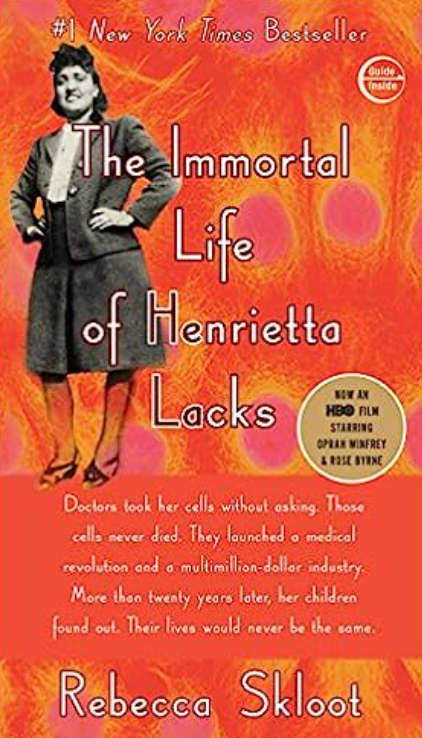
The Immortal Life of Henrietta Lacks: Foreword–"Deborah's Voice"
This biography immortalizes a woman whose cancerous cells contributed to medical breakthroughs around the world.
Here are links to our lists for the book: Foreword–"Deborah's Voice", Part 1, Part 2, Part 3, "Where They Are Now"–Afterword
15 words
4602 learners
Learn words with Flashcards and other activities
Definition First

Other learning activities
Full list of words from this list:
-
verbatim
in precisely the same words used by a writer or speakerSince Henrietta Lacks died decades before I began writing this book, I relied on interviews, legal documents, and her medical records to re-create scenes from her life. In those scenes, dialogue is either deduced from the written record or quoted verbatim as it was recounted to me in an interview.Because she'd spent years with Henrietta Lacks's family—getting to know them, recording them, and quoting their dialogues verbatim—the reporter/writer Skloot is able to deduce ("conclude by reasoning") and re-create dialogues that are suggested by the written evidence in front of her.
-
disparate
including markedly dissimilar elementsThe extract from Henrietta’s medical record in chapter I is a summary of many disparate notations.
-
oblivious
lacking conscious awareness ofIt’s the late 1940s and she hasn’t yet reached the age of thirty. Her light brown skin is smooth, her eyes still young and playful, oblivious to the tumor growing inside her—a tumor that would leave her five children motherless and change the future of medicine.
-
inconceivable
totally unlikelyOne scientist estimates that if you could pile all HeLa cells ever grown onto a scale, they’d weigh more than 50 million metric tons—an inconceivable number, given that an individual cell weighs almost nothing.The piling of all the HeLa cells would be totally unlikely, but 50 million metric tons only seems like an "inconceivable" ("incapable of being understood or grasped fully") number in contrast to the actual weight of an individual cell.
-
cytoplasm
the substance inside a cell, not including the nucleusUnder the microscope, a cell looks a lot like a fried egg: It has a white (the cytoplasm) that’s full of water and proteins to keep it fed, and a yolk (the nucleus) that holds all the genetic information that makes you you.
-
mitosis
the process by which a cell divides into two new cellsAll it takes is one small mistake anywhere in the division process for cells to start growing out of control, he told us. Just one enzyme misfiring, just one wrong protein activation, and you could have cancer. Mitosis goes haywire, which is how it spreads.
-
immortal
not subject to deathScientists had been trying to keep human cells alive in culture for decades, but they all eventually died. Henrietta’s were different: they reproduced an entire generation every twenty-four hours, and they never stopped. They became the first immortal human cells ever grown in a laboratory.This scientific definition of cell immortality is not the same as the immortality associated with gods and supernatural beings. Since the cells are reproducing, they are actually creating new cells rather than simply living forever. "Immortal" also means "a person of enduring fame" and this can now apply to Henrietta Lacks, since Skloot's book has positively connected her to the immortal HeLa cells.
-
chromosome
a threadlike strand of DNA that carries genesTheir chromosomes and proteins have been studied with such detail and precision that scientists know their every quirk.
-
parenthetical
expression in punctuation marks enclosing textual materialAfter class, I ran home and threw myself onto my bed with my biology textbook. I looked up “cell culture” in the index, and there she was, a small parenthetical...
(Cells of this line are called HeLa cells because their original source was a tumor removed from a woman named Henrietta Lacks.) -
pathology
the branch of medical science that studies diseasesAs I graduated from high school and worked my way through college toward a biology degree, HeLa cells were omnipresent. I heard about them in histology, neurology, pathology; I used them in experiments on how neighboring cells communicate.
-
snippet
a small piece of anythingWhen I got my first computer in the mid-nineties and started using the Internet, I searched for information about her, but found only confused snippets: most sites said her name was Helen Lane; some said she died in the thirties; others said the forties, fifties, or even sixties.
-
ethical
adhering to moral principlesWhile trying to make sense of the history of cell culture and the complicated ethical debate surrounding the use of human tissues in research, I’d be accused of conspiracy and slammed into a wall both physically and metaphorically, and I’d eventually find myself on the receiving end of something that looked a lot like an exorcism.
-
resilient
recovering readily from adversity, depression, or the likeI did eventually meet Deborah, who would turn out to be one of the strongest and most resilient women I’d ever known.
-
agnostic
of or pertaining to a religious orientation of doubtDeborah and I came from very different cultures: I grew up white and agnostic in the Pacific Northwest, my roots half New York Jew and half Midwestern Protestant; Deborah was a deeply religious black Christian from the South.
-
predominantly
much greater in number or influenceShe grew up in a black neighborhood that was one of the poorest and most dangerous in the country; I grew up in a safe, quiet middle-class neighborhood in a predominantly white city and went to high school with a total of two black students.
Created on Mon Jul 29 13:40:02 EDT 2013
(updated Tue Jul 01 18:39:20 EDT 2025)
Sign up now (it’s free!)
Whether you’re a teacher or a learner,
Vocabulary.com can put you or your class
on the path to systematic vocabulary improvement.