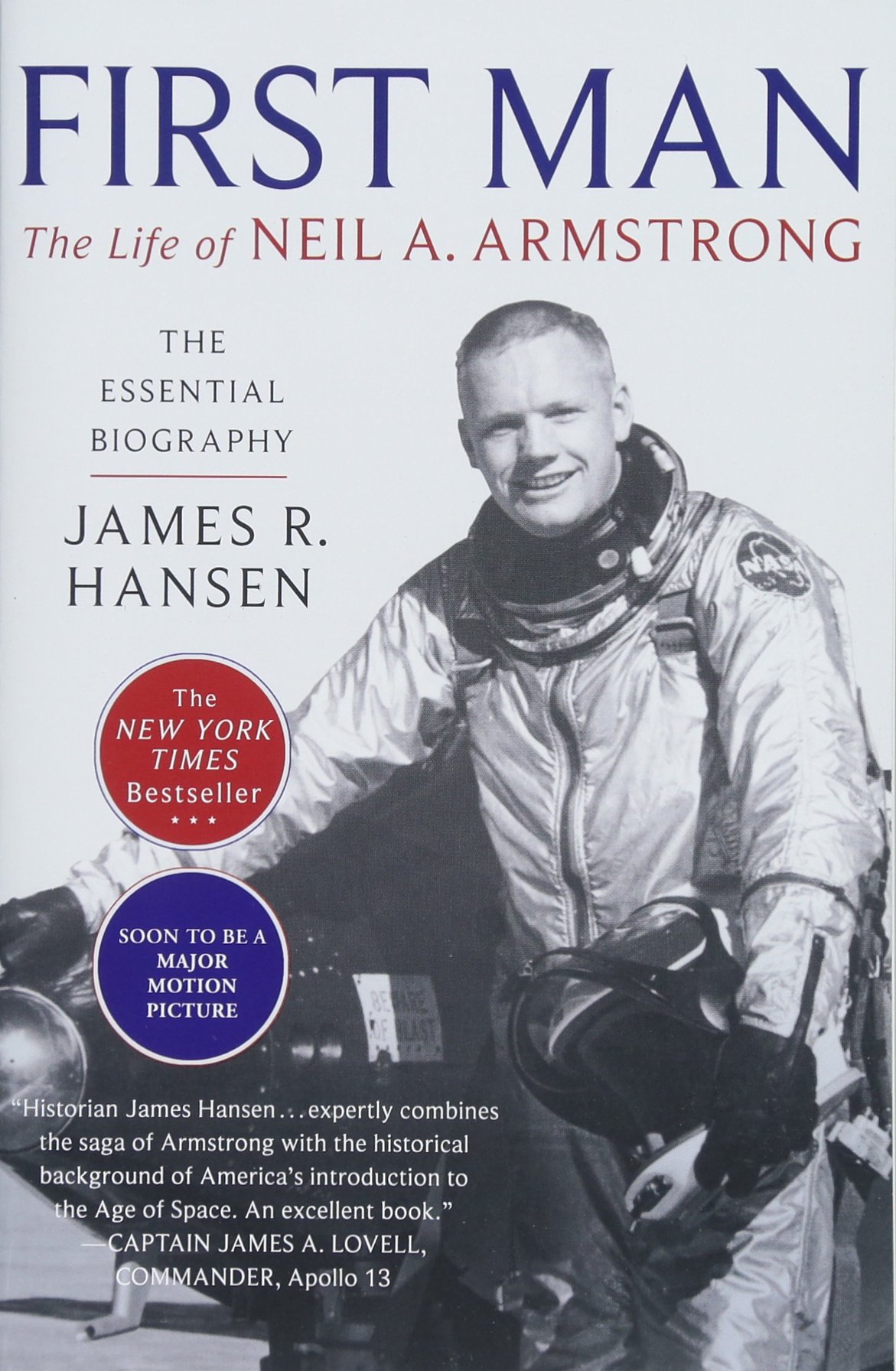
First Man: The Life of Neil A. Armstrong: Part Six
This biography explores the life and legacy of the first astronaut to walk on the moon.
Here are links to our lists for the biography: Prologue–Part Two, Part Three, Part Four, Part Five, Part Six, Part Seven, Part Eight
45 words
38 learners
Learn words with Flashcards and other activities
Definition First

Other learning activities
Full list of words from this list:
-
loquacious
full of trivial conversationLoquacious Hubert H. Humphrey, the vice president, glibly mingled, whereas Secretary of State Dean Rusk and the American ambassador to the United Nations, Averill Harriman, socialized more studiously.
-
glib
marked by lack of intellectual depthLoquacious Hubert H. Humphrey, the vice president, glibly mingled, whereas Secretary of State Dean Rusk and the American ambassador to the United Nations, Averill Harriman, socialized more studiously.
-
complacent
contented to a fault with oneself or one's actionsAs to why all the brainpower at NASA and in the aerospace industry missed the danger of ground testing the spacecraft in a 100 percent oxygen-rich environment, “Well, it was some bad oversight. We’d been getting away with it for a period of time, as we had tested that way all through the Gemini program, and I guess we just became too complacent.”
-
ponderous
having great mass and weight and unwieldinessThe ship leaving for the Moon after Earth orbit rendezvous would be smaller than the battleship-sized Nova, but it would still be a very ponderous stack of machinery to eyeball down to a pinpoint landing.
-
vernacular
the everyday speech of the peopleIn the vernacular, people still pronounced the acronym, not as two individual letters, but as if the vowel were still there.
-
truss
a rigid framework of beams that supports a structureStanding ten feet tall and weighing 3,700 pounds, the LLRV had four aluminum truss legs that spread out across some thirteen feet.
-
modulate
fix or adjust the time, amount, degree, or rate ofOperating in the lunar mode, the pilot could modulate the angle and thrust of the engine to compensate for aerodynamic drag in all axes.
-
substantive
having a firm basis in reality and therefore important“The flying volume—180 feet high, 360 feet long, and 42 feet wide—was limiting, but adequate to give pilots a substantive introduction to lunar flight characteristics.”
-
vexatious
causing irritation or annoyanceArmstrong found out just how unforgiving the vexatious machine could be on Monday afternoon, May 6, 1968, just fourteen months before the Apollo 11 landing.
-
circumspect
careful to consider potential consequences and avoid riskNeil’s reaction to hearing Al Bean’s story is just as circumspect as his behavior in the story itself: “That is true, I did go back to the office. I mean, what are you going to do? It’s one of those sad days when you lose a machine.”
-
adamant
impervious to pleas, persuasion, requests, or reason“Gilruth and I were ready to eliminate it completely,” Kraft notes, “but the astronauts were adamant. They wanted the training it offered.”
-
bolster
support and strengthenGene Matranga puts the capstone on the significance of the landing simulator for the pilot of the first Moon landing: “Psychologically, it didn’t hurt that the LLRV/LLTV was harder to fly than the LM. That pleasant surprise had to bolster any astronaut’s confidence on his way down to the lunar surface.”
-
adulation
exaggerated flattery or praiseEven amid the clamor, criticism, and declining support for the space program, evidenced for more than two years in polling numbers and in congressional votes, the astronauts remained the object of the American public’s adulation.
-
itinerant
traveling from place to place to workAlso as with Armstrong, the itinerant life of his family did not affect him at all adversely.
-
kindred
similar in quality or characterBy 1956, First Lieutenant Collins was a part of a fighter squadron flying F-86s in Chambley, France, and had gotten to very much like what he was doing. In fighter pilots, he found kindred spirits.
-
impetuous
characterized by undue haste and lack of thoughtYou can be irresponsible and you may get away with it being a fighter pilot; but you most certainly cannot as a test pilot. Fighter pilots can be impetuous; test pilots can’t.
-
abrasive
sharply disagreeable, unpleasant, or harshHe had served as an aide to General Billy Mitchell, the outspoken and abrasive advocate of a separate U.S. air force who came before army court-martial in 1925.
-
dirigible
a steerable self-propelled aircraftHe even made a few trips by airship, including one memorable crossing of the Atlantic in the famous German zeppelin Hindenburg. (According to Buzz, his father told friends after making the dirigible flight that it was neither safe nor practical.)
-
foray
a sudden short attackDebriefing with the renegade squadron of F-86Fs, something that was customary for a pilot to do after joining up with another formation, Buzz never told anyone else about the foray into Manchuria.
-
protege
a person who receives support from an influential patronWrigley, a protégé of Dr. Charles Stark Draper and, like Draper, a specialist on inertial navigation, had serious questions about Buzz’s emphasis on the need for piloting abilities to control spacecraft in precise maneuvers.
-
sobriquet
a familiar name for a personSeveral of his peers started referring to him as “Dr. Rendezvous.” Apt though it was due to his MIT degree, the sobriquet was not meant to be flattering.
-
plaintively
in a manner expressing sorrowAs the mission commander, Armstrong began to answer, “I think I can..." then stopped himself in midsentence and turned to Deke Slayton, the director for flight crew operations, and asked plaintively, “You want to take a crack at it?”
-
tantamount
being essentially equal to somethingBuzz told no one about his preference at the time, other than his wife Joan, because within the astronaut corps declining a flight was “tantamount to sacrilege.”
-
enigmatic
resembling an oracle in obscurity of thoughtIf Aldrin expected a definitive resolution from Armstrong, he was sadly mistaken. “Neil, who can be enigmatic if he wishes, was just that,” Buzz recalls.
-
equivocate
be deliberately ambiguous or unclearIn Return to Earth, Aldrin wrote that Neil, “equivocated a minute or so, then with a coolness I had not known he possessed he said that the decision was quite historical and he didn’t want to rule out the possibility of going first.”
-
palatable
acceptable to the taste or mindDeke dropped by Buzz’s office to say that it would probably be Neil who would be out first. At least Slayton gave Buzz a more palatable reason for the pecking order.
-
intemperate
excessive in behaviorNeil was also oblivious of any behind-the-scenes campaigning being done on Buzz’s behalf by the intemperate Gene Aldrin.
-
posthumously
after deathIn his posthumously published 2001 autobiography, Deke!, Slayton states that if Gus Grissom had not been killed in the Apollo fire, he would have chosen Grissom to be the first man on the Moon.
-
internecine
within a group or organizationEven if he had known about the behind-the-scenes campaigning by Buzz’s father, “Neil was not the sort that would have gotten into the fray and presented counterarguments. He always rose above internecine warfare of that kind.”
-
paraphernalia
equipment consisting of miscellaneous articlesThis vital piece of equipment, the EMU, was composed of all the protective apparel and paraphernalia worn during lunar surface work, including suit, helmet, gloves, outer boots, backpack, remote control, hoses, cables, liquid-cooled garment (LCG), outer visor, and so forth.
-
tectonic
pertaining to the structure or movement of the earth's crustThe assumption was that on the Moon we would encounter tectonic formations principally, or remnants of volcanic and tectonic lava flows, that sort of thing.
-
nonplussed
filled with bewilderment“Neil and Buzz continued their discussion far into the night, but the next morning at breakfast neither appeared changed, ruffled, nonplussed, or pissed off, so I assume it was a frank and beneficial discussion, as they say in the State Department. It was the only such outburst in our training cycle.”
-
dialectical
relating to reasoning by the exchange of logical argumentsInterestingly, this story of the simulation-that-Armstrong-would-not-abort is reminiscent of Neil’s April 1962 flight in the X-15, the one in which his aircraft ballooned up and ended up dangerously over Pasadena. In both cases, Neil was trying to promote technological learning through dialectical experimentation.
-
replete
deeply filled or permeatedYet the Apollo 11 mission was replete with unknowns, uncertainties, and unexplored risks—some technological, others human.
-
supersede
take the place or move into the position ofHow would individual astronauts perform in the clutch, during a crisis moment when some instinct or impulse of personality might supersede the rational mind?
-
derision
the act of treating with contemptMailer called the restrained jeering at Old Glory “a splash of derision” at the entire Apollo show, already sufficiently American without yet another American flag on display.
-
peripheral
related to the key issue but not of central importanceThat is the objective. There are a number of peripheral secondary objectives including some of those you mentioned early in the question that we hope very highly to achieve in great depth.
-
recourse
something or someone turned to for assistance or securityWe don’t think that’s at all a likely situation. It’s simply a possible one, but at the present time we’re left without recourse should that occur.
-
acumen
shrewdness shown by keen insightIt was such seemingly passionless answers to questions about the human dimensions of spaceflight and about the historical and existential meanings of going to the Moon that piqued Norman Mailer’s razor-sharp acumen for disdainful insight.
-
dogged
stubbornly unyieldingMailer continued his dogged pursuit of the puzzle-that-was-Armstrong into the press conference organized exclusively for the magazine writers and beyond that into the studio where NBC filmed its interview of the astronauts.
-
entrench
fix firmly or securelyAs the journalists kept pushing hard for the crew of Apollo 11 to disclose personal feelings and emotions, Mailer watched and listened as Armstrong entrenched himself ever deeper in his engineer’s protective cloak, the armor of “a shining knight of technology.”
-
discursive
tending to cover a wide range of subjectsNeil left them with very few opportunities for discursive follow-ups.
-
corroborate
support with evidence or authority or make more certainMailer had read Hamblin’s story when it appeared but dismissed its importance until he heard Armstrong, after a day filled with Neil’s engineer-speak, corroborate that, indeed, as a boy, he had such dreams.
-
archetypal
of an original pattern on which other things are modeledOn the one hand, consciously, Armstrong, the archetypal astronaut-engineer, was grounded in the “conventional,” the “practical,” the “technical,” and the “hardworking.”
-
profundity
the intellectual ability to penetrate deeply into ideasYet Mailer really did not care about Armstrong, the man, on a personal level, only as a vessel into which the author could pour his own mental energy and profundity.
Created on Tue Jun 26 14:35:58 EDT 2018
(updated Wed Jul 11 12:17:08 EDT 2018)
Sign up now (it’s free!)
Whether you’re a teacher or a learner,
Vocabulary.com can put you or your class
on the path to systematic vocabulary improvement.