An American Plague: Chapters 10-11
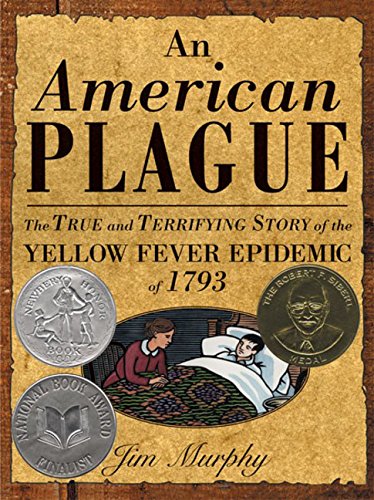
Drawing on medical research, news articles, and firsthand accounts, Jim Murphy traces the yellow fever epidemic of 1793 in this gripping historical account.
Here are links to our lists for the book: Chapters 1-2, Chapters 3-4, Chapters 5-6, Chapters 7-9, Chapters 10-11
Here is a link to our lists for another work by Jim Murphy: The Great Fire
15 words
237 learners
Learn words with Flashcards and other activities
Definition First

Other learning activities
Full list of words from this list:
-
squalid
foul and run-down and repulsivePoor people couldn’t flee to comfortable country homes like their wealthier neighbors, but at least they could escape the most squalid and plague-ridden sections of town.
-
visitation
any disaster or catastropheIf the foul smell of rotting coffee could cause health problems, they reasoned, why couldn’t foul-smelling water? Complaints about the water and its link to yellow fever increased with each new visitation, until action was finally taken in 1799.
-
virulent
harsh or corrosive in toneIn 1797 Rush’s opponents were joined by a new and highly virulent voice—that of journalist William Cobbett.
-
recurrence
event of happening again, especially at regular intervalsBut the vote for the third election happened during the 1797 recurrence of yellow fever, when most well-to-do citizens had left the city.
-
vilify
spread negative information aboutYet despite such a careful approach, Carey did go out of his way to vilify one segment of the population: the black volunteers.
-
exhort
spur on or encourage especially by cheers and shouts“We have many unprovoked enemies,” they told the reader, “who begrudge us the liberty we enjoy, [who] are glad to hear of any complaint against our colour, be it just or unjust; in consequence of which we are more earnestly endeavoring all in our power, to warn, rebuke, and exhort our African friends, to keep conscience void of offense towards God and man..."
-
unassailable
immune to attack; incapable of being tampered withTo counter such a simple response and put an official seal of approval on their analysis of the situation, they ended their book with the words of someone who was both unassailable and white: Matthew Clarkson.
-
approbation
official recognition or commendation“I with cheerfulness give this testimony of my approbation of their proceedings,” Clarkson wrote.
-
banal
repeated too often; overfamiliar through overuseIt would be banal to recall that phthiriasis is caused by lice, and that certain larvae of Diptera, such as the cestrids, may occasion the disease called myasis. This old pathogenic role, which has been taught to all the medical and veterinary generations of our time, is quite true.
-
pathogenic
able to cause diseaseIt would be banal to recall that phthiriasis is caused by lice, and that certain larvae of Diptera, such as the cestrids, may occasion the disease called myasis. This old pathogenic role, which has been taught to all the medical and veterinary generations of our time, is quite true.
-
inoculate
introduce a microorganism intoLet us suppose, then, that in the course of these wanderings one of them happens to fasten itself on an individual affected by a parasitic or bacterial disease, the agent of which lives in the blood. In sucking the blood it absorbs also the germs which are contained in it, and thus is infected. Should it then attack a healthy person there is danger that it will inoculate him with the disease.
-
specter
a mental representation of some haunting experienceThe specter of yellow fever had incited a normally peaceful group of individuals to violence, and Staten Island officials did not want that mob to turn its fury on them.
-
unethical
not conforming to approved standards of social behaviorIn 1880 Dr. Carlos Finlay of Havana, Cuba, captured mosquitoes and let them ingest the blood of patients suffering from yellow fever. Then, in an experiment that would be considered highly unethical today, he allowed these mosquitoes to feed on healthy humans.
-
vector
any agent that carries and transmits a diseaseOf course, establishing the Aedes aegypti mosquito as the disease carrier, or vector, did not answer all the questions about yellow fever.
-
susceptible
yielding readily to or capable of undergoing a processBecause the old mosquito—and with it the disease—had been absent so long, hardly anyone had built up an immunity to yellow fever. As a result, hundreds of millions of people were now susceptible to getting yellow fever and other deadly diseases carried by Aedes aegypti.
Created on Tue Oct 31 13:16:36 EDT 2017
(updated Fri Aug 01 16:24:39 EDT 2025)
Sign up now (it’s free!)
Whether you’re a teacher or a learner,
Vocabulary.com can put you or your class
on the path to systematic vocabulary improvement.