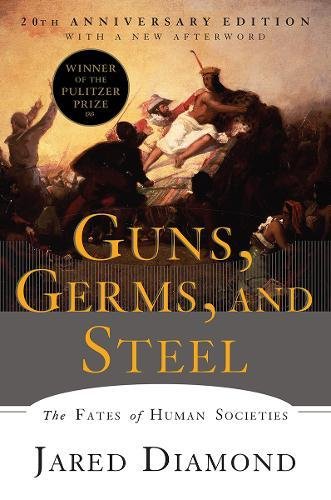
Guns, Germs, and Steel: Part III: Chapters 11-12
In this Pulitzer Prize-winning book, Jared Diamond explores how geographical, biological, and environmental factors shaped the development of human societies.
Here are links to our lists for the book: Prologue-Part I, Part II: Chapters 4-7, Part II: Chapters 8-10, Part III: Chapters 11-12, Part III: Chapters 13-14, Part IV: Chapters 15-17, Part IV: Chapters 18-19, Epilogue-Afterword
35 words
38 learners
Learn words with Flashcards and other activities
Definition First

Other learning activities
Full list of words from this list:
-
microbe
a minute life form, especially one that causes diseaseThe husband was a small, timid man, sick with pneumonia caused by an unidentified microbe, and with only limited command of the English language.
-
epidemic
attacking or affecting many individuals simultaneouslyThe major killers of humanity throughout our recent history—smallpox, flu, tuberculosis, malaria, plague, measles, and cholera—are infectious diseases that evolved from diseases of animals, even though most of the microbes responsible for our own epidemic illnesses are paradoxically now almost confined to humans.
-
perpetrate
perform an act, usually with a negative connotationThe dirtiest of all tricks for passive carriage is perpetrated by microbes that pass from a woman to her fetus and thereby infect babies already at birth.
-
belligerent
characteristic of an enemy or one eager to fightThe skin lesions caused by smallpox similarly spread microbes by direct or indirect body contact (occasionally very indirect, as when U.S. whites bent on wiping out “belligerent” Native Americans sent them gifts of blankets previously used by smallpox patients).
-
antibody
a protein that produces an immune responseThe specific antibodies that we gradually build up against a particular microbe infecting us make us less likely to get reinfected once we become cured.
-
inoculate
inject or treat with the germ of a disease to render immuneThat’s the principle of vaccination: to stimulate our antibody production without our having to go through the actual experience of the disease, by inoculating us with a dead or weakened strain of microbe.
-
antigen
any substance that stimulates an immune response in the bodySome have learned to trick us by changing those molecular pieces of the microbe (its so-called antigens) that our antibodies recognize.
-
pathogen
any disease-producing agentAs a result, over the course of history, human populations repeatedly exposed to a particular pathogen have come to consist of a higher proportion of individuals with those genes for resistance—just because unfortunate individuals without the genes were less likely to survive to pass their genes on to babies.
-
wane
grow smallerWhat’s true for measles in the Faeroes is true of our other familiar acute infectious diseases throughout the world. To sustain themselves, they need a human population that is sufficiently numerous, and sufficiently densely packed, that a numerous new crop of susceptible children is available for infection by the time the disease would otherwise be waning.
-
deduce
conclude by reasoningIn fact, the first attested dates for many familiar infectious diseases are surprisingly recent: around 1600 B.C. for smallpox (as deduced from pockmarks on an Egyptian mummy), 400 B.C. for mumps, 200 B.C. for leprosy, A.D. 1840 for epidemic polio, and 1959 for AIDS.
-
proximity
the property of being close togetherGiven our proximity to the animals we love, we must be getting constantly bombarded by their microbes.
-
winnow
select desirable parts from a group or listThose invaders get winnowed by natural selection, and only a few of them succeed in establishing themselves as human diseases.
-
vector
any agent that carries and transmits a diseaseWhat is actually going on in those stages, as an exclusive disease of animals transforms itself into an exclusive disease of humans? One transformation involves a change of intermediate vector: when a microbe relying on some arthropod vector for transmission switches to a new host, the microbe may be forced to find a new arthropod as well.
-
virulent
infectious; having the ability to cause diseaseThe virus changed so as to kill fewer rabbits and to permit lethally infected ones to live longer before dying. As a result, a less lethal myxo virus spreads baby viruses to more rabbits than did the original, highly virulent myxo.
-
tenacity
persistent determinationBut when Cortes’s next onslaught came, the Aztecs were no longer naive and fought street by street with the utmost tenacity.
-
embroil
force into some kind of situation or course of actionAs we saw in Chapter 3, the result of the throne’s being left vacant was that two other sons of Huayna Capac, Atahuallpa and Huascar, became embroiled in a civil war that Pizarro exploited to conquer the divided Incas.
-
scrutiny
the act of examining something closely, as for mistakesHowever, archaeological excavations, and scrutiny of descriptions left by the very first European explorers on our coasts, now suggest an initial number of around 20 million Indians.
-
paucity
an insufficient quantity or numberIn turn, we also saw that this extreme paucity of domestic animals in the New World reflects the paucity of wild starting material.
-
denote
be a sign or indication ofThe three basic strategies underlying writing systems differ in the size of the speech unit denoted by one written sign: either a single basic sound, a whole syllable, or a whole word. Of these, the one employed today by most peoples is the alphabet, which ideally would provide a unique sign (termed a letter) for each basic sound of the language (a phoneme).
-
cuneiform
an ancient wedge-shaped script used in MesopotamiaBefore the spread of alphabetic writing, systems making much use of logograms were more common and included Egyptian hieroglyphs, Maya glyphs, and Sumerian cuneiform.
-
phonetic
using symbols to represent each speech soundLike all alphabetic writing systems, English uses many logograms, such as numerals, $, %, and + : that is, arbitrary signs, not made up of phonetic elements, representing whole words.
-
rebus
a puzzle consisting of pictures representing wordsLinguists term this decisive innovation, which also underlies puns today, the rebus principle.
-
spectrum
a broad range of related objects, values, or qualitiesSuch transmission of inventions assumes a whole spectrum of forms. At the one end lies “blueprint copying,” when you copy or modify an available detailed blueprint. At the opposite end lies “idea diffusion,” when you receive little more than the basic idea and have to reinvent the details.
-
feasibility
the quality of being doableOr was it merely that the revelation of America’s A-bomb at Hiroshima at last convinced Stalin of the feasibility of building such a bomb, and that Russian scientists then reinvented the principles in an independent crash program, with little detailed guidance from the earlier American effort?
-
runic
relating to characters from an ancient alphabetLike Saint Cyril’s invention, Ulfilas’s alphabet was a mishmash of letters borrowed from different sources: about 20 Greek letters, about five Roman letters, and two letters either taken from the runic alphabet or invented by Ulfilas himself.
-
ambiguous
open to two or more interpretationsConvenient starting points for our discussion are the limited capabilities, uses, and users of early writing systems. Early scripts were incomplete, ambiguous, or complex, or all three.
-
cadre
a small unit serving as part of a larger political movementKnowledge of writing was confined to professional scribes in the employ of the king or temple. For instance, there is no hint that Linear B was used or understood by any Mycenaean Greek beyond small cadres of palace bureaucrats.
-
clerical
appropriate for or engaged in office workAbout 90 percent of the tablets in the earliest known Sumerian archives, from the city of Uruk, are clerical records of goods paid in, workers given rations, and agricultural products distributed.
-
bard
a lyric poetThe Iliad and Odyssey were composed and transmitted by non-literate bards for non-literate listeners, and not committed to writing until the development of the Greek alphabet hundreds of years later.
-
propaganda
information that is spread to promote some causeEarly Egyptian hieroglyphs recorded religious and state propaganda and bureaucratic accounts.
-
accession
the act of attaining a new office or right or positionPreserved Maya writing was similarly devoted to propaganda, births and accessions and victories of kings, and astronomical observations of priests.
-
incise
make a depression in by carving or cuttingThe oldest preserved Chinese writing of the late Shang Dynasty consists of religious divination about dynastic affairs, incised into so-called oracle bones.
-
auspicious
indicating favorable circumstances and good luckA sample Shang text: “The king, reading the meaning of the crack [in a bone cracked by heating], said: ‘If the child is born on a keng day, it will be extremely auspicious.’”
-
facilitate
make easierAs the anthropologist Claude Levi-Strauss put it, ancient writing’s main function was “to facilitate the enslavement of other human beings.”
-
nimble
moving quickly and lightlyFor instance, the first preserved example of Greek alphabetic writing, scratched onto an Athenian wine jug of about 740 B.C., is a line of poetry announcing a dancing contest: “Whoever of all dancers performs most nimbly will win this vase as a prize.”
Created on Thu Aug 31 20:30:19 EDT 2017
(updated Thu Sep 28 16:06:06 EDT 2017)
Sign up now (it’s free!)
Whether you’re a teacher or a learner,
Vocabulary.com can put you or your class
on the path to systematic vocabulary improvement.