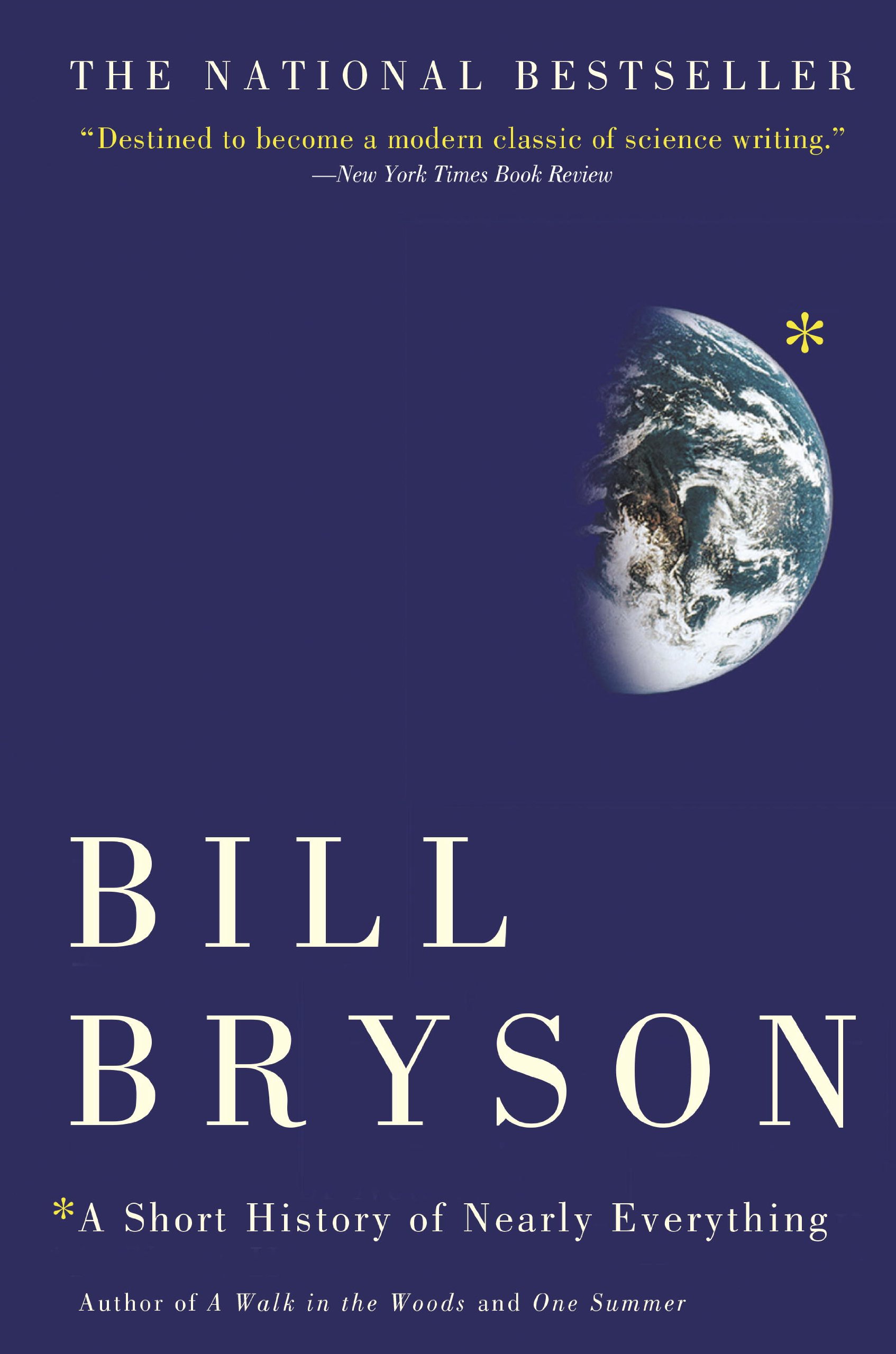
A Short History of Nearly Everything: Part IV
In this engaging work of nonfiction, Bill Bryson explores profound questions about the origins of the universe, the development of life on Earth, and modern civilization.
Here are links to our lists for the book: Introduction–Part I, Part II, Part III, Part IV, Part V, Part VI
15 words
124 learners
Learn words with Flashcards and other activities
Definition First

Other learning activities
Full list of words from this list:
-
trajectory
the path followed by an object moving through spaceThey spent one week each month at the Palomar Observatory in California looking for objects, asteroids primarily, whose trajectories carried them across Earth’s orbit
-
mundane
found in the ordinary course of eventsBy this time, too, astrophysics had moved on so much that few astronomers wanted to devote their lives to anything as mundane as rocky planetoids.
-
perturbation
activity that is a malfunction, intrusion, or interruptionEven if every asteroid in the solar system had a name and known orbit no one could say what perturbations might send any of them hurtling toward us. We can’t forecast rock disturbances on our own surface.
-
extrapolate
gain knowledge of by generalizingAltogether it is thought — though it is really only a guess, based on extrapolating from cratering rates on the Moon — that some two thousand asteroids big enough to imperil civilized existence regularly cross our orbit.
-
infinitesimal
immeasurably smallEvery year the Earth accumulates some thirty thousand metric tons of "cosmic spherules" — space dust in plainer language — which would be quite a lot if you swept it into one pile, but is infinitesimal when spread across the globe.
-
inexorable
impervious to pleas, persuasion, requests, or reasonSo when, in the first week of 1980, at a meeting of the American Association for the Advancement of Science, the Alvarezes announced their belief that the dinosaur extinction had not taken place over millions of years as part of some slow inexorable process, but suddenly in a single explosive event, it shouldn’t have come as a shock.
-
efficacy
capacity or power to produce a desired resultI remember harboring some strong initial doubts about the efficacy of such an event.
-
seismograph
an instrument for measuring movements of the groundThen in 1906, an Irish geologist named R. D. Oldham, while examining some seismograph readings from an earthquake in Guatemala, noticed that certain shock waves had penetrated to a point deep within the Earth and then bounced off at an angle, as if they had encountered some kind of barrier.
-
propagate
transmit or cause to broaden or spreadAnd because they come from a much greater depth, they tend to propagate over much wider areas.
-
viscous
having a relatively high resistance to flowScientists are generally agreed that the world beneath us is composed of four layers — rocky outer crust, a mantle of hot, viscous rock, a liquid outer core, and a solid inner core.
-
polemic
a verbal or written attack, especially of a belief or dogmaHe died of cancer in 1991, but shortly before his death he "lashed out at his critics in a polemic in an Australian earth science journal that charged them with perpetuating myths," according to a report in Earth magazine in 1998.
-
caldera
a large crater caused by the violent explosion of a volcanoIn particular what he couldn’t find was a structure known as a caldera.
-
reverberate
be reflected as heat, sound, or light or shock wavesThe biggest blast in recent times was that of Krakatau in Indonesia in August 1883, which made a bang that reverberated around the world for nine days, and made water slosh as far away as the English Channel.
-
innocuous
not injurious to physical or mental health"It looks completely innocuous," he said. "It’s just a big pond. But this big hole didn’t used to be here. At some time in the last fifteen thousand years this blew in a really big way. You’d have had several tens of millions of tons of earth and rock and superheated water blowing out at hypersonic speeds.
-
congenial
suitable to your needsEmerald Pool, remarkably, was all these things, yet at least two types of living things, Sulpholobus acidocaldarius and Thermophilus aquaticus as they became known, found it congenial.
Created on Wed Feb 22 19:20:58 EST 2017
(updated Tue Jul 01 12:22:23 EDT 2025)
Sign up now (it’s free!)
Whether you’re a teacher or a learner,
Vocabulary.com can put you or your class
on the path to systematic vocabulary improvement.