Vocabulary.com Blog
Articles from October, 2010
Blog Excerpts
Words of the World
"Words of the World" is a series of short videos presented by experts from the University of Nottingham's School of Modern Languages and Cultures. From vodka to junta, from aficionado to zeitgeist, the Nottingham scholars explore the global history of words in fascinating detail. Start watching here.
 The English language is full of paradoxes, like the fact that "literally" pretty much always means "figuratively. Other words mean their opposites as well — "scan" means both 'read closely' and 'skim.' "Restive" originally meant 'standing still' but now it often means 'antsy.' "Dust" can mean 'to sprinkle with dust' and 'to remove the dust from something.' "Oversight" means both looking closely at something and ignoring it. "Sanction" sometimes means 'forbid,' sometimes, 'allow.' And then there's "ravel," which means 'ravel, or tangle' as well as its opposite, 'unravel,' as when Macbeth evokes "Sleepe that knits up the rauel'd Sleeue of Care."
Continue reading...
The English language is full of paradoxes, like the fact that "literally" pretty much always means "figuratively. Other words mean their opposites as well — "scan" means both 'read closely' and 'skim.' "Restive" originally meant 'standing still' but now it often means 'antsy.' "Dust" can mean 'to sprinkle with dust' and 'to remove the dust from something.' "Oversight" means both looking closely at something and ignoring it. "Sanction" sometimes means 'forbid,' sometimes, 'allow.' And then there's "ravel," which means 'ravel, or tangle' as well as its opposite, 'unravel,' as when Macbeth evokes "Sleepe that knits up the rauel'd Sleeue of Care."
Continue reading...
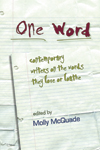 We are pleased to present another excerpt from the new anthology entitled, One Word: Contemporary Writers on the Words They Love or Loathe, published by Sarabande Books. The editor, Molly McQuade, asked 66 writers the question, "What one word means the most to you, and why?" Among the essays McQuade has collected is "Verb," by Lia Purpura.
Continue reading...
We are pleased to present another excerpt from the new anthology entitled, One Word: Contemporary Writers on the Words They Love or Loathe, published by Sarabande Books. The editor, Molly McQuade, asked 66 writers the question, "What one word means the most to you, and why?" Among the essays McQuade has collected is "Verb," by Lia Purpura.
Continue reading...
When I wrote an On Language column in the New York Times Magazine last month about the rise in popularity of the expression "man up," little did I know that it would turn into one of the key catchphrases of American political discourse in advance of November's midterm elections.
Continue reading...
 The title of this month's column is a direct quote from one of my students. Please imagine it being delivered in an accusatory tone. What caused such a lament? You see, I had the audacity to suggest that learning new words was, well, fun.
Continue reading...
The title of this month's column is a direct quote from one of my students. Please imagine it being delivered in an accusatory tone. What caused such a lament? You see, I had the audacity to suggest that learning new words was, well, fun.
Continue reading...
Word RoutesExploring the pathways of our lexicon
"Truthiness": The Silly Word that Feels Wrong in Your Mouth
This Sunday marks the fifth anniversary of the premiere episode of "The Colbert Report," Stephen Colbert's endlessly entertaining sendup of political pundit programs. On that episode, Colbert introduced the word "truthiness," which has proved so popular that it has entered the latest edition of the New Oxford American Dictionary. For my On Language column in Sunday's New York Times Magazine, I had the pleasure of interviewing Colbert (as himself, not his put-upon persona) and learned the inside story of "truthiness." Here is an extended excerpt from our conversation.
Continue reading...
Blog Excerpts
Moynihan's Sesquipedalianism
Newly published letters from longtime New York Senator Daniel Patrick Moynihan reveal his efforts to popularize the word floccinaucinihilipilificationism ("the futility of making estimates on the accuracy of public data"). Read about it on The New York Times City Room blog here.
Sign up now (it’s free!)
Whether you’re a teacher or a learner,
Vocabulary.com can put you or your class
on the path to systematic vocabulary improvement.